A giant on two legs
Tyrannosaurus rex lived at the very end of the age of dinosaurs, shortly before the mass extinction about 66 million years ago 1 2. Its skeletons are found in rocks of the Late Cretaceous of North America – “Scotty”, for example, in Saskatchewan, Canada, in rocks about 67 million years old 3 – and in the Hell Creek Formation of Montana, where, in the upper part of the formation, Tyrannosaurus skeletons are about as common as those of the plant-eater Edmontosaurus 2. Adults weighed about 6,000–8,000 kg – the largest specimen in that 2011 study, “Sue”, perhaps around 9,500 kg – and grew to that size from hatchlings of less than 10 kg in under 20 years 4.
How fast could such an animal move? The question matters for how T. rex lived – as a pursuit hunter or not 5 – and it has long been controversial. As Hutchinson and Garcia summarised in 2002, some studies argued that T. rex was limited to walking or at best reached 11 m/s; others argued for running speeds of at least 20 m/s 6. Biomechanical models alone give top speeds anywhere from 5 to 15 m/s 5.
Nobody can time a dinosaur. But its footprints, the strength of its bones and the laws of physics narrow the answer down. This article follows these clues – from fossil trackways and the physics of size to the chemistry that turns bone into stone, and to computer models that learn to walk like a dinosaur.
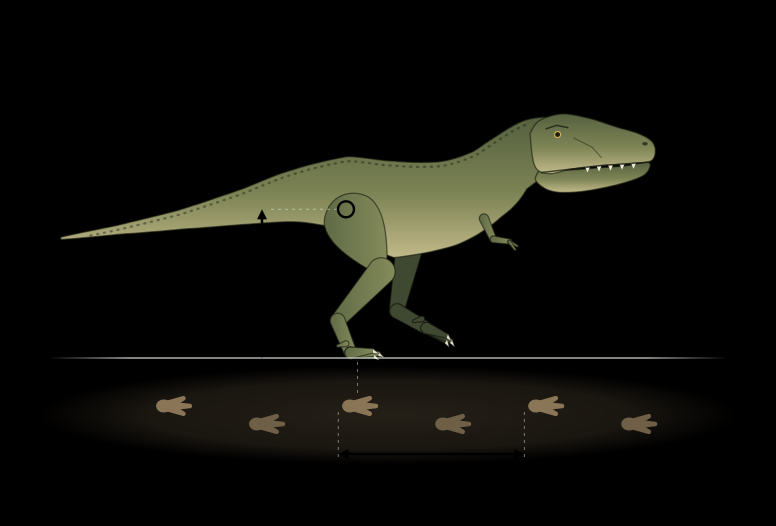
From footprint to speed in four steps
- Find a trackway. A trackway is a series of footprints of the same animal – a trace fossil, a fossilised record of behaviour rather than of the body. Trackways of tyrannosaurids are very rare; the first were described only in 2014 7.
- Measure the stride. The stride length λ is the distance between two prints of the same foot, so it spans two steps 7.
- Estimate the hip height. The hip height h – the height of the hip joint above the ground – stands for the length of the leg. It is estimated from the size of the footprint – as a rough rule going back to Alexander, about four times the footprint length 7.
- Apply dynamic similarity. Animals of different size that move in a similar way take strides of the same relative length λ/h. A rule found in living animals turns λ/h into a speed 8 9.
Biology lens: built like a seesaw
A seesaw on two legs. T. rex walked on two legs. Its tail made up about half of its body length or more and balanced the heavy head and trunk: in 3D reconstructions, the centre of mass lies close to the hips, slightly in front of them. The hip extensor muscles had to hold the body against tipping forwards – one proposed reason why they were so large 4.
A tail full of muscle. The tail was not only a counterweight. Scott Persons and Philip Currie reconstructed the tail muscles from fossil measurements, scars on the tail bones and dissections of living reptiles: the M. caudofemoralis, which runs from the tail to the thigh bone, was exceptionally large in many non-avian theropods and further enlarged in Tyrannosaurus. It is the main muscle that pulls the leg backwards in each step, and Persons and Currie see its large size as evidence in favour of greater athleticism – in running ability, balance and turning agility 10. The bone-stress model in the Physical AI lens gives its T. rex generous muscles and asks whether the skeleton could bear the loads 5. In walking, the tail was suspended by ligaments that could store elastic energy 11.
Massive thighs, growing torso. John Hutchinson and colleagues scanned four large skeletons and a putative juvenile in 3D and rebuilt their bodies in the computer. T. rex probably had hip and thigh muscles relatively larger than those of any living animal. As it grew, its torso became longer and heavier while its limbs became relatively shorter and lighter – changes that would have further reduced the relative locomotor performance of large adults, although the authors call the overall consequences for locomotion ambiguous 4. In 2020, Persons, Currie and Gregory Erickson described the skeleton RSM P2523.8, known as “Scotty”: a skeletally mature T. rex whose estimated body mass exceeds that of all other known specimens 12 3.
Scales, not a feather coat. Skin impressions of Tyrannosaurus and other large tyrannosaurids show scaly, reptile-like skin. Some early relatives of T. rex had extensive feather coverings, but these were lost before the large tyrannosaurids evolved 13. Every picture of a living T. rex is a reconstruction.
Footprints as behaviour. Richard McCrea and colleagues described three tyrannosaurid trackways from the Upper Cretaceous of British Columbia, Canada, and named their new ichnotaxon – a name for a type of trace fossil – Bellatoripes fredlundi. All three animals were heading in the same direction within a corridor 8.5 m wide, apparently at the same time, which the authors read as evidence that tyrannosaurids sometimes moved in groups. The prints were made by relatives of T. rex: a single footprint attributed almost certainly to T. rex, Tyrannosauripus pillmorei, is about 40 % longer, and its trackway is unknown 7.
Physics lens: the square–cube law
Bigger is not simply stronger. Imagine scaling an animal up while keeping its shape: every length is multiplied by a factor k. Its volume – and with it its mass and weight – grows as k3. The cross-sections of its bones and muscles, which carry the load and produce the force, grow only as k2. The stress – force per area – in bones and muscles therefore grows in proportion to k: area-to-volume scaling predicts that stresses increase with size 14. The same square–cube law works the other way round for small fliers: in How insects fly, shrinking makes the wings relatively larger compared with the weight – but they must beat faster.
A T. rex of 7,000 kg weighs a hundred times as much as a person of 70 kg. If it were simply a scaled-up person, all its lengths would be 1001/3 ≈ 4.6 times larger – and so would the stress in its bones at the same posture and motion (a calculation for this article, not a measurement).
How animals cope. Living mammals avoid this rise in stress up to a size of about 300 kg by changing their posture: larger mammals run with straighter legs, which gives their muscles a better lever on the ground force. Above this size, very large mammals show more pronounced changes in skeletal proportions and reduced locomotor ability 14. Across 474 species from 30 µg to 100 tonnes, Myriam Hirt and colleagues found that maximum speed first rises with body mass and then falls again: the largest animals are not the fastest, because the time animals can spend accelerating is limited 15.
Muscle and bone as speed limits. Hutchinson and Mariano Garcia calculated the minimum mass of supporting extensor muscle a leg needs for fast running. Their model worked for alligators and chickens and showed that small dinosaurs could have been competent runners – but an adult T. rex would have needed an unreasonably large mass of leg muscle to run quickly, even with generous assumptions 6. Hutchinson later concluded that the hip extensor muscles appear to be a crucial limit on running in large theropods 16. Robert McNeill Alexander summarises an older argument from bone strength: for geometrically similar animals, the bending strength of the leg bones relative to body weight falls as body mass to the power −0.33, and an analysis of T. rex bones by James Farlow and colleagues concluded that it is unlikely to have run faster than 10 m/s 8.
Mathematics lens: the speed in a trackway
One number for all sizes. In How we walk, the Froude number explains why a child and an adult switch from walking to running at the same “speed number”. It compares the centripetal acceleration of a body moving on a curve with gravity:
Here v is the speed, g = 9.81 m/s² the acceleration of gravity and h the hip height. Animals that move at the same Froude number move in an approximately dynamically similar way: they take strides of about equal relative length λ/h 8. Here we apply this tool to an animal that nobody has ever seen walking.
Alexander’s rule. In 1976, Alexander fitted the relationship between relative stride length and Froude number, mostly from data on mammals 8 11:
This is the form William Sellers and Phillip Manning give 9. Solving it for the speed – first for Fr, then for v – gives the formula used for trackways (a short calculation for this article; the same formula with the factor 0.25 · √g ≈ 0.78 appears in the trackway study by McCrea and colleagues 7):
A worked example. In the tyrannosaurid trackway described by McCrea and colleagues, the stride length is 3.46 m. For the hip height they used an equation tailored to tyrannosaurids: 2.87 m for a straight leg, and 2.30 m with the knee and ankle flexed, which they considered anatomically more realistic. With these values McCrea and colleagues obtained 6.4 to 8.5 km/h – a walk 7. The computer science lens below repeats this calculation.
How precise is it? Not very. The empirical points for mammals scatter widely around the regression line: a given stride length can occur at speeds that differ from the prediction by a factor of up to 1.5. The hip height estimated from the footprint and the state of the ground add further errors. Still, Alexander notes, there is no danger of confusing a stroll with a sprint 8.
A second clock: the tail. Van Bijlert, van Soest and Schulp estimated the preferred walking speed of T. rex in a completely different way. They treated the tail, suspended by ligaments, as a spring-mass system and calculated its natural frequency: 0.66 swings per second. Walking in step with it would save energy. With a step length of 1.94 m, scaled from the tyrannosaurid trackway, this gives a walking speed of 1.28 m/s, or 4.6 km/h (range 0.80–1.64 m/s) – lower than the 2–3 m/s that dynamic similarity typically gives for large theropods 11.
Chemistry lens: how bone turns to stone
What bone is made of. Living bone is a composite: a framework of the protein collagen – collagen I is its main organic component 17 – stiffened by tiny crystals of a calcium phosphate mineral, hydroxyapatite, Ca5(PO4)3(OH) 3.
Diagenesis: the slow chemical makeover. After burial, bone is not simply preserved. It is a porous, open system through which molecules and microbes can move 18, and its minerals change over time. These changes are called diagenesis. The mineral of bone, bioapatite, transforms over geological time into thermodynamically more stable phases; how fast this happens, and how much the burial environment and microbes control it, is still not fully understood 19.
From hydroxyapatite to fluorapatite. One of these changes can be traced in T. rex itself. In a rib of “Scotty”, Mitchell and colleagues found calcium, phosphorus, oxygen and fluorine in the bone matrix, which suggests that the original hydroxyapatite has been at least partially transformed into fluorapatite, Ca5(PO4)3F, with fluoride ions taking the place of hydroxide ions 3. In a dinosaur rib from South Korea, Jung-Kyun Kim and colleagues likewise found fluorapatite crystals as a sign of diagenetic alteration of the original bioapatite 20.
Filling the pores: permineralization. Bone is full of channels for blood vessels. In permineralization, minerals carried by groundwater crystallise in these cavities. In the Korean rib, calcite (calcium carbonate) mostly filled the vascular channels and cracks, while clay minerals occupied the small pores 20. In Scotty’s rib, a network of vessel-like structures – which the authors think grew as a fracture healed – is preserved as casts of pyrite (iron sulfide), partly oxidised to the iron oxides goethite or hematite: permineralized casts. No original soft tissue could be recovered with the methods used 3.
The soft-tissue controversy. Can any original organic material survive for more than 66 million years? Here researchers disagree, and the question is open.
- The case for preservation. In 2005, Mary Schweitzer and colleagues dissolved the mineral from a T. rex leg bone (specimen MOR 1125) and found transparent, flexible, hollow structures that looked like blood vessels, with cell-like microstructures 21. In 2007 they reported that collagen I was preserved in low concentrations 17, and John Asara and colleagues reported protein sequences from the 68-million-year-old T. rex bone, obtained by mass spectrometry 22. Schweitzer and colleagues later proposed a chemical explanation: iron from blood could cross-link and protect proteins. In an ostrich blood-vessel model, haemoglobin made the tissue more than 200 times more stable 23. In 2019, Elizabeth Boatman, Schweitzer and colleagues reported type I collagen in the outer layers of blood vessels from a second T. rex (USNM 555000) and argued that non-enzymatic cross-links – from Fenton chemistry with iron and from glycation – likely stabilised them 24.
- The case against. Thomas Kaye and colleagues found similar coatings in many fossil bones and interpreted them as bacterial biofilms; carbon dating pointed to a relatively modern origin, and they identified the round “cells” as iron-oxygen spheres formed from pyrite 25. Mike Buckley and colleagues applied tests developed for ancient DNA to the protein data: the mastodon samples passed, while the evidence suggested that the T. rex data did not 26. Evan Saitta and colleagues dug up the bone of a horned dinosaur with aseptic methods and found that its “soft tissues” differed chemically from collagen, while the bone hosted an abundant microbial community 18.
Between the two sides stands a reanalysis of the T. rex mass spectra by Marshall Bern and colleagues: it found common laboratory contaminants and soil bacteria – but also bird-like haemoglobin and collagen 27. The debate is not settled: even the 2019 study that reports collagen calls the persistence of original soft tissue controversial 24.
A clock in the rock. The age of the rocks is measured with a clock that chemists read: in 40Ar/39Ar dating, the slow radioactive decay of potassium-40 into argon-40 in minerals gives the age of a rock layer. With high-precision 40Ar/39Ar dates of the layers around the Cretaceous–Paleogene boundary, Paul Renne and colleagues showed that the Chicxulub impact and the mass extinction that ended the age of the non-avian dinosaurs about 66 million years ago happened within 32,000 years of each other 1.
Computer science lens: a speedometer for footprints
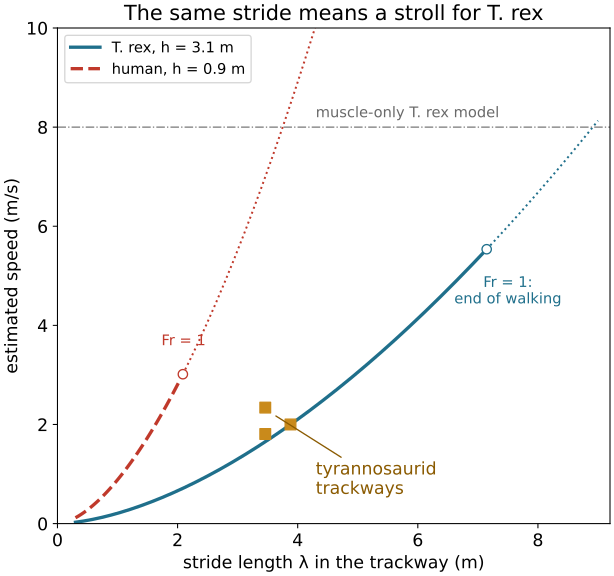
How fast did the makers of the tyrannosaurid trackways walk, how does T. rex compare with a person, and where does walking end? The program below applies Alexander’s rule λ/h ≈ 2.3 Fr0.3 9 to the measured trackway 7, scales it to an adult T. rex and compares the result with the walking limit and with a computer model limited only by muscle. Inputs and assumptions: the stride length of 3.46 m and the two hip heights of 2.87 m and 2.30 m 7; a stride of 3.88 m (two steps of 1.94 m), which van Bijlert and colleagues obtained by scaling the tyrannosaurid trackway to the footprint length of the adult T. rex “Trix”, and the hip height of 3.1 m they assumed for it 11; a scatter of the rule by a factor of 1.5 8; the top speed of 8.0 m/s and leg length of 3.09 m of the muscle-only model 9. The human stride of 1.40 m and hip height of 0.90 m are assumed, typical of an adult.
import numpy as np
import matplotlib.pyplot as plt

# How fast was the maker of a fossil trackway? Speed from stride length and hip height.
G = 9.81                 # acceleration of gravity (m/s²)
HIP_TREX = 3.10          # hip height of the adult T. rex "Trix" (m), as used by van Bijlert et al.
HIP_HUMAN = 0.90         # hip height of an adult human (m) – assumed
UNCERTAINTY = 1.5        # mammal data scatter around the rule by factors up to 1.5
TRACKWAYS = {            # name: (stride length λ in m, hip height h in m)
    "tyrannosaurid trackway, straight leg": (3.46, 2.87),
    "tyrannosaurid trackway, bent leg": (3.46, 2.30),
    "same trackway scaled to T. rex": (3.88, HIP_TREX),   # scaled to the foot of "Trix" by van Bijlert et al.
    "human walking (assumed)": (1.40, HIP_HUMAN),
}
SIMULATED_TOP_SPEED = 8.0    # T. rex model limited by muscle only (m/s), leg length 3.089 m


def froude(speed, hip, g=G):
    """Froude number v²/(g·h): the 'speed number' that is equal for dynamically similar gaits."""
    return speed**2 / (g * hip)


def speed_from_trackway(stride, hip, g=G):
    """Alexander's rule for dynamically similar animals, λ/h ≈ 2.3·Fr^0.3, solved for v:
    Fr = (λ / 2.3h)^(1/0.3), v = √(Fr·g·h) ≈ 0.25·√g·λ^1.67·h^-1.17."""
    fr = (stride / (2.3 * hip)) ** (1 / 0.3)
    return np.sqrt(fr * g * hip)


def walking_limit(hip, g=G):
    """At Fr = 1 gravity can no longer hold the body on its arc over the foot: v = √(g·h)."""
    return np.sqrt(g * hip)


for name, (stride, hip) in TRACKWAYS.items():
    v = speed_from_trackway(stride, hip)
    print(f"{name}: λ/h = {stride / hip:.2f} → {v:.1f} m/s = {3.6 * v:.1f} km/h (Fr = {froude(v, hip):.2f})")

v_trex = speed_from_trackway(*TRACKWAYS["same trackway scaled to T. rex"])
print(f"with the scatter of the rule (×/÷ {UNCERTAINTY}), the scaled T. rex trackway gives "
      f"{3.6 * v_trex / UNCERTAINTY:.0f}–{3.6 * v_trex * UNCERTAINTY:.0f} km/h")
v_limit = walking_limit(HIP_TREX)
print(f"walking limit of T. rex (Fr = 1): {v_limit:.1f} m/s = {3.6 * v_limit:.0f} km/h")
print(f"muscle-only simulation: {SIMULATED_TOP_SPEED:.1f} m/s = {3.6 * SIMULATED_TOP_SPEED:.0f} km/h "
      f"(Fr = {froude(SIMULATED_TOP_SPEED, 3.089):.1f}) – a running gait")

plt.rcParams["font.size"] = 13      # large type: the chart stays readable on a phone
fig, ax = plt.subplots(figsize=(6.4, 6.0), layout="constrained")
for hip, label, color, style in ((HIP_TREX, "T. rex, h = 3.1 m", "#1f6f8b", "-"),
                                 (HIP_HUMAN, "human, h = 0.9 m", "#c0392b", "--")):
    stride = np.linspace(0.3, 9.0, 400)
    v = speed_from_trackway(stride, hip)
    walk = v <= walking_limit(hip)
    ax.plot(stride[walk], v[walk], lw=2.5, ls=style, color=color, label=label)
    ax.plot(stride[~walk], v[~walk], lw=1.5, ls=":", color=color)
    i = np.argmax(~walk)
    ax.plot(stride[i], v[i], "o", ms=7, mfc="white", color=color)
ax.text(7.5, 5.0, "Fr = 1:\nend of walking", va="top", ha="center", fontsize=11, color="#1f6f8b")
ax.text(2.1, 3.6, "Fr = 1", ha="center", fontsize=11, color="#c0392b")
for name, (stride, hip) in list(TRACKWAYS.items())[:3]:
    ax.plot(stride, speed_from_trackway(stride, hip), "s", ms=8, color="#c98a1b")
ax.annotate("tyrannosaurid\ntrackways", xy=(3.6, 2.2), xytext=(4.3, 0.6), color="#8a5a00",
            arrowprops=dict(arrowstyle="-", color="#8a5a00"))
ax.axhline(SIMULATED_TOP_SPEED, color="grey", lw=1, ls="-.")
ax.text(4.3, SIMULATED_TOP_SPEED + 0.2, "muscle-only T. rex model", fontsize=11, color="dimgrey")
ax.set_xlabel("stride length λ in the trackway (m)")
ax.set_ylabel("estimated speed (m/s)")
ax.set_xlim(0, 9.2)
ax.set_ylim(0, 10)
ax.set_title("The same stride means a stroll for T. rex")
ax.legend(loc="upper left", fontsize=11)
plt.show()
Output · what the code prints, re-run at every build
tyrannosaurid trackway, straight leg: λ/h = 1.21 → 1.8 m/s = 6.5 km/h (Fr = 0.12)
tyrannosaurid trackway, bent leg: λ/h = 1.50 → 2.3 m/s = 8.4 km/h (Fr = 0.24)
same trackway scaled to T. rex: λ/h = 1.25 → 2.0 m/s = 7.2 km/h (Fr = 0.13)
human walking (assumed): λ/h = 1.56 → 1.5 m/s = 5.6 km/h (Fr = 0.27)
with the scatter of the rule (×/÷ 1.5), the scaled T. rex trackway gives 5–11 km/h
walking limit of T. rex (Fr = 1): 5.5 m/s = 20 km/h
muscle-only simulation: 8.0 m/s = 29 km/h (Fr = 2.1) – a running gait
What the result teaches:
- The trackways record a walk. The tyrannosaurid trackway gives 6.5 km/h with a straight leg and 8.4 km/h with a bent leg – close to the 6.4–8.5 km/h (± 0.4 km/h) published by McCrea and colleagues. Scaled to an adult T. rex, the same trackway gives 7.2 km/h at a Froude number of only 0.13.
- Size changes everything. The same stride of 3.5 m would be a fast run for a person, but a stroll for T. rex: relative to its long legs, the stride is short. Comparing the Froude numbers – 0.13 for T. rex, 0.27 for a person walking at 5.6 km/h – shows that the scaled trackway describes a slow walk for an animal of this size.
- Robust and uncertain at once. With the scatter of the rule, the scaled trackway allows anything from 5 to 11 km/h – the exact number is uncertain, the gait is not.
- Where walking ends. In the pendulum model, walking ends at Fr = 1, here at 5.5 m/s or 20 km/h – a theoretical upper limit, not a measured speed. The muscle-only model reached 8.0 m/s, which corresponds to Fr = 2.1 – a running gait. Whether T. rex could reach it is exactly what the bone-stress model questions (Physical AI lens).
Try it yourself:
- Use the leg length of “Sue”, 3.30 m, as an approximate hip height for the adult T. rex: set
HIP_TREX = 3.30. The scaled trackway drops to 6.7 km/h and the walking limit rises to 5.7 m/s – for the same stride, a taller animal gets a lower speed and Froude number. - Put in the stride of the muscle-only model, 9.56 m: change
(3.88, HIP_TREX)to(9.56, HIP_TREX). The rule now gives 9.0 m/s at Fr = 2.66 – about 1 m/s faster than the 8.0 m/s of the simulation; Sellers and Manning found their simulated strides in good agreement with the rule 9. Such a stride is not known from any tyrannosaurid trackway.
Tested output with HIP_TREX = 3.30
tyrannosaurid trackway, straight leg: λ/h = 1.21 → 1.8 m/s = 6.5 km/h (Fr = 0.12)
tyrannosaurid trackway, bent leg: λ/h = 1.50 → 2.3 m/s = 8.4 km/h (Fr = 0.24)
same trackway scaled to T. rex: λ/h = 1.18 → 1.9 m/s = 6.7 km/h (Fr = 0.11)
human walking (assumed): λ/h = 1.56 → 1.5 m/s = 5.6 km/h (Fr = 0.27)
with the scatter of the rule (×/÷ 1.5), the scaled T. rex trackway gives 4–10 km/h
walking limit of T. rex (Fr = 1): 5.7 m/s = 20 km/h
muscle-only simulation: 8.0 m/s = 29 km/h (Fr = 2.1) – a running gait
Tested output with (9.56, HIP_TREX)
tyrannosaurid trackway, straight leg: λ/h = 1.21 → 1.8 m/s = 6.5 km/h (Fr = 0.12)
tyrannosaurid trackway, bent leg: λ/h = 1.50 → 2.3 m/s = 8.4 km/h (Fr = 0.24)
same trackway scaled to T. rex: λ/h = 3.08 → 9.0 m/s = 32.4 km/h (Fr = 2.66)
human walking (assumed): λ/h = 1.56 → 1.5 m/s = 5.6 km/h (Fr = 0.27)
with the scatter of the rule (×/÷ 1.5), the scaled T. rex trackway gives 22–49 km/h
walking limit of T. rex (Fr = 1): 5.5 m/s = 20 km/h
muscle-only simulation: 8.0 m/s = 29 km/h (Fr = 2.1) – a running gait
Physical AI lens: dinosaurs that learn to walk in the computer
Physical AI – embodied artificial intelligence: machines that sense and act in the physical world – usually means robots. But the same tools can bring an extinct animal back to life as a simulated robot: a body of rigid segments, joints and virtual muscles that has to find out on its own how to move.
Evolutionary robotics. Sellers and Manning built simple musculoskeletal models of three living and five extinct bipeds, from Compsognathus to Tyrannosaurus. Nobody told the models how to walk. Instead, an evolutionary algorithm – a search method inspired by natural selection – tried out patterns of muscle activation: a population of 1,000 candidates was improved over up to 1,000 generations, and each candidate was scored by how far the model got in a fixed time, 5 s for Tyrannosaurus. A model that fell over scored badly 9. The approach is called evolutionary robotics.
What the virtual T. rex learned. The 6,000 kg model reached a top speed of 8.0 m/s, about 29 km/h. For living species, the models agreed reasonably well with top speeds from the literature – an ostrich model reached 15.4 m/s against 17 m/s, a human model 7.9 m/s against 10 m/s 9. In these models, the muscles were the only limit 5.
Adding the skeleton. Ten years later, Sellers and colleagues let the optimiser search for gaits while also calculating the stress in the leg bones. They suspected that a search for the fastest gait alone might overlook gaits that are only slightly slower but much gentler on the skeleton. With a loose stress limit (above 200 MPa), the model reached at most 7.7 m/s. With the peak bone stress limited to about 100 MPa, typical of the bones of living animals, its speed fell to a Froude number of about 1 – the usual upper limit of walking. Every gait with a true aerial phase overloaded the skeleton, so T. rex was most likely limited to walking 5. The authors add that the stress-limited model barely raised and lowered its centre of mass, and that low-impact, bird-style “grounded running” – a running-like motion without an aerial phase – may suit bipedal dinosaurs 5. Their simulation system, GaitSym, is open source 5.
Robots that test fossils. The idea also works with real hardware. John Nyakatura, Auke Ijspeert and colleagues reconstructed the gait of Orobates pabsti, a stem amniote – an early four-legged land animal – known from a complete fossil skeleton preserved together with its trackways. They combined measurements on four living species, simulations and a robot to narrow down the gaits that match the footprints and the physics 28.
Heavy robots meet scale effects too. Engineers of legged robots face the consequences of size as well. A review of scale in biomimetics by Valentina Perricone and colleagues cites a study of a six-legged robot: as the robot got heavier, the forces on its feet, the maximum joint torque and the power it needed all increased; scale effects in robots are analogous to the adaptive challenges of animals 29. By the same reasoning – an inference for this article, not a result of the study – a robot the size of a T. rex would face the same physics of size as the animal.
What we still do not know
The bone-stress model points to walking, earlier muscle models already doubted that T. rex could run fast, and the known footprints are consistent with this, though they cannot test it: an adult T. rex most likely did not run with all feet off the ground 5 6 – although the trackways, made by relatives with smaller feet, only show how they walked, not how fast they could go 7. How fast it walked, and how its locomotion changed as it grew from a light juvenile to a giant, is still debated, because muscles and tendons are almost never preserved and every model depends on assumptions about them 11 5 4. More trackways would help: the known tyrannosaurid trackways record only walking, and future models can use them as a control 7.
The chemistry of fossil bones remains just as open. New tools such as synchrotron X-rays let researchers image structures inside a bone and map their chemistry, and healing fractures, rich in new blood vessels, may be a good place to look for preserved soft tissue in the future 3. Whether original dinosaur proteins can survive for tens of millions of years will take studies that rule out contamination and test mechanisms of preservation to decide 18 24.
Frequently asked questions
How fast could Tyrannosaurus rex run?
Probably not very fast. Biomechanical models give top speeds between about 5 and 15 metres per second, depending on assumptions about muscles, which almost never fossilise. A model that also checks the strength of the bones found that true running would probably have overloaded the skeleton, so T. rex was most likely limited to walking gaits. In the pendulum model, the theoretical upper limit of walking (Froude number 1) lies at about 20 km/h for a hip height of 3.1 metres – a limit of the model, not a measured speed.
How do scientists estimate speed from dinosaur footprints?
They measure the stride length – the distance between two prints of the same foot – and estimate the hip height, for example as about four times the footprint length. Animals of different size that move in a similar way take strides of the same relative length – stride length divided by hip height. A rule found in living animals then gives the speed. The method is rough: the scatter in the data alone means the true speed can differ from the estimate by a factor of up to 1.5, and the estimated hip height adds further errors.
Are there footprints of T. rex?
Hardly any. The first trackways of tyrannosaurids – the family of T. rex – were described in 2014 from Canada; they were made by relatives with smaller feet than T. rex, and the track-makers were walking. A single large footprint, named Tyrannosauripus pillmorei, is regarded as almost certainly made by T. rex, but it is not part of a trackway.
Have scientists found T. rex proteins?
This is disputed. In 2005 and 2007, a research team reported flexible blood vessels and traces of collagen in a T. rex bone. Other researchers interpret the structures as bacterial biofilms or recent contamination, and a reanalysis of the protein data found laboratory contaminants and soil bacteria alongside bird-like haemoglobin and collagen. The question is still open.
Did T. rex have feathers?
Skin impressions of Tyrannosaurus and other large tyrannosaurids show scales. Some early relatives of T. rex had extensive feather coverings, but these were lost before the large tyrannosaurids evolved. Every picture of a living T. rex is still a reconstruction.
Sources
- Renne, P. R., Deino, A. L., Hilgen, F. J., Kuiper, K. F., Mark, D. F., Mitchell, W. S., Morgan, L. E., Mundil, R., Smit, J. (2013). Time Scales of Critical Events Around the Cretaceous-Paleogene Boundary. Science 339, 684–687. doi:10.1126/science.1230492
- Horner, J. R., Goodwin, M. B., Myhrvold, N. (2011). Dinosaur Census Reveals Abundant Tyrannosaurus and Rare Ontogenetic Stages in the Upper Cretaceous Hell Creek Formation (Maastrichtian), Montana, USA. PLoS ONE 6, e16574. doi:10.1371/journal.pone.0016574 · Open Access
- Mitchell, J. L., Barbi, M., McKellar, R. C., Cliveti, M., Coulson, I. M. (2025). In situ analysis of vascular structures in fractured Tyrannosaurus rex rib. Scientific Reports 15, 20327. doi:10.1038/s41598-025-06981-z · Open Access
- Hutchinson, J. R., Bates, K. T., Molnar, J., Allen, V., Makovicky, P. J. (2011). A Computational Analysis of Limb and Body Dimensions in Tyrannosaurus rex with Implications for Locomotion, Ontogeny, and Growth. PLoS ONE 6, e26037. doi:10.1371/journal.pone.0026037 · Open Access
- Sellers, W. I., Pond, S. B., Brassey, C. A., Manning, P. L., Bates, K. T. (2017). Investigating the running abilities of Tyrannosaurus rex using stress-constrained multibody dynamic analysis. PeerJ 5, e3420. doi:10.7717/peerj.3420 · Open Access
- Hutchinson, J. R., Garcia, M. (2002). Tyrannosaurus was not a fast runner. Nature 415, 1018–1021. doi:10.1038/4151018a
- McCrea, R. T., Buckley, L. G., Farlow, J. O., Lockley, M. G., Currie, P. J., Matthews, N. A., Pemberton, S. G. (2014). A ‘Terror of Tyrannosaurs’: The First Trackways of Tyrannosaurids and Evidence of Gregariousness and Pathology in Tyrannosauridae. PLoS ONE 9, e103613. doi:10.1371/journal.pone.0103613 · Open Access
- Alexander, R. M. (2006). Dinosaur biomechanics. Proceedings of the Royal Society B: Biological Sciences 273, 1849–1855. doi:10.1098/rspb.2006.3532 · Open Access
- Sellers, W. I., Manning, P. L. (2007). Estimating dinosaur maximum running speeds using evolutionary robotics. Proceedings of the Royal Society B: Biological Sciences 274, 2711–2716. doi:10.1098/rspb.2007.0846 · Open Access
- Persons, W. S., Currie, P. J. (2011). The Tail of Tyrannosaurus: Reassessing the Size and Locomotive Importance of the M. caudofemoralis in Non‐Avian Theropods. The Anatomical Record 294, 119–131. doi:10.1002/ar.21290
- van Bijlert, P. A., van Soest, A. J., Schulp, A. S. (2021). Natural Frequency Method: estimating the preferred walking speed of Tyrannosaurus rex based on tail natural frequency. Royal Society Open Science 8, 201441. doi:10.1098/rsos.201441 · Open Access
- Persons, W. S., Currie, P. J., Erickson, G. M. (2020). An Older and Exceptionally Large Adult Specimen of Tyrannosaurus rex. The Anatomical Record 303, 656–672. doi:10.1002/ar.24118
- Bell, P. R., Campione, N. E., Persons, W. S., Currie, P. J., Larson, P. L., Tanke, D. H., Bakker, R. T. (2017). Tyrannosauroid integument reveals conflicting patterns of gigantism and feather evolution. Biology Letters 13, 20170092. doi:10.1098/rsbl.2017.0092 · Open Access
- Biewener, A. A. (2005). Biomechanical consequences of scaling. Journal of Experimental Biology 208, 1665–1676. doi:10.1242/jeb.01520
- Hirt, M. R., Jetz, W., Rall, B. C., Brose, U. (2017). A general scaling law reveals why the largest animals are not the fastest. Nature Ecology & Evolution 1, 1116–1122. doi:10.1038/s41559-017-0241-4
- Hutchinson, J. R. (2004). Biomechanical modeling and sensitivity analysis of bipedal running ability. II. Extinct taxa. Journal of Morphology 262, 441–461. doi:10.1002/jmor.10240
- Schweitzer, M. H., Suo, Z., Avci, R., Asara, J. M., Allen, M. A., Arce, F. T., Horner, J. R. (2007). Analyses of Soft Tissue from Tyrannosaurus rex Suggest the Presence of Protein. Science 316, 277–280. doi:10.1126/science.1138709
- Saitta, E. T., Liang, R., Lau, M. C., Brown, C. M., Longrich, N. R., Kaye, T. G., Novak, B. J., Salzberg, S. L., Norell, M. A., Abbott, G. D., Dickinson, M. R., Vinther, J., Bull, I. D., Brooker, R. A., Martin, P., Donohoe, P., Knowles, T. D., Penkman, K. E., Onstott, T. (2019). Cretaceous dinosaur bone contains recent organic material and provides an environment conducive to microbial communities. eLife 8, e46205. doi:10.7554/elife.46205 · Open Access
- Keenan, S. W. (2016). From bone to fossil: A review of the diagenesis of bioapatite. American Mineralogist 101, 1943–1951. doi:10.2138/am-2016-5737
- Kim, J. K., Kwon, Y. E., Lee, S. G., Kim, C. Y., Kim, J. G., Huh, M., Lee, E., Kim, Y. J. (2017). Correlative microscopy of the constituents of a dinosaur rib fossil and hosting mudstone: Implications on diagenesis and fossil preservation. PLOS ONE 12, e0186600. doi:10.1371/journal.pone.0186600 · Open Access
- Schweitzer, M. H., Wittmeyer, J. L., Horner, J. R., Toporski, J. K. (2005). Soft-Tissue Vessels and Cellular Preservation in Tyrannosaurus rex. Science 307, 1952–1955. doi:10.1126/science.1108397
- Asara, J. M., Schweitzer, M. H., Freimark, L. M., Phillips, M., Cantley, L. C. (2007). Protein Sequences from Mastodon and Tyrannosaurus Rex Revealed by Mass Spectrometry. Science 316, 280–285. doi:10.1126/science.1137614
- Schweitzer, M. H., Zheng, W., Cleland, T. P., Goodwin, M. B., Boatman, E., Theil, E., Marcus, M. A., Fakra, S. C. (2014). A role for iron and oxygen chemistry in preserving soft tissues, cells and molecules from deep time. Proceedings of the Royal Society B: Biological Sciences 281, 20132741. doi:10.1098/rspb.2013.2741 · Open Access
- Boatman, E. M., Goodwin, M. B., Holman, H.-Y. N., Fakra, S., Zheng, W., Gronsky, R., Schweitzer, M. H. (2019). Mechanisms of soft tissue and protein preservation in Tyrannosaurus rex. Scientific Reports 9, 15678. doi:10.1038/s41598-019-51680-1 · Open Access
- Kaye, T. G., Gaugler, G., Sawlowicz, Z. (2008). Dinosaurian Soft Tissues Interpreted as Bacterial Biofilms. PLoS ONE 3, e2808. doi:10.1371/journal.pone.0002808 · Open Access
- Buckley, M., Walker, A., Ho, S. Y. W., Yang, Y., Smith, C., Ashton, P., Oates, J. T., Cappellini, E., Koon, H., Penkman, K., Elsworth, B., Ashford, D., Solazzo, C., Andrews, P., Strahler, J., Shapiro, B., Ostrom, P., Gandhi, H., Miller, W., Raney, B., Zylber, M. I., Gilbert, M. T. P., Prigodich, R. V., Ryan, M., Rijsdijk, K. F., Janoo, A., Collins, M. J. (2008). Comment on “Protein Sequences from Mastodon and Tyrannosaurus rex Revealed by Mass Spectrometry”. Science 319, 33. doi:10.1126/science.1147046 · Open Access
- Bern, M., Phinney, B. S., Goldberg, D. (2009). Reanalysis of Tyrannosaurus rex Mass Spectra. Journal of Proteome Research 8, 4328–4332. doi:10.1021/pr900349r · Open Access
- Nyakatura, J. A., Melo, K., Horvat, T., Karakasiliotis, K., Allen, V. R., Andikfar, A., Andrada, E., Arnold, P., Lauströer, J., Hutchinson, J. R., Fischer, M. S., Ijspeert, A. J. (2019). Reverse-engineering the locomotion of a stem amniote. Nature 565, 351–355. doi:10.1038/s41586-018-0851-2
- Perricone, V., Santulli, C., Rendina, F., Langella, C. (2021). Organismal Design and Biomimetics: A Problem of Scale. Biomimetics 6, 56. doi:10.3390/biomimetics6040056 · Open Access
Text and figures: CC BY-SA 4.0. Found a mistake? Open an issue or edit this article on GitHub.