The bee that “could not fly”
In 1934, A. Magnan and A. Sainte-Laguë concluded from a simple calculation that the flight of bees was “impossible”. Ever since, bees have stood for the gap between aerodynamic theory and living animals 1. The calculation was wrong – but it pointed at something real: an insect wing, tested in a wind tunnel in steady flow, produces too little lift to carry the animal 1. Typically, insect wings produce 2–3 times more lift than conventional aerodynamics can account for 2.
Insects fly anyway, and they do it at astonishing rates. A honeybee with wings 9.7 mm long beats them about 230 times per second; a fruit fly, much smaller, flaps its 2.5 mm wings about 200 times per second 1. Across more than 150 species, wingbeat frequencies span from 6 beats per second in a butterfly, the green-veined white, to 480 in the yellow-fever mosquito 3.
This article explains where the missing lift comes from, how flies keep their balance with a built-in gyroscope, why small flyers have to beat faster – and why engineers who build robot insects run into the same physics. In the size of their world, insects sit between two other articles on this site: the bacterium, for which water feels like honey (Swimming in honey), and us.
A wingbeat in four steps
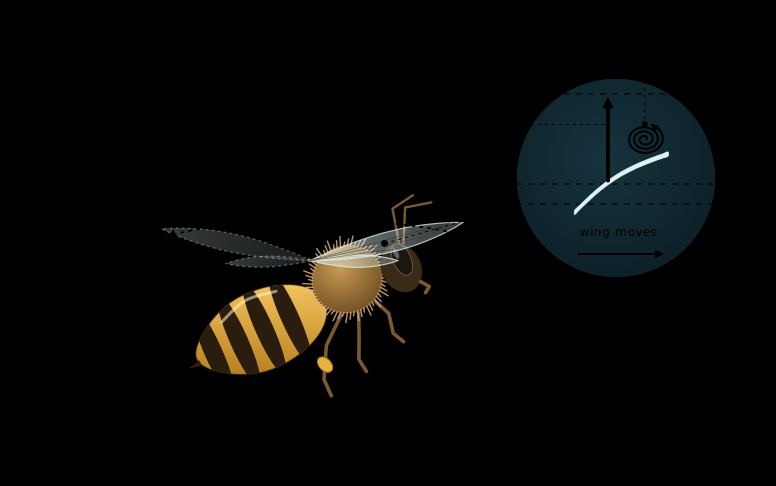
A hovering insect does not flap its wings up and down like a bird in cruising flight. In what Torkel Weis-Fogh called “normal hovering”, the wings beat almost horizontally, forward and back 4:
- Forward stroke. The wing sweeps forward at a steep angle of attack. Air separates at the leading edge and rolls up into a leading-edge vortex on the upper side, which stays attached during the stroke – a “delayed stall” 5 6.
- Turn. At the end of the stroke the wing slows down and rotates rapidly about its long axis, so that the same edge leads on the way back. The rotation itself creates extra force 5.
- Backstroke. The flipped wing sweeps back; again a leading-edge vortex forms and the wing produces lift.
- Meeting its own wake. After the next turn, the wing moves through the air it has just set in motion and gains force from it (“wake capture”) 5.
Biology lens: a flight motor and a gyroscope
Two ways to hover. Insects do not all beat their wings in the same way. Fruit flies sweep their wings through a large angle of 145–165°. Honeybees use short strokes of about 90° at a high frequency of about 230 Hz – and they get a large part of their force at the turns, from unsteady effects such as the rapid rotation of the wing, the acceleration of the air and the interaction with their own wake 1. Douglas Altshuler and colleagues let honeybees hover in heliox, a breathable mixture of oxygen and helium that is only about a third as dense as air. The bees kept their wingbeat frequency almost constant and made their strokes nearly 50 % wider instead 1.
A motor that runs by itself. Hundreds of contractions per second are hard for an ordinary muscle, which needs one nerve impulse per contraction. Some insects use a special kind of flight muscle instead: asynchronous muscle, in which electrical and mechanical activity are not in step. Such a muscle is activated with a delay when it is stretched and deactivated when it shortens; driven by a steady train of nerve impulses, it can do work over and over in an oscillating system 7. According to Deakin’s analysis, insects with small wings and heavy bodies, such as bees, need such muscles to reach the frequencies they require 3. And because the wings must be accelerated and stopped at every turn, most insects depend on an effective elastic system in the thorax that stores and returns the energy of the wing motion 4.
A gyroscope from hind wings. Flies (Diptera) have only one pair of wings. Their hind wings evolved into halteres: small, dumbbell-shaped organs with sense organs at their base 8. A haltere beats up and down through about 150°, at a frequency set by its own mechanical resonance 9. When the body of the fly rotates, the moving haltere experiences gyroscopic or Coriolis forces at right angles to its beat, and the sense organs at its base detect them 9 8. Michael Dickinson swung a flight arena with fruit flies inside back and forth: the flies responded with compensatory changes of their wing strokes, and these reflexes vanished when the halteres were removed 8. As early as 1948, John Pringle photographed a fly without halteres in free flight – it showed the spiral instability expected of a fly that cannot stabilise its turns 9.
Bees have no halteres, and it is not known for certain how they stay upright. One suggestion is the ocelli, three simple light sensors on top of the head that sense the brightness of the sky; hawkmoths, on the other hand, sense rotations with their vibrating antennae, by a mechanism similar to the halteres 10.
Physics lens: between honey and air
Where insects live in the world of flows. The Reynolds number Re = ρ v L / η compares inertial forces with viscous forces (see Swimming in honey). A bacterium swims at about 10−5: viscosity rules, and inertia plays no role. A human swimmer reaches millions. Insects lie in between: in a dataset of more than 150 species, the lowest value, about 8, belongs to a small aphid; apart from a few aphids and whiteflies, values above 100 – typically around 1,000 – are the rule 3. The tiny wasp Encarsia formosa flies at Re = 10–20 4, a fruit fly at 100–200 11. In this middle range, both forces matter: the air is viscous enough to spoil the performance of ordinary wings, but the insect’s body still has inertia. When a fruit fly turns, it is inertia, not friction, that dominates the flight dynamics of its body 12.
The leading-edge vortex. In 1996, Charles Ellington and colleagues made the airflow around the wings of the hawkmoth Manduca sexta visible, together with a large mechanical model of a flapping wing, the “flapper”. On the downstroke they found an intense leading-edge vortex, strong enough to explain the high lift. It is created by dynamic stall and spirals out towards the wingtip with a spanwise speed comparable to the flapping speed; the flow resembles the conical vortex on a delta wing, and the spanwise flow stabilises the vortex 6. On a non-flapping wing at such a steep angle, the vortex would be shed into the wake; on the flapping insect wing it remains stably attached and greatly enhances the forces 13. Even model hawkmoth wings that simply revolve like a propeller produce high force coefficients because of this vortex 14.
Rotation and wake capture. Michael Dickinson, Fritz-Olaf Lehmann and Sanjay Sane described three interacting mechanisms: delayed stall during the strokes, and rotational circulation and wake capture at the turns. The two rotational mechanisms also give the insect a powerful way to change the size and direction of its flight forces when it steers 5.
Clap and fling. Some insects bring their wings together above the body and then fling them open like a book. Weis-Fogh discovered this mechanism in 1973 in Encarsia formosa: at its low Reynolds number, the wasp needs a lift coefficient of 2 or 3, which steady-state aerodynamics cannot deliver. The fling sets up the circulation around each wing before the downstroke begins, and lift is produced almost instantly 4. On a model fruit fly wing, clap and fling increased total lift by up to 17 %, but only if the wings came within 10–12° of each other 11. Most insects, however, rely on the leading-edge vortex 2.
Mathematics lens: why small flyers beat faster
The lift of a moving wing. A wing of area S that moves through air of density ρ at speed U produces the lift
where CL is the lift coefficient, a number that describes how well the wing is shaped and angled. A flapping wing of length R that sweeps through the stroke angle Φ with frequency f moves its tip on average at U = 2 Φ R f – two strokes per wingbeat. Aerodynamic forces therefore grow with the square of the tip speed, which is a product of stroke amplitude, wingbeat frequency and wing length 1.
The square–cube law. Now shrink an insect while keeping its shape: every length is multiplied by a factor k. The mass – and with it the weight W – falls with the volume, as k3; the wing area falls only as k2. To hover, lift must equal weight:
The wings of a smaller insect need to move more slowly, but because they are so short, they must beat faster. A honeybee shrunk to half its length would need √2 ≈ 1.41 times the frequency: about 325 instead of 230 beats per second.
What the data say. Real insects are not scale models of each other – Diptera are shaped differently from butterflies. The mathematician Michael Deakin used dimensional analysis to derive a formula for the wingbeat frequency n from mass m and wing area A and tested it on more than 150 species 3:
This formula explains 75 % of the variation in the measured frequencies; mass alone does not – among butterflies there is no significant correlation between mass and wingbeat frequency 3. For insects of the same shape, m ∝ k3 and A ∝ k2, so √m/A ∝ k−1/2 – the same law as above. The honeybee and the fruit fly show the limits of “same shape”: with wings four times shorter, the fly would be expected to beat at about 450 Hz, yet it gets by with 200 Hz – partly by sweeping its wings through 1.6–1.8 times the angle 1. The rest of the gap lies in what the simple scaling law ignores: the two insects are not built alike.
Power and weight. How much power does hovering cost per newton of weight? A simple estimate treats the beating wings like a rotor that pushes air downwards: the power per weight is then the speed of the downwash, which grows with the square root of the weight per swept area, √(W/ρ Aswept) ∝ k1/2. On paper, small flyers should hover more cheaply. In reality the air gets “stickier” for them: the lift-to-drag ratio of a wing deteriorates at low Reynolds numbers, and Weis-Fogh found that the aerodynamic power of hovering animals – between 1.3 and 4.7 W per newton of weight – does not vary systematically with size 4. In the fruit fly, the profile power – the cost of overcoming the drag of the wings – is about twice the induced power, the cost of producing lift 15.
For a machine, shrinking is worse. The weight falls with k3, but the heat an electric motor produces per unit of its mass grows as 1/k2, and friction grows relative to volume. The rotational accelerations of a flying body grow as 1/k, so its control must react ever faster 10. Power and weight diverge – which is why insect-sized robots need different motors altogether.
Computer science lens: a simple model of a flapping wing
How large must the lift coefficient of a honeybee’s wing be for it to hover? The program below answers this with a quasi-steady model: at every instant, the wing is treated as if it were moving steadily at its current speed, and the lift of all its strips is added up. The mass of 102 mg is an estimate for the honeybee from the literature 10; wing length (9.7 mm), wingbeat frequency (230 Hz), stroke amplitude (90°) and the densities of air and heliox are measured values 1. Model assumptions: the wing is a rectangle 3 mm wide, it sweeps horizontally and sinusoidally, and its lift coefficient is constant during the stroke.
import numpy as np
import matplotlib.pyplot as plt

# Honeybee hovering – measured values, see the article
MASS = 102e-6              # body mass (kg)
WING_LENGTH = 9.7e-3       # wing length R, base to tip (m)
FREQUENCY = 230.0          # wingbeats per second (Hz)
AMPLITUDE = 90.0           # stroke amplitude Φ: the angle one wing sweeps (degrees)
AIR = 1.21                 # density of air (kg/m³)
HELIOX = 0.41              # density of heliox, an oxygen–helium mixture (kg/m³)
# Model assumptions
CHORD = 3.0e-3             # wing width (m): the wing as a rectangle of constant width
SCALE = 1.0                # shrink or grow the whole bee: lengths × SCALE, mass × SCALE³
G = 9.81                   # gravity (m/s²)
VISCOSITY = 1.8e-5         # dynamic viscosity of air (Pa·s)

mass, length, chord = MASS * SCALE**3, WING_LENGTH * SCALE, CHORD * SCALE
weight = mass * G
t = np.linspace(0, 2 / FREQUENCY, 800, endpoint=False)          # two wingbeats


def stroke(amplitude_deg):
    """Sinusoidal stroke φ(t) = Φ/2 · sin(2πft) and its angular speed ω(t) = dφ/dt."""
    phi_max = np.radians(amplitude_deg) / 2
    phase = 2 * np.pi * FREQUENCY * t
    return phi_max * np.sin(phase), phi_max * 2 * np.pi * FREQUENCY * np.cos(phase)


def lift(lift_coefficient, omega, density):
    """Quasi-steady lift of both wings. A strip at distance r moves at u = ω·r and adds
    ½·ρ·C_L·c·u²·dr; summed from base to tip this gives ½·ρ·C_L·ω²·c·R³/3 per wing."""
    return 2 * 0.5 * density * lift_coefficient * omega**2 * chord * length**3 / 3


def needed_cl(amplitude_deg, density):
    """The lift coefficient at which the mean lift over a wingbeat equals the weight."""
    _, omega = stroke(amplitude_deg)
    return weight / lift(1.0, omega, density).mean()


tip_speed = 2 * np.radians(AMPLITUDE) * length * FREQUENCY   # two strokes of Φ·R per wingbeat
reynolds = AIR * tip_speed * chord / VISCOSITY
cl = needed_cl(AMPLITUDE, AIR)
angle, omega = stroke(AMPLITUDE)
force = lift(cl, omega, AIR)
print(f"weight {weight * 1e3:.2f} mN, mean wing-tip speed {tip_speed:.1f} m/s, "
      f"Reynolds number about {round(reynolds, -1):.0f}")
print(f"lift coefficient needed to hover: C_L = {cl:.1f}")
print(f"lift peaks at {force.max() / weight:.1f} × body weight in mid-stroke, 0 at each turn")
print(f"in heliox with the same stroke: C_L = {needed_cl(AMPLITUDE, HELIOX):.1f}; "
      f"with a 50 % wider stroke: C_L = {needed_cl(1.5 * AMPLITUDE, HELIOX):.1f}")

plt.rcParams["font.size"] = 13      # large type: the chart stays readable on a phone
fig, (top, bottom) = plt.subplots(2, 1, figsize=(6.4, 8.4), layout="constrained", sharex=True)
ms = t * 1e3
for ax in (top, bottom):
    for turn in np.arange(0.25, 2, 0.5) / FREQUENCY * 1e3:    # the four turns
        ax.axvline(turn, color="#c98a1b", lw=6, alpha=0.18)
top.plot(ms, np.degrees(angle), lw=2.5, color="black")
top.axhline(0, color="grey", lw=0.8)
top.set_ylabel("stroke angle φ (°)")
top.set_title("The wing sweeps forward and back")
top.text(0.25 / FREQUENCY * 1e3 + 0.07, -40, "turn:\nwing flips", fontsize=11)
bottom.plot(ms, force * 1e3, lw=2.5, label="lift, quasi-steady model")
bottom.axhline(weight * 1e3, color="black", ls="--", lw=1.5, label="body weight")
bottom.set_xlabel("time (ms)")
bottom.set_ylabel("lift (mN)")
bottom.set_ylim(0, 2.6)
bottom.set_title("Lift: peaks mid-stroke, zero at turns")
bottom.legend(loc="upper right", fontsize=11)
plt.show()
Output · what the code prints, re-run at every build
weight 1.00 mN, mean wing-tip speed 7.0 m/s, Reynolds number about 1410
lift coefficient needed to hover: C_L = 1.4
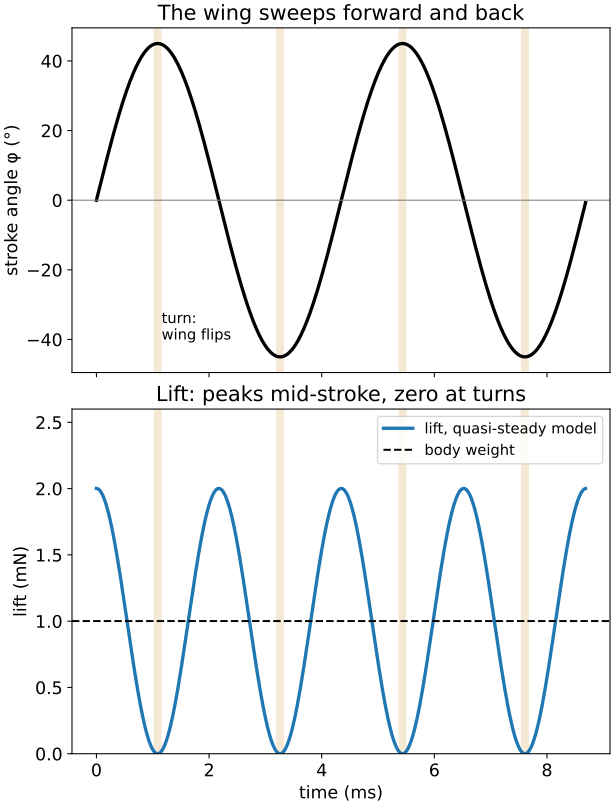
lift peaks at 2.0 × body weight in mid-stroke, 0 at each turn
in heliox with the same stroke: C_L = 4.2; with a 50 % wider stroke: C_L = 1.8
What the result teaches:
- The wing must work hard. To carry its weight of 1.00 mN, the bee’s wing needs an average lift coefficient of 1.4 – at a mean wing-tip speed of 7.0 m/s and a Reynolds number of about 1410. That is a demanding value: conventional aerodynamics accounts for only a third to a half of the lift insects need, and the leading-edge vortex helps to close the gap 2 14. For real hovering honeybees, Altshuler and colleagues give a Reynolds number of about 1,100 1; if the true mean wing width is smaller than the assumed 3 mm, the true lift coefficient is even higher.
- The model misses the turns. In the quasi-steady model, lift peaks at 2.0 times the body weight in mid-stroke and drops to 0 at each turn. Measurements on a robotic bee wing show additional force peaks at the beginning and end of each stroke, from the rotation of the wing, the accelerated air and the wake – a large part of the bee’s lift 1. That is where the model breaks down; it is a first estimate, not the truth.
- Thin air. In heliox with the same stroke, the bee would need CL = 4.2 – three times the value it needs in air. With a 50 % wider stroke, as the bees actually did, the requirement falls to 1.8. The wider stroke does most of the work; the rest has to come from the wing itself.
Try it yourself:
- Shrink the bee to half its size: set
SCALE = 0.5. At the same frequency, the needed lift coefficient doubles to 2.8, and the Reynolds number falls to about 350 – the mathematics lens in action: a smaller insect has to beat faster. - Use the lower wingbeat frequency that another paper gives for honeybees: set
FREQUENCY = 197.010. The needed lift coefficient rises to 1.9 – the result is sensitive to the frequency, because lift grows with its square.
Tested output with SCALE = 0.5
weight 0.13 mN, mean wing-tip speed 3.5 m/s, Reynolds number about 350
lift coefficient needed to hover: C_L = 2.8
lift peaks at 2.0 × body weight in mid-stroke, 0 at each turn
in heliox with the same stroke: C_L = 8.3; with a 50 % wider stroke: C_L = 3.7
Tested output with FREQUENCY = 197.0
weight 1.00 mN, mean wing-tip speed 6.0 m/s, Reynolds number about 1210
lift coefficient needed to hover: C_L = 1.9
lift peaks at 2.0 × body weight in mid-stroke, 0 at each turn
in heliox with the same stroke: C_L = 5.7; with a 50 % wider stroke: C_L = 2.5
Physical AI lens: robot insects
For Physical AI – robots that sense and act in the physical world – insects set the standard: flies perform turns within milliseconds and land upside down on ceilings, with a nervous system of only 105–107 neurons 10. Copying them means meeting the scaling laws of the mathematics lens head on.
Artificial flight muscles. Electric motors work poorly at insect size, so Robert Wood’s group at Harvard University drives the wings of its robot insects, known as RoboBees, with piezoelectric actuators, thin layers that bend when a voltage is applied, in a muscle-like back-and-forth motion. Piezoelectric actuators scale down more favourably than electromagnetic motors 10. The robot’s joints are thin flexures instead of hinges, made with a manufacturing method for rapid prototyping of articulated sub-millimetre mechanisms. In 2013, Kevin Ma and colleagues reported controlled flights of an 80 mg robot, modelled loosely on flies: stable hovering and basic flight manoeuvres, tethered to a thin wire but otherwise unconstrained 16.
Staying upright. Like many insects, the robot has its centre of mass hanging below its wings. That gives it unstable, pendulum-like dynamics: without constant corrections, it tumbles. Sawyer Fuller and colleagues stabilised it with a 25 mg light sensor inspired by the ocelli of insects. The controller applies a torque in proportion to how fast the light from above appears to move – the first known use of onboard sensors at this scale 10. Before, the corrections came from external cameras that tracked the robot 10. The RoboBee flapped at 120 Hz; for honeybees, the same paper gives 197 Hz 10.
Cutting the wire. In 2019, Noah Jafferis and colleagues flew a four-winged robot without a tether: a 90 mg vehicle with four wings driven by two piezoelectric actuators, a peak lift of 4.1 times its weight and, together with solar cells and the electronics that drive the actuators, 259 mg in total. It used 110–120 mW of power – according to the authors, the same thrust efficiency as similarly sized insects such as bees – and, according to the authors, was at the time the lightest insect-scale vehicle to achieve sustained untethered flight 17.
Soft muscles and robots as research tools. Rigid microactuators break easily in collisions. Yufeng Chen and colleagues therefore built flying microrobots with soft artificial muscles – multilayered dielectric elastomer actuators of 100 mg each with a power density of 600 W/kg. These robots survive collisions with walls and with each other; their power and control, however, still come from outside, from offboard amplifiers and a motion-capture system 18. Larger flapping robots are useful to biology, too: Matěj Karásek and colleagues built a tailless, programmable flapping robot 55 times the size of a fruit fly that imitates its rapid escape manoeuvres. With the robot’s yaw control switched off, it still turned towards the escape heading – showing that this turn in flies can arise passively from aerodynamic coupling 19.
Where is the intelligence? In today’s insect robots, a large part of it sits outside: in external cameras, offboard amplifiers or, at best, a single light sensor and a simple control rule. A fly carries everything – sensors, a small brain, muscles and fuel – in a body of a few milligrams. Whether insect-sized robots will one day sense, decide and fly on their own power over long periods is an open question. The authors of the four-winged robot see room for additional onboard devices in its payload capacity 17, and Karásek’s group sees its robot as suitable for real-world flight missions 19; for fully autonomous robot insects, sensing and control at this scale 10 and the high energy cost of flying small 17 remain the big challenges.
What we can learn from a bee
The bee that “could not fly” shows how a good question can come out of a bad calculation. The answer – a vortex that stays on the wing instead of being shed, wings that flip at every turn, muscles that oscillate by themselves and a gyroscope made from a pair of wings – took high-speed video, flow visualisation and mechanical and computer models to find 13.
Open questions remain: how bees and other insects without halteres keep their balance 10, how a comprehensive theory of the forces during the strokes and at the turns can explain the many wing motions of different insects 5, and how to build flying machines the size of an insect that carry their own power and their own intelligence. The reverse direction works, too: robots that fly like insects are becoming instruments for testing ideas about how insects fly 19.
Frequently asked questions
Is it true that bees should not be able to fly?
No. The claim goes back to a simple calculation from 1934 whose assumptions later proved wrong. It is true that conventional fixed-wing aerodynamics cannot explain how bees fly – but flapping wings produce extra lift with unsteady effects, above all a leading-edge vortex that stays attached to the wing, and modern unsteady aerodynamics explains insect flight.
How fast do insect wings beat?
It varies enormously. In a dataset of more than 150 species, wingbeat frequencies range from 6 beats per second in a butterfly to 480 per second in the yellow-fever mosquito. A honeybee beats its wings about 230 times per second, a fruit fly about 200 times.
What is a leading-edge vortex?
When an insect wing sweeps through the air at a steep angle, the flow separates at its front edge and rolls up into a vortex on the upper side. On an aeroplane wing such a vortex would detach and the wing would stall. On a flapping insect wing it stays attached for the whole stroke and spirals out towards the wingtip. The low pressure in the vortex adds lift.
What are halteres?
Halteres are the small, club-shaped organs of flies in place of the hind wings. They beat up and down in time with the wings. When the fly turns, Coriolis forces push them sideways, and sense organs at their base measure this. The fly uses the signal like a gyroscope to keep its body stable.
What is the RoboBee?
The RoboBee is a family of insect-sized flying robots from Harvard University. Its wings are driven by piezoelectric actuators, thin layers that bend when a voltage is applied, because electric motors work poorly at this size. The version flown in 2013 weighed 80 milligrams and needed a wire for power and control; a four-winged version flew without a wire in 2019, powered by solar cells. Fully autonomous flight with onboard sensing, computing and power is still a research goal.
Sources
- Altshuler, D. L., Dickson, W. B., Vance, J. T., Roberts, S. P., Dickinson, M. H. (2005). Short-amplitude high-frequency wing strokes determine the aerodynamics of honeybee flight. Proceedings of the National Academy of Sciences 102, 18213–18218. doi:10.1073/pnas.0506590102 · Open Access
- Ellington, C. P. (1999). The novel aerodynamics of insect flight: applications to micro-air vehicles. Journal of Experimental Biology 202, 3439–3448. doi:10.1242/jeb.202.23.3439
- Deakin, M. A. B. (2010). Formulae for Insect Wingbeat Frequency. Journal of Insect Science 10, 1–9. doi:10.1673/031.010.9601 · Open Access
- Weis-Fogh, T. (1973). Quick Estimates of Flight Fitness in Hovering Animals, Including Novel Mechanisms for Lift Production. Journal of Experimental Biology 59, 169–230. doi:10.1242/jeb.59.1.169
- Dickinson, M. H., Lehmann, F. O., Sane, S. P. (1999). Wing Rotation and the Aerodynamic Basis of Insect Flight. Science 284, 1954–1960. doi:10.1126/science.284.5422.1954
- Ellington, C. P., van den Berg, C., Willmott, A. P., Thomas, A. L. R. (1996). Leading-edge vortices in insect flight. Nature 384, 626–630. doi:10.1038/384626a0 · Open Access
- Josephson, R. K., Malamud, J. G., Stokes, D. R. (2000). Asynchronous Muscle: A Primer. Journal of Experimental Biology 203, 2713–2722. doi:10.1242/jeb.203.18.2713
- Dickinson, M. H. (1999). Haltere–mediated equilibrium reflexes of the fruit fly, Drosophila melanogaster. Philosophical Transactions of the Royal Society of London. Series B: Biological Sciences 354, 903–916. doi:10.1098/rstb.1999.0442 · Open Access
- Pringle, J. W. S. (1948). The gyroscopic mechanism of the halteres of Diptera. Philosophical Transactions of the Royal Society of London. Series B, Biological Sciences 233, 347–384. doi:10.1098/rstb.1948.0007
- Fuller, S. B., Karpelson, M., Censi, A., Ma, K. Y., Wood, R. J. (2014). Controlling free flight of a robotic fly using an onboard vision sensor inspired by insect ocelli. Journal of The Royal Society Interface 11, 20140281. doi:10.1098/rsif.2014.0281 · Open Access
- Lehmann, F. O., Sane, S. P., Dickinson, M. (2005). The aerodynamic effects of wing–wing interaction in flapping insect wings. Journal of Experimental Biology 208, 3075–3092. doi:10.1242/jeb.01744 · Open Access
- Fry, S. N., Sayaman, R., Dickinson, M. H. (2003). The Aerodynamics of Free-Flight Maneuvers in Drosophila. Science 300, 495–498. doi:10.1126/science.1081944
- Sane, S. P. (2003). The aerodynamics of insect flight. Journal of Experimental Biology 206, 4191–4208. doi:10.1242/jeb.00663
- Usherwood, J. R., Ellington, C. P. (2002). The aerodynamics of revolving wings I. Model hawkmoth wings. Journal of Experimental Biology 205, 1547–1564. doi:10.1242/jeb.205.11.1547
- Lehmann, F. O., Dickinson, M. H. (1997). The Changes in Power Requirements and Muscle Efficiency During Elevated Force Production in the Fruit Fly Drosophila Melanogaster. Journal of Experimental Biology 200, 1133–1143. doi:10.1242/jeb.200.7.1133
- Ma, K. Y., Chirarattananon, P., Fuller, S. B., Wood, R. J. (2013). Controlled Flight of a Biologically Inspired, Insect-Scale Robot. Science 340, 603–607. doi:10.1126/science.1231806
- Jafferis, N. T., Helbling, E. F., Karpelson, M., Wood, R. J. (2019). Untethered flight of an insect-sized flapping-wing microscale aerial vehicle. Nature 570, 491–495. doi:10.1038/s41586-019-1322-0
- Chen, Y., Zhao, H., Mao, J., Chirarattananon, P., Helbling, E. F., Hyun, N. P., Clarke, D. R., Wood, R. J. (2019). Controlled flight of a microrobot powered by soft artificial muscles. Nature 575, 324–329. doi:10.1038/s41586-019-1737-7 · Open Access
- Karásek, M., Muijres, F. T., De Wagter, C., Remes, B. D. W., de Croon, G. C. H. E. (2018). A tailless aerial robotic flapper reveals that flies use torque coupling in rapid banked turns. Science 361, 1089–1094. doi:10.1126/science.aat0350 · Open Access
Text and figures: CC BY-SA 4.0. Found a mistake? Open an issue or edit this article on GitHub.