A cat that exists only on paper
Few ideas from physics are as famous as a cat that is alive and dead at the same time. Yet the cat never existed. Schrödinger’s cat is a thought experiment – a scene imagined to test an idea, not an experiment anyone carried out. No cat was ever locked in a box.
In 1935, the physicist Erwin Schrödinger published a long essay on “the present situation in quantum mechanics” in the journal Die Naturwissenschaften. At the end of its first part, he described what he himself called a quite burlesque case 1. In the same year, Albert Einstein, Boris Podolsky and Nathan Rosen had argued that the wave function of quantum mechanics does not give a complete description of physical reality 2. How the mathematics of quantum theory relates to the world we see was a hot topic.
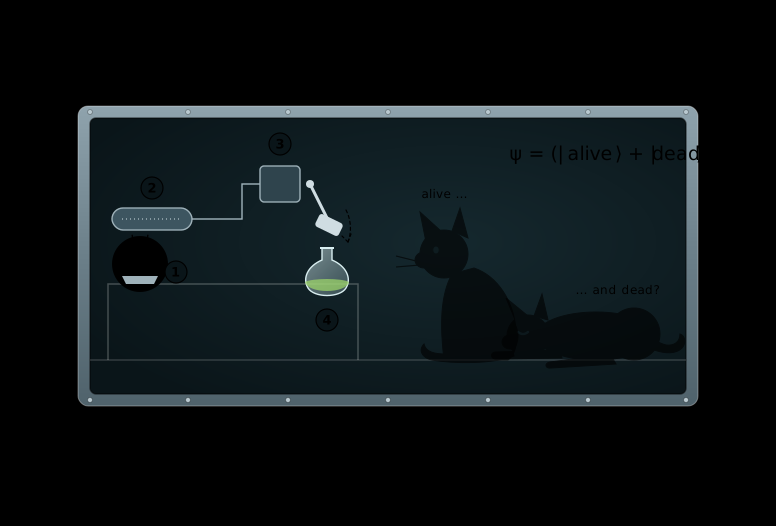
Schrödinger’s scene goes like this 1: a cat is shut in a steel chamber together with a device that the cat cannot touch. The device contains a radioactive substance – so little that within one hour perhaps one of its atoms decays, but with equal probability none. If an atom decays, a Geiger counter responds and, through a relay, releases a small hammer that shatters a flask of hydrocyanic acid, a deadly poison. After one hour, the cat is alive if no atom has decayed, and dead if one has.
The trouble starts when the whole system is described with quantum mechanics. For a single atom, it is normal to describe its state as a combination – a superposition – of “decayed” and “not decayed”. Applied to the whole chamber, the same description contains the living and the dead cat mixed in equal parts 1. Schrödinger did not believe that cats can be half dead. His point was the opposite: a blurred description that works for atoms cannot simply be taken as a picture of reality for everyday objects.
The thought experiment in four steps
- Seal. The cat, the radioactive sample, the counter, the hammer and the flask of poison are shut in the chamber. No one can look inside 1.
- Wait. Radioactive decay is random. The amount of substance is chosen so that after one hour a decay is exactly as likely as no decay 1.
- Couple. Atom, counter, hammer, flask and cat are linked in a chain: “decayed” goes with “dead”, “not decayed” with “alive”. Described by quantum mechanics, the chamber is now in one joint superposition of both possibilities.
- Open. Whoever opens the box finds either a living or a dead cat – never both. After one hour, each result has a probability of 50 %.
Biology lens: why a real cat is never half dead
A living cat is warm, wet and in constant contact with its surroundings. Air molecules bump into its fur, it gives off heat radiation, light scatters from its body, its heart beats and its nerves fire. Every one of these interactions carries a little information about the cat’s state out into the environment. Physicists call this process decoherence: the environment in effect keeps watching certain properties of an object, and superpositions of the alternatives disappear. According to Wojciech Zurek, many – perhaps all – of the features of our classical everyday world can be explained in this way, and the environment eliminates in particular the “Schrödinger cat states” 3.
How fast does this happen in living tissue? Max Tegmark estimated decoherence times for processes in the brain, such as the firing of nerve cells. He found 10−13 to 10−20 s – far shorter than the 10−3 to 10−1 s on which nerve cells work. For the brain, a classical description is therefore appropriate 4. A whole cat is far larger than a nerve cell and just as warm, so by the same reasoning a superposition of “alive” and “dead” could not last for any measurable time.
Where, then, does the quantum world end? Experiments push the boundary further and further. In 1999, Markus Arndt, Anton Zeilinger and colleagues showed wave interference with C60 molecules – football-shaped cages of 60 carbon atoms that they called “almost a classical body” because of their many internal ways of moving 5. In 2019, Arndt’s group demonstrated superposition for molecules heavier than 25,000 atomic mass units, made of up to 2,000 atoms 6. A cat consists of roughly 1026 atoms (see the mathematics lens) – a gap of more than twenty orders of magnitude. The cat in the box is a thought experiment, and biology explains why it stays one.
Physics lens: superposition, measurement and decoherence
Superposition. In quantum mechanics, the state of a system can be a combination of several possible states. A radioactive nucleus that has had time to decay is described as a superposition of “decayed” and “not decayed”. This is not just a statement of ignorance: superpositions can interfere, like waves that reinforce or cancel each other – that is how they differ from a simple “we don’t know”.
Coupling. In Schrödinger’s chamber, the atom does not stay alone. Its state is copied through the counter, the relay and the hammer to the flask and the cat. The result is a single joint state in which “decayed” is linked to “dead” and “not decayed” to “alive”. Neither the atom nor the cat has a state of its own any more – only the pair has.
Measurement. When the box is opened, only one of the two results appears. Quantum theory predicts the probabilities of the results with great accuracy, but how and why a single result arises has been debated since the 1930s. This open question is known as the measurement problem, and Schrödinger’s cat is its best-known illustration.
Decoherence. Part of the answer is well understood today. An object that interacts with its environment loses the ability to show interference between its alternatives: the environment in effect measures it all the time. The superposition does not become visible as a “half-dead cat”; it turns, for all practical purposes, into an ordinary either–or 3. Decoherence explains why we never observe superpositions of everyday objects. Whether it answers every question about measurement is still discussed.
Cats in the laboratory. Physicists have built small “Schrödinger cats” to watch this process:
- In 1996, Christopher Monroe, David Wineland and colleagues put a single laser-cooled beryllium ion into a superposition of two separate positions and proved it by detecting the interference between the two wave packets 7.
- In the same year, Michel Brune, Serge Haroche and colleagues created a superposition of a microwave field in a cavity whose phase pointed in two different directions at once – the “meter” of a measuring apparatus showing two readings. They watched this superposition turn into an ordinary mixture step by step as decoherence unfolded 8.
Mathematics lens: amplitudes, probabilities and a half-life
Radioactive decay. For a sample with half-life T, the probability that nothing has decayed after the time t is
Schrödinger chose the amount of substance so that after one hour a decay is as likely as none 1 – in other words, T = 1 hour for “at least one decay”. After two hours the cat would survive with a probability of 25 %, after three hours with 12.5 %.
Amplitudes. Quantum mechanics describes the state by amplitudes, not probabilities. As a shorthand for the whole chamber:
The Born rule turns amplitudes into probabilities: square their absolute values. After one hour both amplitudes are 1/√2, and (1/√2)2 = ½ – the 50 % of the thought experiment.
Superposition or ignorance? Both a real superposition and a box whose cat is simply alive or dead – we just don’t know which – give 50 % for each result when you look. The difference only shows up in a second kind of measurement, one that tests for interference. The density matrix makes this visible:
| The diagonal entries are the probabilities of “alive” and “dead”. The off-diagonal entry c measures the coherence – the ability to interfere. A test that asks “is the state ( | alive⟩ + | dead⟩)/√2?” answers “yes” with probability ½ + c: always for the superposition, only half of the time for mere ignorance. Decoherence makes c decay, roughly as c(t) = ½ e−t/τ with a decoherence time τ. |
How big is a cat? A cat of 4 kg consists mostly of water, whose atoms weigh on average 18 u / 3 ≈ 6 u. Proteins, fat and bone contain heavier atoms, so assume an average of about 7 u. Then the cat contains
The largest molecules shown in a superposition have up to 2,000 atoms 6 – about 1023 times fewer.
Computer science lens: telling a superposition from ignorance
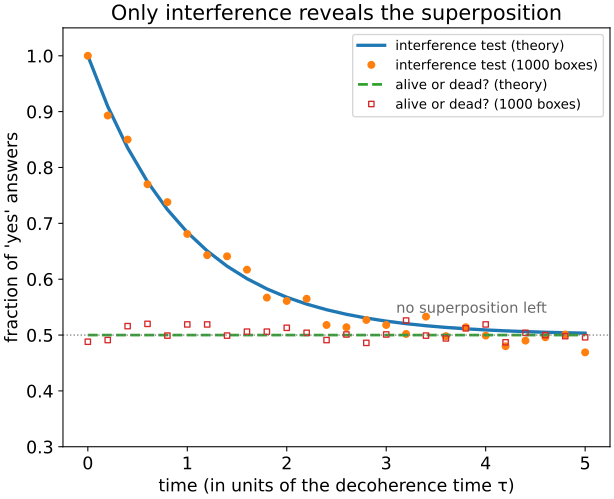
The mathematics lens showed that “alive or dead?” cannot tell a superposition from simple ignorance – both give 50 : 50. Only an interference test can. The program below simulates many identical boxes, each opened once, and applies both tests while decoherence gradually destroys the coherence c. It works with the density matrix directly and draws every single result at random according to the Born rule. The question: how quickly does the difference between a superposition and an ordinary “either–or” disappear?
In a real laboratory the interference test is done on ions or light fields, not on cats 7 8. The time is measured in units of the decoherence time τ.
import numpy as np
import matplotlib.pyplot as plt

BOXES = 1000        # boxes opened per point in time (repetitions of the experiment)
TAU = 1.0           # decoherence time – the unit of time on the x axis
rng = np.random.default_rng(1)


def density_matrix(t):
    """State after time t: the equal superposition (|alive⟩ + |dead⟩)/√2,
    whose coherence – the off-diagonal entry – decays as the environment 'watches'."""
    coherence = 0.5 * np.exp(-t / TAU)
    return np.array([[0.5, coherence],
                     [coherence, 0.5]])


def probabilities(rho):
    """Born rule for two measurements on the same state.
    'Alive or dead?' asks for |alive⟩; the interference test asks for (|alive⟩ + |dead⟩)/√2."""
    p_alive = rho[0, 0]
    p_interference = 0.5 * (rho[0, 0] + rho[1, 1]) + rho[0, 1]
    return p_alive, p_interference


def open_boxes(p):
    """Each box gives one yes/no answer; return the fraction of 'yes' among BOXES boxes."""
    return rng.binomial(BOXES, p) / BOXES


print("time/τ   alive: theory  measured   interference: theory  measured")
for t in [0, 0.5, 1, 2, 5]:
    p_alive, p_int = probabilities(density_matrix(t))
    print(f"{t:6.1f}   {p_alive:13.3f}  {open_boxes(p_alive):8.3f}   {p_int:20.3f}  {open_boxes(p_int):8.3f}")
p_mix = probabilities(np.diag([0.5, 0.5]))[1]
print(f"a box that is simply alive or dead (no superposition): interference {p_mix:.3f}")

times = np.linspace(0, 5, 26)
exact = np.array([probabilities(density_matrix(t)) for t in times])
measured = np.array([[open_boxes(p) for p in row] for row in exact])
plt.rcParams["font.size"] = 13      # large type: the chart stays readable on a phone
fig, ax = plt.subplots(figsize=(6.4, 5.2), layout="constrained")
ax.plot(times, exact[:, 1], lw=2.5, label="interference test (theory)")
ax.plot(times, measured[:, 1], "o", ms=5, label=f"interference test ({BOXES} boxes)")
ax.plot(times, exact[:, 0], "--", lw=2, label="alive or dead? (theory)")
ax.plot(times, measured[:, 0], "s", ms=4, mfc="none", label=f"alive or dead? ({BOXES} boxes)")
ax.axhline(0.5, color="gray", lw=1, ls=":")
ax.text(3.1, 0.54, "no superposition left", color="dimgray", fontsize=11)
ax.set_xlabel("time (in units of the decoherence time τ)")
ax.set_ylabel("fraction of 'yes' answers")
ax.set_title("Only interference reveals the superposition")
ax.set_ylim(0.3, 1.05)
ax.legend(loc="upper right", fontsize=10)
plt.show()
Output · what the code prints, re-run at every build
time/τ   alive: theory  measured   interference: theory  measured
   0.0           0.500     0.493                  1.000     1.000
   0.5           0.500     0.458                  0.803     0.808
   1.0           0.500     0.501                  0.684     0.705
   2.0           0.500     0.514                  0.568     0.575
   5.0           0.500     0.517                  0.503     0.491
a box that is simply alive or dead (no superposition): interference 0.500
What the result teaches:
- “Alive or dead?” never shows the superposition. At every time, both theory and simulation give 50 %, whether the coherence is still there or not. Opening the box and looking is exactly the measurement that cannot reveal the superposition.
- The interference test does. At the start it gives “yes” in every box (theory 1.000); after one decoherence time only 0.684, after five 0.503 – practically the 0.500 of a box that is simply alive or dead.
- Single results are random. With 1,000 boxes, the measured fractions scatter by a few hundredths around the theory. Quantum mechanics predicts probabilities, not the outcome of one box.
Two programming ideas are worth noticing:
- The density matrix as the data structure. Four numbers hold everything the program needs: probabilities on the diagonal, coherence off the diagonal. Decoherence is one line – a decaying exponential on the off-diagonal entries.
- Monte Carlo with
binomial. Instead of opening 1,000 boxes one by one,rng.binomial(BOXES, p)draws the number of “yes” answers directly – the same statistics, much faster.
Try it yourself – each change takes one line:
- Set
BOXES = 100000: the measured values move much closer to the theory; the scatter shrinks roughly with the square root of the number of boxes. - Set
TAU = 0.2: decoherence is five times faster. After half a time unit the interference test gives only 0.541 instead of 0.803, after one time unit 0.503 – for a large, warm object like a cat, τ would be unimaginably shorter still.
Tested output with BOXES = 100000
time/τ   alive: theory  measured   interference: theory  measured
   0.0           0.500     0.499                  1.000     1.000
   0.5           0.500     0.503                  0.803     0.804
   1.0           0.500     0.500                  0.684     0.686
   2.0           0.500     0.501                  0.568     0.566
   5.0           0.500     0.501                  0.503     0.505
a box that is simply alive or dead (no superposition): interference 0.500
Tested output with TAU = 0.2
time/τ   alive: theory  measured   interference: theory  measured
   0.0           0.500     0.493                  1.000     1.000
   0.5           0.500     0.458                  0.541     0.548
   1.0           0.500     0.501                  0.503     0.526
   2.0           0.500     0.514                  0.500     0.509
   5.0           0.500     0.517                  0.500     0.488
a box that is simply alive or dead (no superposition): interference 0.500
From a paper cat to quantum technology
Schrödinger’s cat began as a critique, but “cat states” have become tools. In 2013, a team at Yale University mapped quantum information onto superpositions of two microwave fields in a superconducting cavity – cat states with up to 111 photons 9. In 2020, Raphaël Lescanne and colleagues encoded a qubit in two such states of a superconducting resonator. The further apart the two states were pulled, the rarer one kind of error – the bit-flip – became: it fell exponentially, while the other kind, the phase-flip, grew only linearly 10. Such cat qubits are one of the routes towards quantum computers that correct their own errors.
At the same time, experiments with ever larger molecules test whether quantum mechanics holds unchanged for heavier objects 6. And the thought experiment itself remains one of the best ways to think about the boundary between the quantum world and ours – without harming a single cat.
Frequently asked questions
Was Schrödinger's cat a real experiment?
No. It is a thought experiment that Erwin Schrödinger described in 1935 in an essay on the current situation of quantum mechanics. No cat was ever placed in a box with poison. Schrödinger himself called the scene a burlesque case: it was meant to show how absurd it becomes to apply the blurred quantum description of atoms directly to everyday objects.
Is Schrödinger's cat alive and dead at the same time?
Only if quantum mechanics is taken literally for the whole box. The radioactive sample is described as a superposition of decayed and not decayed, and through the counter, hammer and poison this superposition would carry over to the cat. When the box is opened, one always finds either a living or a dead cat – after one hour each with a probability of 50 percent. Schrödinger's point was that a smeared-out cat cannot be a picture of reality.
What did Schrödinger want to show with his cat?
He wanted to show a problem. In quantum mechanics, a radioactive atom can be described as being in a superposition of decayed and not decayed. Schrödinger showed that if this description is applied naively to a large object coupled to the atom, the result is a cat that is alive and dead at once – something no one has ever observed. The thought experiment asks where and how the quantum description of possibilities turns into one definite result.
Why do we never see superpositions in everyday life?
Because large objects are never isolated. Air molecules, light and heat constantly interact with them, and each interaction carries information about their state into the environment. This process, called decoherence, destroys the interference between the alternatives almost instantly. Estimates for processes in the brain give decoherence times of 10 to the power of minus 13 to minus 20 seconds, far shorter than anything a living system does.
What is a cat state in physics?
A cat state is a superposition of two clearly different states of one quantum system, named after Schrödinger's cat. Physicists have made cat states with a single beryllium ion in two places at once, with microwave fields in a cavity whose phase points in two directions, and with light fields of up to 111 photons. Such states are used to study decoherence and to build more robust qubits for quantum computers.
Sources
- Schrödinger, E. (1935). Die gegenwärtige Situation in der Quantenmechanik. Die Naturwissenschaften 23, 807–812. doi:10.1007/BF01491891
- Einstein, A., Podolsky, B., Rosen, N. (1935). Can quantum-mechanical description of physical reality be considered complete?. Physical Review 47, 777–780. doi:10.1103/PhysRev.47.777
- Zurek, W. H. (2003). Decoherence, einselection, and the quantum origins of the classical. Reviews of Modern Physics 75, 715–775. doi:10.1103/RevModPhys.75.715 · Open Access
- Tegmark, M. (2000). Importance of quantum decoherence in brain processes. Physical Review E 61, 4194–4206. doi:10.1103/PhysRevE.61.4194 · Open Access
- Arndt, M., Nairz, O., Vos-Andreae, J., Keller, C., van der Zouw, G., Zeilinger, A. (1999). Wave–particle duality of C60 molecules. Nature 401, 680–682. doi:10.1038/44348
- Fein, Y. Y., Geyer, P., Zwick, P., Kiałka, F., Pedalino, S., Mayor, M., Gerlich, S., Arndt, M. (2019). Quantum superposition of molecules beyond 25 kDa. Nature Physics 15, 1242–1245. doi:10.1038/s41567-019-0663-9
- Monroe, C., Meekhof, D. M., King, B. E., Wineland, D. J. (1996). A "Schrödinger cat" superposition state of an atom. Science 272, 1131–1136. doi:10.1126/science.272.5265.1131
- Brune, M., Hagley, E., Dreyer, J., Maître, X., Maali, A., Wunderlich, C., Raimond, J. M., Haroche, S. (1996). Observing the progressive decoherence of the "meter" in a quantum measurement. Physical Review Letters 77, 4887–4890. doi:10.1103/PhysRevLett.77.4887
- Vlastakis, B., Kirchmair, G., Leghtas, Z., Nigg, S. E., Frunzio, L., Girvin, S. M., Mirrahimi, M., Devoret, M. H., Schoelkopf, R. J. (2013). Deterministically encoding quantum information using 100-photon Schrödinger cat states. Science 342, 607–610. doi:10.1126/science.1243289
- Lescanne, R., Villiers, M., Peronnin, T., Sarlette, A., Delbecq, M., Huard, B., Kontos, T., Mirrahimi, M., Leghtas, Z. (2020). Exponential suppression of bit-flips in a qubit encoded in an oscillator. Nature Physics 16, 509–513. doi:10.1038/s41567-020-0824-x
Text and figures: CC BY-SA 4.0. Found a mistake? Open an issue or edit this article on GitHub.