A snap that makes water boil – without heat
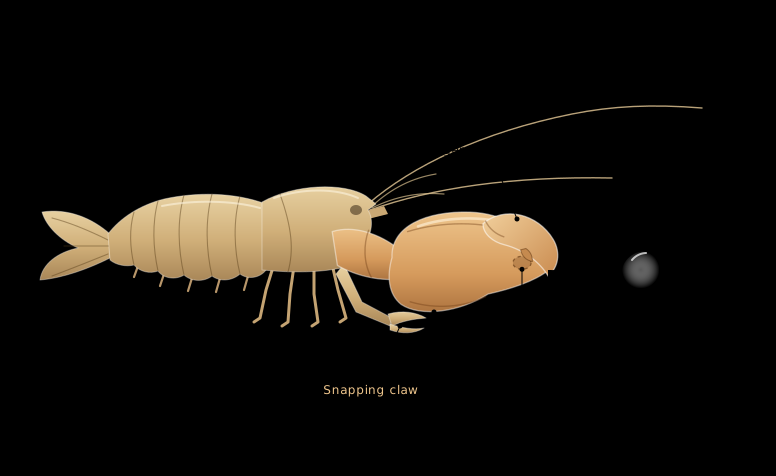
Pistol shrimp, also called snapping shrimp, belong to the family Alpheidae. They are only a few centimetres long and live in warm and temperate coastal waters – in coral reefs, seagrass meadows and burrows on the sea floor. One of their two claws is hugely enlarged. With it, they produce a sharp crack that can stun or even kill prey 1 and that they also use for defence and communication 3. Where many shrimp live together, their snapping merges into a crackling noise that is loud enough to disturb underwater communication 2.
For a long time, it seemed obvious where the sound came from: the two halves of the claw striking each other. In 2000, a team led by Michel Versluis and Detlef Lohse at the University of Twente filmed the snap with high-speed cameras while recording it with a hydrophone. The recordings showed that the sound is emitted when a cavitation bubble collapses – not when the claw closes 1.
The snap in four steps
- Cocking. The shrimp opens its snapping claw and builds up muscle tension while the claw stays locked open.
- Jet. When the claw is released, a plunger on the movable finger – the dactyl – plunges into a matching socket in the claw. The water in the socket is shot out as a narrow jet.
- Cavitation. The jet is so fast that the pressure inside it drops below the vapour pressure of water. The water “tears” and forms a bubble filled with vapour.
- Collapse. Once the jet has passed, the surrounding water crushes the bubble. It implodes within a fraction of a millisecond, emitting a shock wave and a brief flash of light 1 2.
Biology lens: weapon, signal – and a claw that can switch sides
For the shrimp, the snapping claw is a multi-purpose tool. The shock wave stuns or kills small prey 1; the same snap serves for defence and communication 3. Even without a sound, the claw carries information: in experiments by Hughes, male snapping shrimp reacted aggressively to isolated claws fixed open in the display posture – and how strongly they reacted depended on the size of the claw relative to their own 5. The open claw works as a visual signal of body size, which lets rivals assess each other before a fight escalates.
The claw is also remarkably plastic. In snapping shrimp of the genus Alpheus, the large snapping claw and the small pincer claw can swap roles: after the snapper is lost, the pincer on the opposite side is rebuilt into a new snapping claw over the following moults. Mellon and Stephens showed in 1978 that the form and function of a claw can be transformed even by cutting a nerve on the opposite side of the body – the nervous system controls which claw becomes the weapon 6.
Snapping shrimp shape entire habitats acoustically. They are among the main sources of biological noise in shallow bays, harbours and coastal waters. For the species Synalpheus parneomeris, Au and Banks measured peak-to-peak source levels of 183 to 189 dB re 1 µPa at 1 m, with energy spread from a few kilohertz up to 200 kHz. This crackling can limit human sonar and may interfere with the sounds of dolphins and whales 7. Note that underwater decibels use a reference pressure of 1 µPa instead of 20 µPa in air, so they cannot be compared directly with sound levels in air.
Physics lens: why fast water boils
We usually make water boil by heating it. But boiling depends on pressure just as much as on temperature: at the top of Mount Everest, water boils at around 70 °C. Lower the pressure far enough, and water boils even at room temperature. The pistol shrimp lowers the pressure – with speed.
Bernoulli’s principle says that along a streamline, the static pressure p plus the dynamic pressure ½ρv² stays constant. The faster the water flows, the lower its static pressure:
Versluis and colleagues estimated the speed of the shrimp’s jet from high-speed video of the closing claw: about 25 m/s 1 8. With p0 = 101 kPa (atmospheric pressure) and ρ = 998 kg/m³ for water, the dynamic pressure at 25 m/s is ½ · 998 · 25² ≈ 312 kPa – three times the atmospheric pressure. Long before that point, at about 14 m/s, the static pressure reaches the vapour pressure of water (2.3 kPa at 20 °C). The water can no longer stay liquid: it cavitates. Simulations suggest the details are more complex: the low pressure arises in the core of a vortex ring that rolls up around the jet, so the cavity is ring-shaped rather than spherical 8.

Engineers capture this with the cavitation number σ = (p∞ − pv) / (½ρv²). The smaller σ, the more likely cavitation. For a jet of 25 m/s, σ ≈ 0.3. The mechanical replica of the claw built by Tang and Staack produced jets of about 26 to 37 m/s, with σ = 0.14 to 0.30 – comparable to the real shrimp 3.
The dramatic part comes next. When the jet has passed, the full ambient pressure acts on the bubble, and it collapses faster and faster. The little gas left inside is compressed so violently that it heats up to at least 5,000 K and glows for an instant – shrimpoluminescence, to the authors’ knowledge the first observation of this kind of light production in any animal 2. At the same moment, a shock wave races outwards at the speed of sound in water, about 1,500 m/s 3.
The same physics that the shrimp uses as a weapon is a nuisance for engineers: cavitation bubbles collapsing on ship propellers and pump impellers slowly erode even hardened steel – a process known as cavitation erosion.
Mathematics lens: how long does the collapse take?
In 1917, Lord Rayleigh calculated how an empty spherical cavity in a liquid collapses under a constant pressure difference 4. His result for the collapse time is remarkably simple:
Let us assume a bubble with a maximum radius of Rmax = 3 mm – a bubble a few millimetres across. With ρ = 998 kg/m³ and p∞ − pv = 101,325 Pa − 2,339 Pa ≈ 99,000 Pa:
Two things follow directly from the formula. The collapse time grows in proportion to the bubble size: a bubble twice as large takes twice as long to collapse. And it is inversely proportional to the square root of the pressure difference: in deeper water, where the ambient pressure is higher, bubbles collapse faster.

Why does the collapse get so hot? If the gas inside is compressed quickly, it has no time to give off heat – the compression is adiabatic. For an ideal gas, the temperature then rises as
where γ is the adiabatic index, the ratio of the gas’s heat capacities cp/cV (1.4 for air). A bubble that shrinks to one tenth of its radius already reaches 293 K · 101.2 ≈ 4,600 K – the same order of magnitude as the at least 5,000 K derived from the flash 2. The energy spread over the whole bubble is focused into a volume 10³ = 1,000 times smaller. Real bubbles contain water vapour and lose some heat, so this estimate is a rough guide, not a precise prediction.
Computer science lens: simulating a bubble
Rayleigh’s formula assumes an empty bubble. To model a real one – with gas inside, surface tension and viscosity – physicists use the Rayleigh–Plesset equation, an ordinary differential equation for the bubble radius R(t). Versluis and colleagues used a model of this type to reproduce both the bubble radius over time and the sound emitted by the shrimp 1:
Here pB is the pressure in the liquid at the bubble wall: gas pressure plus vapour pressure, minus the effects of surface tension and viscosity.
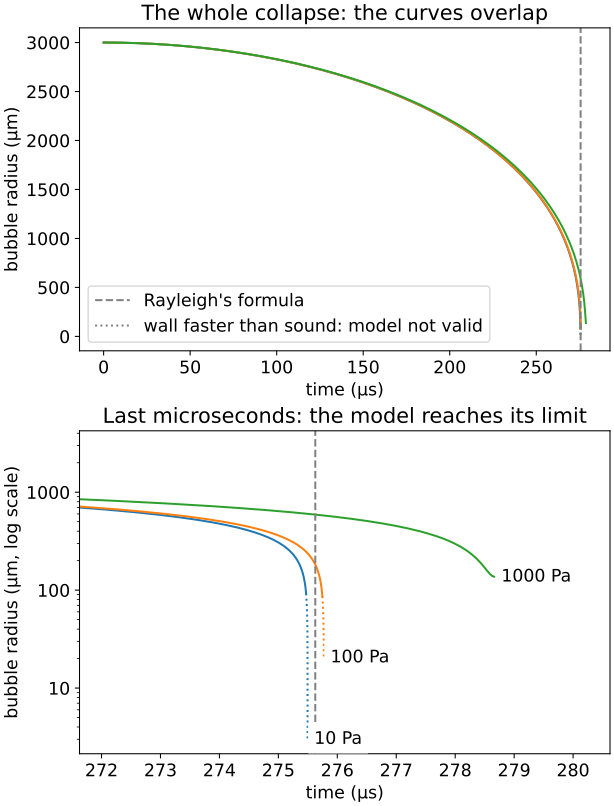
One number in this model is unknown: how much gas the shrimp’s bubble contains. Nobody has measured it. So the program below does what scientists do with an unknown input – it tries several values. It simulates the collapse with 10, 100 and 1,000 Pa of gas pressure (at the largest radius), prints collapse time, smallest radius, top wall speed and the temperature estimate from the physics lens, and draws the radius over time:
import numpy as np
import matplotlib.pyplot as plt
from scipy.integrate import solve_ivp

# Water at 20 °C
RHO, P_INF, P_V = 998.0, 101_325.0, 2_339.0   # density (kg/m³), ambient and vapour pressure (Pa)
SIGMA, MU = 0.0728, 1.0e-3                    # surface tension (N/m), viscosity (Pa·s)
T0 = 293.0                                    # temperature of the water (K)

R_MAX = 3.0e-3        # bubble radius at its largest (m)
GAMMA = 1.4           # polytropic exponent of the gas
C_WATER = 1482.0      # speed of sound in water (m/s)

def collapse(p_gas):
    """Simulate the collapse from R_MAX; p_gas = gas pressure in the bubble at R_MAX (Pa)."""
    def rayleigh_plesset(t, y):
        R, dR = y
        p_wall = p_gas * (R_MAX / R) ** (3 * GAMMA) + P_V - 2 * SIGMA / R - 4 * MU * dR / R
        ddR = ((p_wall - P_INF) / RHO - 1.5 * dR**2) / R
        return [dR, ddR]

    def turnaround(t, y):    # event: the bubble wall stops and turns around
        return y[1]
    turnaround.terminal, turnaround.direction = True, 1

    return solve_ivp(rayleigh_plesset, (0, 2e-3), [R_MAX, 0.0], method="LSODA",
                     events=turnaround, rtol=1e-10, atol=1e-13, max_step=1e-6)

rayleigh = 0.915 * R_MAX * np.sqrt(RHO / (P_INF - P_V))
print(f"Rayleigh's formula (empty bubble): {rayleigh * 1e6:.0f} µs\n")
print("gas (Pa)   collapse (µs)   R_min (µm)   max. speed (km/s)   T_max (1000 K)")

plt.rcParams["font.size"] = 13      # stacked and with larger type, so the chart stays readable on a phone
fig, (whole, end) = plt.subplots(2, 1, figsize=(6.4, 8.4), layout="constrained")
for p_gas in [10, 100, 1000]:     # nobody has measured how much gas the shrimp's bubble holds
    sol = collapse(p_gas)
    r_min, speed = sol.y[0, -1], np.abs(sol.y[1]).max()
    t_max = T0 * (R_MAX / r_min) ** (3 * (GAMMA - 1))    # adiabatic heating (physics lens)
    print(f"{p_gas:8}   {sol.t[-1] * 1e6:13.0f}   {r_min * 1e6:10.1f}   {speed / 1e3:17.1f}   {t_max / 1e3:14,.1f}")
    t_us, r_um = sol.t * 1e6, sol.y[0] * 1e6
    fast = np.abs(sol.y[1]) > C_WATER         # wall faster than sound: the model no longer holds
    i = np.argmax(fast) if fast.any() else len(fast)
    for ax in (whole, end):
        line, = ax.plot(t_us[:i + 1], r_um[:i + 1])
        ax.plot(t_us[i:], r_um[i:], ":", color=line.get_color())
    end.annotate(f"{p_gas} Pa", (t_us[-1], r_um[-1]), xytext=(5, 0), textcoords="offset points",
                 va="center", backgroundcolor="white")

for ax in (whole, end):
    ax.axvline(rayleigh * 1e6, color="grey", linestyle="--", label="Rayleigh's formula")
    ax.set_xlabel("time (µs)")
whole.plot([], [], ":", color="grey", label="wall faster than sound: model not valid")
whole.set(ylabel="bubble radius (µm)", title="The whole collapse: the curves overlap")
whole.legend(loc="lower left")
end.set(ylabel="bubble radius (µm, log scale)", xlim=(rayleigh * 1e6 - 4, rayleigh * 1e6 + 5), yscale="log",
        title="Last microseconds: the model reaches its limit")
end.yaxis.set_major_formatter("{x:g}")
plt.show()
Output · what the code prints, re-run at every build
Rayleigh's formula (empty bubble): 276 µs

gas (Pa)   collapse (µs)   R_min (µm)   max. speed (km/s)   T_max (1000 K)
      10             275          3.0                89.7          1,160.6
     100             276         20.5                 5.1            116.3
    1000             279        137.0                 0.3             11.9
What the result teaches:
- The collapse time is robust. However much gas is inside, the bubble collapses after 275–279 µs, within about 1 % of Rayleigh’s formula (1.1 % for the most gas). A prediction that barely depends on an unknown input is one you can trust.
- The end point is not. The smallest radius ranges from 137 µm down to 3 µm – a factor of about 45. Because the temperature grows with (Rmax/Rmin)3(γ − 1), the estimate swings from about 12,000 K to over a million kelvin. The model cannot pin down the temperature.
- The model shows its own limits. With 10 or 100 Pa of gas, once the bubble is smaller than about 90 µm (dotted in Fig. 4), the wall would move at 5 to 90 km/s – faster than sound travels in water (about 1.5 km/s). The Rayleigh–Plesset equation treats water as incompressible and ignores heat loss, so in this last phase its numbers are no longer physical. Real bubbles are cushioned by water vapour, heat conduction and the compressibility of water; the flash measured for the shrimp points to at least 5,000 K 2.
A few programming ideas are worth noticing, too:
- Stiffness. Near the collapse, the radius changes extremely fast. An adaptive solver such as LSODA shrinks its time step automatically where needed.
- Events. Instead of guessing how long to simulate, the code stops exactly when the bubble wall turns around – the moment of maximum compression.
- Validation. With almost no gas inside, the simulation must agree with Rayleigh’s analytical result – and it does, to within a microsecond. Comparing numerics with a known limit is a habit worth keeping.
Try it yourself – each change takes one line:
- Set
R_MAX = 6.0e-3: the collapse time doubles to 551–557 µs and every radius doubles, but speeds and temperatures stay the same – only the ratio Rmax/Rmin matters. - Set
P_INF = 201_325.0(10 m of water depth): the bubble collapses after only 194–195 µs – and harder, so all speeds and temperatures rise. - Add
10_000to the list of gas pressures: the gas cushions the collapse, the bubble stops at about 800 µm after 308 µs and heats up to only about 1,400 K.
Tested output with R_MAX = 6.0e-3
Rayleigh's formula (empty bubble): 551 µs

gas (Pa)   collapse (µs)   R_min (µm)   max. speed (km/s)   T_max (1000 K)
      10             551          6.0                89.7          1,160.5
     100             552         41.0                 5.1            116.3
    1000             557        274.0                 0.3             11.9
Tested output with P_INF = 201_325.0
Rayleigh's formula (empty bubble): 194 µs

gas (Pa)   collapse (µs)   R_min (µm)   max. speed (km/s)   T_max (1000 K)
      10             194          1.7               304.3          2,332.3
     100             194         11.5                17.1            233.5
    1000             195         77.4                 1.0             23.6
Tested output with p_gas: 10_000
Rayleigh's formula (empty bubble): 276 µs

gas (Pa)   collapse (µs)   R_min (µm)   max. speed (km/s)   T_max (1000 K)
      10             275          3.0                89.7          1,160.6
     100             276         20.5                 5.1            116.3
    1000             279        137.0                 0.3             11.9
   10000             308        799.8                 0.0              1.4
From shrimp to technology
In 2019, Xin Tang and David Staack at Texas A&M University turned the shrimp’s trick into a machine. They scanned the exuvia of a shrimp claw – the shell shed during moulting – with micro-computed tomography (µCT), 3D-printed it at five times its natural size and drove it with torsion springs that mimic the shrimp’s muscle. The device produced a jet with the same cavitation and Reynolds numbers as the animal – and with it, light flashes and shock waves. According to the authors, it generates plasma in water more efficiently than electrical, acoustic or laser-based methods 3. Such compact, low-cost plasma sources could one day be useful wherever energy has to be focused into a tiny volume of liquid.
Controlled cavitation already plays a role in medicine: in extracorporeal shock wave lithotripsy, shock waves break up kidney stones, and the collapse of cavitation bubbles is part of how they work. The pistol shrimp has been using the same principle for far longer – as a weapon a few millimetres in size.
Frequently asked questions
How does a pistol shrimp make its snapping sound?
Not by the claw halves striking each other. When the claw snaps shut, it shoots out a jet of water so fast that the pressure inside it drops below the vapour pressure of water. A cavitation bubble forms, and the sound is emitted when this bubble violently collapses. Versluis and colleagues showed this in 2000 with high-speed video and hydrophone recordings.
How hot does the pistol shrimp's bubble get?
At the moment of collapse, the bubble emits a flash of light that indicates temperatures of at least 5,000 kelvin inside it (Lohse et al., 2001) – close to the temperature of the Sun's visible surface, about 5,800 kelvin. The heat lasts only a tiny fraction of a second and is confined to the tiny volume of the compressed bubble.
What is cavitation?
Cavitation is the formation of vapour-filled cavities in a liquid when the local pressure falls below the liquid's vapour pressure – for example in a very fast jet or behind a ship's propeller. When the pressure recovers, the cavities collapse violently and emit shock waves, which can stun animals or erode metal.
What is shrimpoluminescence?
Shrimpoluminescence is the short flash of light emitted when the cavitation bubble created by a snapping shrimp collapses. It was first reported by Lohse, Schmitz and Versluis in 2001 and resembles sonoluminescence, the light emitted by bubbles driven by ultrasound.
Can engineers copy the pistol shrimp?
Yes. In 2019, Tang and Staack 3D-printed a claw replica based on a micro-CT scan of a moulted shrimp claw. Driven by springs, it produces a water jet matching the shrimp's cavitation number, and it reproduces the flash of light and the shock wave – more efficiently than other ways of generating plasma in water.
How loud is a pistol shrimp?
Very loud for its size. For the snapping shrimp Synalpheus parneomeris, Au and Banks (1998) measured peak-to-peak source levels of 183 to 189 decibels re 1 micropascal at 1 metre. Underwater decibels use a different reference pressure than decibels in air, so the numbers cannot be compared directly. Colonies of snapping shrimp are among the main sources of biological noise in shallow seas.
Sources
- Versluis, M., Schmitz, B., von der Heydt, A., Lohse, D. (2000). How snapping shrimp snap: through cavitating bubbles. Science 289, 2114–2117. doi:10.1126/science.289.5487.2114
- Lohse, D., Schmitz, B., Versluis, M. (2001). Snapping shrimp make flashing bubbles. Nature 413, 477–478. doi:10.1038/35097152
- Tang, X., Staack, D. (2019). Bioinspired mechanical device generates plasma in water via cavitation. Science Advances 5, eaau7765. doi:10.1126/sciadv.aau7765 · Open Access
- Lord Rayleigh (1917). On the pressure developed in a liquid during the collapse of a spherical cavity. The London, Edinburgh, and Dublin Philosophical Magazine and Journal of Science 34, 94–98. doi:10.1080/14786440808635681
- Hughes, M. (1996). Size assessment via a visual signal in snapping shrimp. Behavioral Ecology and Sociobiology 38, 51–57. doi:10.1007/s002650050216
- Mellon, D. Jr., Stephens, P. J. (1978). Limb morphology and function are transformed by contralateral nerve section in snapping shrimps. Nature 272, 246–248. doi:10.1038/272246a0
- Au, W. W. L., Banks, K. (1998). The acoustics of the snapping shrimp Synalpheus parneomeris in Kaneohe Bay. The Journal of the Acoustical Society of America 103, 41–47. doi:10.1121/1.423234
- Koukouvinis, P., Bruecker, C., Gavaises, M. (2017). Unveiling the physical mechanism behind pistol shrimp cavitation. Scientific Reports 7, 13994. doi:10.1038/s41598-017-14312-0 · Open Access
Text and figures: CC BY-SA 4.0. Found a mistake? Open an issue or edit this article on GitHub.