Running up glass without glue
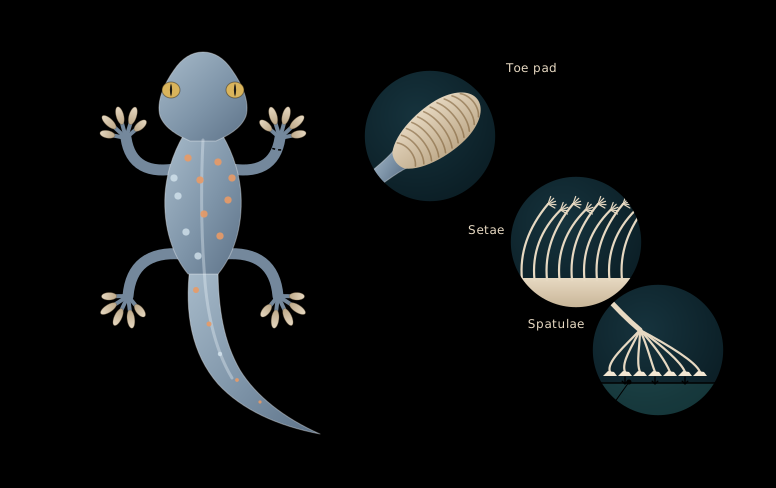
A gecko can race up a pane of glass and hang from the ceiling by one foot. It needs no glue, no suction cups and no claws for this. The secret lies on the underside of its toes: broad pads covered with thin plates, the lamellae 14. Under a microscope, each lamella turns out to be a dense forest of hair-like setae, each 30–130 µm long and only a tenth as thick as a human hair. Every seta branches into hundreds of flat tips, the spatulae, just 0.2–0.5 µm wide 1. A tokay gecko carries about a billion of them 4.
How these structures stick was debated for more than a century. Suction, glue-like secretions, interlocking with tiny bumps and water films were all proposed. In 2002, Kellar Autumn and colleagues tested the question directly: the toes of live tokay geckos stuck equally well to strongly water-repellent and strongly water-attracting surfaces, and so did a single isolated seta. This pointed to van der Waals forces – weak attractions between all molecules, independent of the surface chemistry 2. Later measurements on single spatulae showed that humidity adds a significant contribution at the nanoscale 4. Today, van der Waals forces are regarded as the main mechanism, with water films adding to it.
The grip in four steps
- Touch down. The gecko uncurls its toes and presses them onto the wall. The flexible setae bend and bring millions of spatulae close to the surface 1.
- Load. The gecko pulls its toes slightly towards its body along the wall. This small shear load aligns the setae and increases adhesion strongly 1 8.
- Hold. Billions of spatulae lie flat on the surface. Each one holds only a tiny force, but together they carry the animal – even from a single toe 6.
- Release. The gecko rolls its toes up and back. When the setal shaft reaches an angle of about 30° to the wall, the setae let go; a foot comes free in about 15 ms 3 7.
Biology lens: an invention made eleven times
Adhesive toe pads are not a single lucky invention. Tony Gamble and colleagues reconstructed the family tree of geckos from several genes, covering 107 of 118 recognised genera. The most likely explanation of the data: adhesive toe pads evolved about 11 times independently and were lost about 9 times 9. The pads look strikingly similar from the outside, yet their inner anatomy differs between lineages – a textbook case of convergent evolution. Anoles and skinks have evolved hairy toe pads, too 2.
Walking on sticky feet brings problems of its own. The first is letting go: geckos run with step intervals of about 20 ms, so they must switch their grip on and off almost instantly. By rolling the toes down and gripping inwards, geckos keep the spatulae at small angles to the wall and hold tight; by rolling them upward and backward, they peel the spatulae off. In this way the adhesion and friction of a gecko foot can change by a factor of about a thousand 7.
The second problem is dirt. Geckos are not known to groom their feet, yet they stay sticky for months between moults. Hansen and Autumn dusted gecko toes with tiny particles: after only a few steps, the animals could cling to vertical surfaces again 6. A dirt particle touches only a few spatulae but lies with its whole underside on the wall, so the wall attracts it more strongly than the foot does – and it stays behind. Gecko setae are the first adhesive shown to clean itself in this way 6.
Physics lens: the weakest force, multiplied
Van der Waals forces act between all atoms and molecules, even electrically neutral ones. The electron cloud of a molecule constantly fluctuates; for a brief moment, it forms a tiny electric dipole that induces a matching dipole in its neighbour. The two attract each other. Each of these interactions is extremely weak – but they act everywhere.
Between two flat surfaces separated by a gap D, the van der Waals forces add up to an attractive pressure
where A is the Hamaker constant, a material property. For solids and liquids it is typically of the order of 10−19 J. With this value, surfaces in contact – about 0.3 nm apart, the size of an atom – attract each other with roughly 200 MPa, about 2,000 times atmospheric pressure. This is an order-of-magnitude estimate for ideal, perfectly flat surfaces.
The catch is the D3 in the denominator. Double the gap and the attraction drops eightfold. At 1 nm it is 37 times weaker than at contact, at 10 nm about 37,000 times weaker. Two hard, rough surfaces – a hand on a wall, say – touch only at a few bumps; everywhere else they are micrometres apart, and the attraction is negligible.

This is the problem the gecko has solved. Its setae are made of keratin, but they are so thin and so finely branched that the spatulae can follow the unevenness of a surface and come within molecular distance of it 3. The adhesive properties of setae mainly result from the size and shape of their tips, not from their chemistry 2. In the 2002 experiments, Autumn and colleagues confirmed this with artificial setal tips made from two different materials: both stuck as predicted from their size 2.
Friction matters as much as adhesion. Isolated setal arrays and live gecko toes hold more firmly when they are pulled along the surface: the adhesion grows in direct proportion to the shear force. Autumn and colleagues called this frictional adhesion 8. Without shear, the grip is weak – which is exactly what makes it easy to release.
Mathematics lens: why more, smaller contacts hold better
How much could all the setae of a gecko carry? Autumn and Peattie measured up to 200 µN for a single seta and estimated 6.5 million setae on a tokay gecko 3:
A single seta alone could hold a mass of 200 µN / 9.81 m/s² ≈ 20 mg. Even if only 1 % of all setae were attached, they could carry about 1.3 kg – far more than the gecko weighs. In reality, a gecko uses only a fraction of this capacity at any moment, which leaves a large safety margin.
Why are the contact tips so small? Contact mechanics gives an elegant answer. For a small, rounded tip of radius R pressed onto a flat surface, the force needed to pull it off is proportional to its radius, not to its area (JKR theory):
Here W is the work of adhesion, the energy needed to separate a unit area of contact. Now split this one contact into n smaller tips that cover the same total area. Each tip then has a radius of R/√n, and all of them together hold
Split a contact into 100 tips and it holds 10 times more; into 10,000 tips, 100 times more; into a million tips, 1,000 times more. This is the principle of contact splitting. Arzt, Gorb and Spolenak compared attachment hairs across flies, beetles, spiders and geckos and found a strong trend: the heavier the animal, the finer its contact elements. Flies and beetles get by with micrometre-sized tips, while geckos need tips below a micrometre 5. Autumn and colleagues had come to the same conclusion: theory predicts greater adhesion simply from subdividing setae 2.
The √n rule is a simplified model: it assumes identical, independent tips that all touch at once. Real setae share the load unevenly, and the model breaks down when tips get so small and dense that they stick to each other. Still, it explains the main trend – and it is a design rule engineers use.
Computer science lens: an adhesive switched by an angle
How can the same foot hold on firmly and let go in 15 ms? Yu Tian and colleagues explained it with a tape model: each spatula behaves like a tiny strip of adhesive tape, and the angle at which it is pulled decides how much force it takes to peel it off 7. For an elastic tape of width b, thickness h and Young’s modulus E, pulled at an angle θ to the wall, Kendall’s peeling equation relates the peel force F to the work of adhesion W 12:
The second term is the work done when the peeled strip is pulled away from the wall; the first is the energy stored by stretching it. The program below solves this equation for F at every angle. It takes W from the physics lens – integrating the van der Waals pressure from contact outwards gives W = A / (12πD2) – a spatula about 200 nm across 13 and the stiffness measured for the setal keratin of tokay geckos, 1.6 GPa 15. The thickness of the spatula pad has not been measured precisely, so the program uses an assumed model value of 10 nm. The question: how much stronger is the grip at a flat angle than at a steep one – and what limits it?
import numpy as np
import matplotlib.pyplot as plt
from scipy.optimize import brentq

# Work of adhesion from the physics lens: integrating P = A/(6πD³) from contact to infinity
A_HAMAKER = 1e-19     # Hamaker constant (J), typical for solids
D_CONTACT = 0.3e-9    # distance of surfaces in contact (m), about one atom
W = A_HAMAKER / (12 * np.pi * D_CONTACT**2)   # energy to separate 1 m² of contact (J/m²)

# The spatula as a thin elastic tape
WIDTH = 200e-9        # spatula width (m), about 200 nm
THICKNESS = 10e-9     # thickness of the spatula pad (m), assumed
MODULUS = 1.6e9       # Young's modulus of setal keratin (Pa), measured in tokay geckos


def peel_force(angle_deg):
    """Force (N) that peels the tape off at a given angle to the wall.

    Kendall's equation (F/b)²/(2Eh) + (F/b)(1 − cos θ) = W, solved for F.
    Written so that no two nearly equal numbers are subtracted – that would
    throw away digits (1 − cos θ for small θ, −a + √(a² + ε) for large θ).
    """
    one_minus_cos = 2 * np.sin(np.radians(angle_deg) / 2) ** 2
    stretch = 2 * W / (MODULUS * THICKNESS)    # how much the tape can stretch
    return WIDTH * 2 * W / (one_minus_cos + np.sqrt(one_minus_cos**2 + stretch))


def rigid_tape_force(angle_deg):
    """The same without stretching (E → ∞): F = bW / (1 − cos θ)."""
    return WIDTH * W / (2 * np.sin(np.radians(angle_deg) / 2) ** 2)


print(f"work of adhesion W = {W * 1e3:.0f} mJ/m²")
print("angle   peel force   rigid tape")
for angle in [0, 10, 30, 60, 90]:
    rigid = f"{rigid_tape_force(angle) * 1e9:7.1f} nN" if angle else "   infinite"
    print(f"{angle:4d}°   {peel_force(angle) * 1e9:6.1f} nN   {rigid}")

# The switch: how far must the foot tilt to lose 90 % of the grip?
f_max = peel_force(0)
release = brentq(lambda a: peel_force(a) - 0.1 * f_max, 0, 90)
print(f"switch ratio F(10°) / F(90°) = {peel_force(10) / peel_force(90):.0f}")
print(f"grip falls to 10 % of its maximum at {release:.0f}°")
print("measured for one spatula: about 10 nN (Huber et al. 2005)")

angles = np.linspace(0, 90, 361)
plt.rcParams["font.size"] = 13      # large type: the chart stays readable on a phone
fig, ax = plt.subplots(figsize=(6.4, 5.2), layout="constrained")
ax.semilogy(angles, peel_force(angles) * 1e9, lw=2.5, label="elastic tape (Kendall)")
ax.semilogy(angles[8:], rigid_tape_force(angles[8:]) * 1e9, "--", lw=1.8, label="rigid tape (no stretching)")
ax.plot([90], [10], "ko", ms=7, label="measured: about 10 nN")
ax.axvline(release, color="gray", lw=1, ls=":")
ax.text(release + 1.5, 300, f"10 % grip\nleft at {release:.0f}°", color="dimgray")
ax.set_xlabel("peel angle θ (degrees)")
ax.set_ylabel("force to peel one spatula (nN)")
ax.set_title("Flat angle holds, steep angle lets go")
ax.set_xlim(0, 93)
ax.set_ylim(2, 1000)
ax.yaxis.set_major_formatter("{x:g}")   # plain numbers: 10, 100, 1000
ax.legend(loc="lower left")
plt.show()
Output · what the code prints, re-run at every build
work of adhesion W = 29 mJ/m²
angle   peel force   rigid tape
   0°    194.2 nN      infinite
  10°    151.6 nN     388.0 nN
  30°     41.9 nN      44.0 nN
  60°     11.7 nN      11.8 nN
  90°      5.9 nN       5.9 nN
switch ratio F(10°) / F(90°) = 26
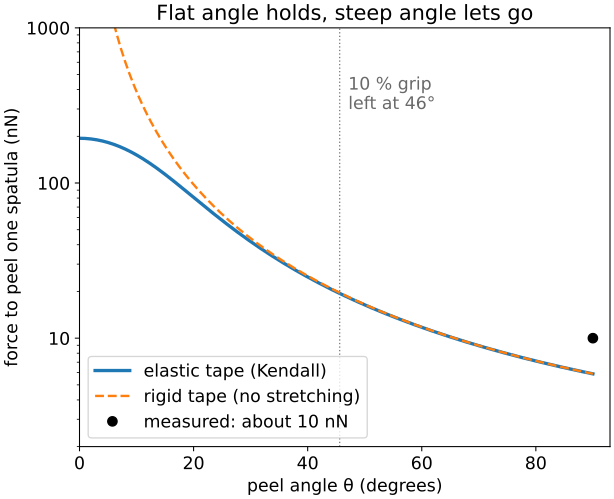
grip falls to 10 % of its maximum at 46°
measured for one spatula: about 10 nN (Huber et al. 2005)
What the result teaches:
- The angle is a switch. Pulled almost along the wall, one spatula holds about 194 nN; pulled at right angles, only 5.9 nN. Between 10° and 90° the force drops by a factor of 26, and by 46° only a tenth of the grip is left. The tape model alone explains part of the gecko’s trick. Including friction from the part of the spatula still in contact and the lever action of the setal shaft, Tian and colleagues calculated that the adhesion and friction forces of geckos can change by three orders of magnitude 7.
- Stretching sets the upper limit. A rigid tape would need an infinite force at 0° – physically impossible. Because the real spatula stretches, the force at flat angles is capped at b√(2EhW). This value depends on the assumed thickness and is only an estimate. At steep angles the stretching hardly matters: there the force is almost exactly bW and depends only on the van der Waals adhesion and the width.
- The order of magnitude fits. At 90° the model gives about 6 nN; atomic force microscope measurements on single spatulae found about 10 nN 13. The model ignores the real shape of the spatula and the contribution of humidity 4, so agreement within a factor of two is as good as can be expected.
- The peel angle of a spatula is not the angle of the setal shaft: the setae let go at a shaft angle of about 30° 3, and the shaft acts as a lever that turns the spatulae to a steep peel angle 7.
A few programming ideas are worth noticing, too:
- Numerical stability. Subtracting two almost equal numbers throws away significant digits. The code avoids it twice: it computes 1 − cos θ as 2 sin2(θ/2), and it writes the solution of the quadratic equation in a form without a difference. Both rewrites are exact in mathematics but lose fewer digits in floating point – a habit that matters most with the 32-bit numbers of small robot controllers.
- Root finding.
brentqfinds the angle at which the force falls to 10 % – the kind of question a controller of a climbing robot asks: how far must a foot tilt before it lets go? - Validation. At 90° the elastic and the rigid tape must agree, and the result must be of the same order as the measurement. Both checks pass.
Try it yourself – each change takes one line:
- Set
THICKNESS = 40e-9: a four times thicker pad doubles the maximum grip to 388.5 nN, while the force at 90° stays at 5.9 nN – the switch gets stronger (ratio 41), and the grip falls to 10 % already at 32°. - Set
WIDTH = 500e-9, the upper end of the measured spatula width 1: every force grows by a factor of 2.5 (14.7 nN at 90°), but the switch ratio stays at 26 – the switch is a matter of the angle, not of size. - Set
D_CONTACT = 0.4e-9: with a gap only 0.1 nm larger, the work of adhesion drops from 29 to 17 mJ/m², and the force at 90° to 3.3 nN – the steep distance law of the physics lens at work.
Tested output with THICKNESS = 40e-9
work of adhesion W = 29 mJ/m²
angle   peel force   rigid tape
   0°    388.5 nN      infinite
  10°    240.0 nN     388.0 nN
  30°     43.4 nN      44.0 nN
  60°     11.8 nN      11.8 nN
  90°      5.9 nN       5.9 nN
switch ratio F(10°) / F(90°) = 41
grip falls to 10 % of its maximum at 32°
measured for one spatula: about 10 nN (Huber et al. 2005)
Tested output with WIDTH = 500e-9
work of adhesion W = 29 mJ/m²
angle   peel force   rigid tape
   0°    485.6 nN      infinite
  10°    379.0 nN     970.0 nN
  30°    104.9 nN     110.0 nN
  60°     29.4 nN      29.5 nN
  90°     14.7 nN      14.7 nN
switch ratio F(10°) / F(90°) = 26
grip falls to 10 % of its maximum at 46°
measured for one spatula: about 10 nN (Huber et al. 2005)
Tested output with D_CONTACT = 0.4e-9
work of adhesion W = 17 mJ/m²
angle   peel force   rigid tape
   0°    145.7 nN      infinite
  10°    105.0 nN     218.3 nN
  30°     24.1 nN      24.7 nN
  60°      6.6 nN       6.6 nN
  90°      3.3 nN       3.3 nN
switch ratio F(10°) / F(90°) = 32
grip falls to 10 % of its maximum at 39°
measured for one spatula: about 10 nN (Huber et al. 2005)
Physical AI lens: robots that stick – and let go
For a robot that acts in the physical world, holding on is as important as moving. Suction cups need air and a smooth seal, magnets need iron, and claws need a rough surface. Gecko-inspired dry adhesives work on smooth surfaces like glass, leave no residue – and, like the gecko’s toes, can be switched on and off by the way they are loaded.
Stickybot, built by Sangbae Kim, Mark Cutkosky and colleagues at Stanford University, climbs smooth vertical surfaces with directional adhesion 10: its synthetic toe hairs stick when they are pulled in one direction along the wall and release easily in the other – the same asymmetry that geckos exploit with frictional adhesion 8.
The same principle has reached space technology. Hao Jiang and colleagues from Stanford and NASA’s Jet Propulsion Laboratory built a gripper that gently grasps, moves and releases flat and curved objects as large as a metre across in microgravity 11. Three ideas make it work:
- Gecko-inspired adhesives that are switched on and off by applying shear forces, just like a gecko’s toes.
- A load-sharing system that spreads the force evenly over many small adhesive patches – the robotic version of the gecko’s many setae.
- A passive wrist that is stiff while the object is moved but gives way when it is overloaded.
Vacuum grippers do not work without an atmosphere, and hand-like grippers are unsuited to large, smooth pieces of space debris. According to the authors, dry adhesion is a viable option for removing such debris from low Earth orbit 11.
For Physical AI, the gecko teaches a lesson beyond adhesion. A large part of the “control” happens in the mechanics: the angle of the setae decides when they stick and when they let go, without any sensor or computation. Designing the body so that it does part of the work makes the control of a robot simpler and faster.
From geckos to technology
Gecko adhesion is a model for a whole family of engineered surfaces: dry adhesives that work without residue, in a vacuum and many times over. The central design rules come straight from the animal – split the contact into many small, flexible tips 5, make the adhesion depend on the direction of loading 8, and let the structure clean itself 6.
Open questions remain. How much water films contribute under everyday conditions is still debated 2 4. And how geckos coordinate the attachment and release of millions of setae at once – from molecules to the whole animal – is still being worked out 3. Evolution has had many attempts at the problem: toe pads arose again and again in geckos 9.
Frequently asked questions
How do geckos stick to walls?
The underside of a gecko's toes is covered with plates called lamellae that carry millions of microscopic hairs, the setae. Each seta branches into hundreds of flat tips, the spatulae, only a fraction of a micrometre wide. They adapt to the surface so closely that van der Waals forces between their molecules and those of the wall add up to a strong grip – without glue, suction or claws.
What are van der Waals forces?
Van der Waals forces are weak attractive forces between all molecules, caused by fluctuating electric dipoles in their electron clouds. They act only over very short distances: between flat surfaces, the attraction falls with the cube of the distance, so it is strong only when surfaces are less than about a nanometre apart. A gecko overcomes this limit with billions of tiny, flexible contact tips.
How strong is a gecko's grip?
Autumn and colleagues measured up to 200 micronewtons for a single seta of a tokay gecko. If all of its roughly 6.5 million setae were attached at the same time, they could in theory hold about 130 kilograms. In practice only a small part of the setae is in contact at any moment, and a tokay gecko can still support its body with a single toe.
How can a gecko let go so quickly if its feet are so sticky?
The grip depends on geometry. When the gecko pulls its toe slightly along the wall, the setae are loaded at a small angle and hold firmly. When the setal shaft is tilted to about 30 degrees, the seta detaches. Geckos roll their toes up and back to peel the spatulae off one row at a time, and can release a foot in about 15 milliseconds.
Do gecko feet get dirty?
They do, but they clean themselves. In experiments by Hansen and Autumn, geckos with dirty feet recovered their ability to cling to vertical surfaces after only a few steps. A dirt particle sticks more strongly to the wall than to the few tiny spatulae touching it, so it is left behind.
Are there robots that climb like geckos?
Yes. Stickybot, developed at Stanford University, climbs smooth vertical surfaces such as glass with a directional dry adhesive inspired by geckos. Researchers at Stanford and NASA's Jet Propulsion Laboratory built a gripper with gecko-inspired adhesives that grasped and released objects up to a metre across in microgravity – a candidate for removing space debris.
Sources
- Autumn, K., Liang, Y. A., Hsieh, S. T., Zesch, W., Chan, W. P., Kenny, T. W., Fearing, R., Full, R. J. (2000). Adhesive force of a single gecko foot-hair. Nature 405, 681–685. doi:10.1038/35015073
- Autumn, K., Sitti, M., Liang, Y. A., Peattie, A. M., Hansen, W. R., Sponberg, S., Kenny, T. W., Fearing, R., Israelachvili, J. N., Full, R. J. (2002). Evidence for van der Waals adhesion in gecko setae. Proceedings of the National Academy of Sciences 99, 12252–12256. doi:10.1073/pnas.192252799 · Open Access
- Autumn, K., Peattie, A. M. (2002). Mechanisms of adhesion in geckos. Integrative and Comparative Biology 42, 1081–1090. doi:10.1093/icb/42.6.1081
- Huber, G., Mantz, H., Spolenak, R., Mecke, K., Jacobs, K., Gorb, S. N., Arzt, E. (2005). Evidence for capillarity contributions to gecko adhesion from single spatula nanomechanical measurements. Proceedings of the National Academy of Sciences 102, 16293–16296. doi:10.1073/pnas.0506328102 · Open Access
- Arzt, E., Gorb, S., Spolenak, R. (2003). From micro to nano contacts in biological attachment devices. Proceedings of the National Academy of Sciences 100, 10603–10606. doi:10.1073/pnas.1534701100 · Open Access
- Hansen, W. R., Autumn, K. (2005). Evidence for self-cleaning in gecko setae. Proceedings of the National Academy of Sciences 102, 385–389. doi:10.1073/pnas.0408304102 · Open Access
- Tian, Y., Pesika, N., Zeng, H., Rosenberg, K., Zhao, B., McGuiggan, P., Autumn, K., Israelachvili, J. (2006). Adhesion and friction in gecko toe attachment and detachment. Proceedings of the National Academy of Sciences 103, 19320–19325. doi:10.1073/pnas.0608841103 · Open Access
- Autumn, K., Dittmore, A., Santos, D., Spenko, M., Cutkosky, M. (2006). Frictional adhesion: a new angle on gecko attachment. Journal of Experimental Biology 209, 3569–3579. doi:10.1242/jeb.02486
- Gamble, T., Greenbaum, E., Jackman, T. R., Russell, A. P., Bauer, A. M. (2012). Repeated origin and loss of adhesive toepads in geckos. PLoS ONE 7, e39429. doi:10.1371/journal.pone.0039429 · Open Access
- Kim, S., Spenko, M., Trujillo, S., Heyneman, B., Santos, D., Cutkosky, M. R. (2008). Smooth vertical surface climbing with directional adhesion. IEEE Transactions on Robotics 24, 65–74. doi:10.1109/TRO.2007.909786 · Open Access
- Jiang, H., Hawkes, E. W., Fuller, C., Estrada, M. A., Suresh, S. A., Abcouwer, N., Han, A. K., Wang, S., Ploch, C. J., Parness, A., Cutkosky, M. R. (2017). A robotic device using gecko-inspired adhesives can grasp and manipulate large objects in microgravity. Science Robotics 2, eaan4545. doi:10.1126/scirobotics.aan4545
- Kendall, K. (1975). Thin-film peeling-the elastic term. Journal of Physics D: Applied Physics 8, 1449–1452. doi:10.1088/0022-3727/8/13/005
- Huber, G., Gorb, S. N., Spolenak, R., Arzt, E. (2005). Resolving the nanoscale adhesion of individual gecko spatulae by atomic force microscopy. Biology Letters 1, 2–4. doi:10.1098/rsbl.2004.0254
- Russell, A. P. (2002). Integrative functional morphology of the gekkotan adhesive system (Reptilia: Gekkota). Integrative and Comparative Biology 42, 1154–1163. doi:10.1093/icb/42.6.1154
- Peattie, A. M., Majidi, C., Corder, A., Full, R. J. (2007). Ancestrally high elastic modulus of gecko setal β-keratin. Journal of the Royal Society Interface 4, 1071–1076. doi:10.1098/rsif.2007.0226
Text and figures: CC BY-SA 4.0. Found a mistake? Open an issue or edit this article on GitHub.