An alien sky
Imagine standing on Earth three billion years ago. There are oceans and volcanoes – but you could not breathe. The air contained less than a millionth of today’s oxygen. Instead it held about 10 to 2,500 times more carbon dioxide and 100 to 10,000 times more methane than today 1. With no macroscopic, many-celled life and such a different atmosphere, the Archean world was alien 1.
The story of Earth’s air starts even earlier, with a catastrophe. When a planet-sized body hit the young Earth and the Moon formed, it made Earth uninhabitable for a short time – and set the starting conditions for its later atmosphere and oceans 2. Afterwards, gases released from the planet’s interior and from impacts built up a new atmosphere 2.
Two puzzles make this early air a fascinating physics problem. First, the young Sun was 25–30 % fainter than today 1 – so why didn’t the oceans freeze? Second, today’s air is 21 % oxygen – so where did all that oxygen come from? The answer to the second question is biological: single-celled organisms, the cyanobacteria, released it by photosynthesis 1 3.
Earth’s air in four steps
- A new atmosphere. After the Moon-forming impact, gases from the interior and from impacts formed the air and the oceans; the oceans were probably salty from the start 2.
- A greenhouse under a faint Sun. In the Archean eon, carbon dioxide and methane kept the planet warm enough for liquid water despite the fainter Sun; average surface temperatures lay between about 0 and 40 °C 1.
- Oxygen floods the air. Between 2.4 and 2.3 billion years ago, oxygen from the photosynthesis of cyanobacteria and their ancestors accumulated in the atmosphere – the Great Oxidation Event 1.
- Towards today. Oxygen built up in the ocean only later and reached near-modern levels in sea and air about two billion years after it first rose 4.
Biology lens: the invention that changed the planet
Life is old. It dates back to before 3.5 to 3.8 billion years ago, or even earlier 1. But for a long time, life did not produce free oxygen. That changed with oxygenic photosynthesis: it uses sunlight to split water, gains energy and reducing power from it, and releases oxygen as a waste product. Woodward Fischer and colleagues call it the most important metabolic innovation in Earth’s history. It freed life from the limited supply of chemical energy sources, greatly increased global productivity – and its waste gas changed the atmosphere and oceans for good 3.
The organisms that invented it were cyanobacteria, single-celled bacteria that still live in oceans and lakes today. When exactly they appeared is debated. Carbon isotopes and structures resembling filaments of cyanobacteria in stromatolites – layered rocks built by microbial mats – are consistent with cyanobacteria by 3.2 to 2.7 billion years ago 1. Fischer and colleagues, by contrast, read the geological and biological records as showing that oxygenic photosynthesis first appeared only in the early Paleoproterozoic, shortly before oxygen rose – a relatively late invention in Earth’s history 3.
Oxygen also opened new paths for life. Once it was available, aerobic respiration – burning food with oxygen – and new biochemical pathways could evolve, and with them much of the richness of modern biology, including complex many-celled life 3. Even before the atmosphere filled with oxygen, lakes and shallow seas inhabited by photosynthesising microbes may have been local “oxygen oases” 1.
Physics lens: a faint Sun, a greenhouse and an open lid
A Sun that grows brighter. As a star like the Sun burns hydrogen in its core, the core contracts and heats up, and the Sun becomes brighter. According to Douglas Gough, this slow brightening is an inevitable consequence of Newtonian physics and of how nuclear reactions depend on density, temperature and composition 5. Models of stellar evolution give a solar input about 25 % lower than today for the early Earth 5.
The faint young Sun paradox. Earth’s temperature is set by a balance: the sunlight it absorbs must equal the heat it radiates. With a quarter less sunlight and all other conditions as today, the early Earth would have been completely frozen for its first two billion years 5. Carl Sagan and George Mullen pointed this out in 1972: with today’s albedo and atmospheric composition, global mean temperatures would have been below the freezing point of seawater until less than 2.3 billion years ago – contrary to geological evidence 6. Rocks from the Archean show liquid water and life 5.
The greenhouse solution. Most explanations invoke more greenhouse gases – carbon dioxide, methane or ammonia – which let sunlight in but absorb part of the heat radiated by the ground and send it back down 5. Sagan and Mullen proposed a few parts per million of ammonia 6. Today’s estimates favour carbon dioxide and methane, whose concentrations were sufficient to offset the fainter Sun 1. Still, every proposed solution has its difficulties, and the problem cannot be regarded as completely solved 5.
Ultraviolet light without a shield. Today the ozone layer in the stratosphere absorbs most of the Sun’s short-wavelength ultraviolet light. Ozone forms from oxygen, so the Archean, with almost no oxygen, had no ozone layer. Short-wavelength UV reached the lower atmosphere and broke up volcanic sulfur dioxide molecules 1. This photochemistry left an unusual fingerprint – a mass-independent fractionation of sulfur isotopes – in rocks older than about 2.45 billion years. It disappears between 2.45 and 2.09 billion years ago, when oxygen rose 7. Physics of light thus dates a biological revolution.
An open lid. Light gases can escape from the top of the atmosphere into space. Catling and Zahnle conclude from xenon isotopes that hydrogen escaped rapidly through the Archean – and that this substantial loss of hydrogen helped to oxidise the Earth 1.
Mathematics lens: the temperature of a planet and the speed of a molecule
Radiation balance. A planet absorbs sunlight on its cross-section πR2 and radiates heat from its whole surface 4πR2. By the Stefan–Boltzmann law, a body at temperature T radiates σT4 per square metre. Setting absorbed equal to emitted energy gives
with the solar constant S ≈ 1361 W/m², the albedo A ≈ 0.3 (the fraction of sunlight reflected) and σ = 5.67 · 10−8 W/(m² K⁴). The result is 255 K, about −18 °C – the temperature of an Earth without greenhouse effect. The actual average is about 288 K; the difference of 33 K is the warming by greenhouse gases today.
A fainter Sun. Because T grows only with the fourth root of the sunlight, 25 % less sunlight lowers the temperature by a factor of 0.751/4 ≈ 0.93 – from 255 K to about 237 K. Small as it seems, this drop of 18 K is enough to push a planet like ours below freezing, unless its greenhouse is stronger.
The brightening Sun. Gough’s formula describes the luminosity L at time t after the Sun’s birth, with today’s age t☉ = 4.57 billion years 5:
At the Sun’s birth (t = 0) this gives 1/1.4 ≈ 71 % of today’s value; four billion years ago, about 74 %. Except for the first roughly 0.2 billion years, the formula agrees very well with detailed models 5.
Why hydrogen escapes. In a gas at temperature T, a molecule of mass m moves on average with the speed
where k = 1.38 · 10−23 J/K is the Boltzmann constant. For an assumed temperature of 1,000 K in the upper atmosphere, a hydrogen atom moves at about 5.0 km/s, an oxygen molecule – 32 times heavier – at only about 0.88 km/s. Earth’s escape velocity is 11.2 km/s. Neither speed reaches it on average, but the fastest hydrogen atoms in the gas do, again and again – so over geological time hydrogen leaks away, while oxygen and nitrogen stay.
Computer science lens: a climate model in thirty lines
How cold would the early Earth have been with today’s atmosphere? The program below combines Gough’s formula for the brightening Sun with the radiation balance of the mathematics lens and a simple model of the greenhouse effect: a single “grey” layer of air that absorbs a fixed fraction of the heat radiated by the ground and sends half of it back down. The model is calibrated to today’s 288 K and then kept unchanged as the Sun grows brighter. Albedo, today’s temperature and the one-layer greenhouse are simplifying assumptions, not a real climate model.
import numpy as np
import matplotlib.pyplot as plt

SOLAR_CONSTANT = 1361.0   # sunlight reaching Earth today (W/m²)
ALBEDO = 0.30             # fraction of sunlight reflected, assumed constant
SIGMA = 5.670e-8          # Stefan–Boltzmann constant (W/m²/K⁴)
SUN_AGE = 4.57            # age of the Sun (billion years)
T_TODAY = 288.0           # mean surface temperature of Earth today (K)
FREEZING = 273.15         # freezing point of water (K)


def luminosity(ago):
    """Brightness of the Sun relative to today, 'ago' billion years ago (Gough's formula)."""
    t = SUN_AGE - ago
    return 1 / (1 + 0.4 * (1 - t / SUN_AGE))


def bare_temperature(ago):
    """Temperature (K) of an Earth without greenhouse effect: absorbed sunlight = emitted heat."""
    absorbed = SOLAR_CONSTANT * luminosity(ago) * (1 - ALBEDO) / 4
    return (absorbed / SIGMA) ** 0.25


def surface_temperature(ago, emissivity):
    """One-layer 'grey' atmosphere: it absorbs the fraction 'emissivity' of the heat radiation
    from the ground and sends half of it back down, so T_surface = T_bare · (2 / (2 − ε))^(1/4)."""
    return bare_temperature(ago) * (2 / (2 - emissivity)) ** 0.25


# Calibrate the atmosphere so that it gives today's 288 K, then keep it unchanged.
emissivity_today = 2 - 2 * (bare_temperature(0) / T_TODAY) ** 4
print(f"today: {bare_temperature(0):.0f} K without greenhouse effect, "
      f"{T_TODAY:.0f} K with it (emissivity {emissivity_today:.2f})")
print("billion years ago   Sun   with today's atmosphere")
for ago in [4.0, 3.0, 2.4, 2.0, 1.0, 0.0]:
    surface = surface_temperature(ago, emissivity_today)
    print(f"{ago:17.1f}   {luminosity(ago) * 100:3.0f} %   {surface - 273.15:6.1f} °C")

ages = np.linspace(4.0, 0, 401)
surface = surface_temperature(ages, emissivity_today)
if (surface < FREEZING).any():
    print(f"with today's atmosphere the oceans would freeze before "
          f"{ages[surface < FREEZING].min():.1f} billion years ago")
else:
    print("with today's atmosphere the oceans would never freeze")
needed = 2 - 2 * (bare_temperature(4.0) / FREEZING) ** 4
more_or_fewer = "more" if needed > emissivity_today else "fewer"
print(f"4.0 billion years ago, liquid water needed an emissivity of {needed:.2f} instead of "
      f"{emissivity_today:.2f} – {more_or_fewer} greenhouse gases than today")

plt.rcParams["font.size"] = 13      # large type: the chart stays readable on a phone
fig, ax = plt.subplots(figsize=(6.4, 5.2), layout="constrained")
ax.axhspan(-60, 0, color="#dbe9f4")
ax.plot(ages, surface - 273.15, lw=2.5, label="today's atmosphere")
ax.plot(ages, bare_temperature(ages) - 273.15, "--", lw=1.8, label="no greenhouse effect")
ax.axvspan(2.4, 2.3, color="0.85")
ax.text(2.33, 22, "oxygen\nrises", color="dimgray", fontsize=11, ha="right")
ax.text(3.95, -16, "frozen oceans", color="steelblue", fontsize=11)
ax.set_xlim(4.0, 0)
ax.set_ylim(-60, 30)
ax.set_xlabel("billion years ago")
ax.set_ylabel("mean surface temperature (°C)")
ax.set_title("A fainter Sun would have frozen the early Earth")
ax.legend(loc="lower right")
plt.show()
Output · what the code prints, re-run at every build
today: 255 K without greenhouse effect, 288 K with it (emissivity 0.78)
billion years ago   Sun   with today's atmosphere
              4.0    74 %     -6.0 °C
              3.0    79 %     -1.5 °C
              2.4    83 %      1.4 °C
              2.0    85 %      3.5 °C
              1.0    92 %      8.9 °C
              0.0   100 %     14.9 °C
with today's atmosphere the oceans would freeze before 2.7 billion years ago
4.0 billion years ago, liquid water needed an emissivity of 0.88 instead of 0.78 – more greenhouse gases than today
What the result teaches:
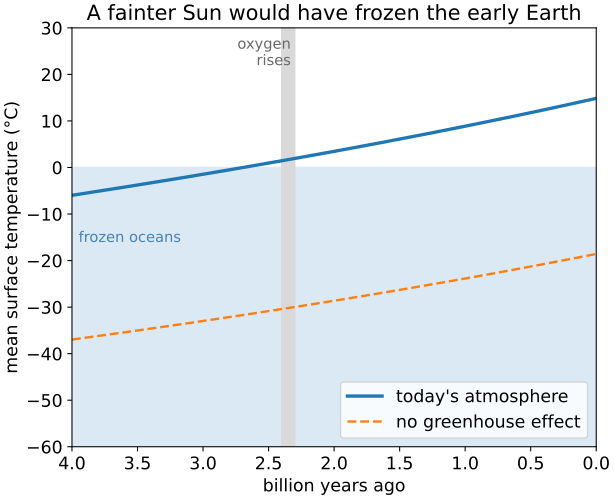
- With today’s air, the early Earth freezes. Four billion years ago the Sun reached 74 % of today’s brightness, and the model surface would have been −6.0 °C; it stays below freezing until 2.7 billion years ago. This contradicts the geological evidence of liquid water 5 – the faint young Sun paradox in numbers.
- More greenhouse was needed. To keep water liquid four billion years ago, the model atmosphere must absorb 88 % of the ground’s heat radiation instead of 78 % today – that is, it needed more greenhouse gases, in line with the high carbon dioxide and methane levels inferred for the Archean 1.
- The model is too simple to give dates. Sagan and Mullen found temperatures below freezing until less than 2.3 billion years ago 6; this model says 2.7. It ignores feedbacks: ice reflects more sunlight, which would cool the planet further, and water vapour adds to the greenhouse as it warms. The direction of the result is robust, the exact dates are not.
Two programming ideas are worth noticing:
- Calibrate, then predict. The program does not guess the greenhouse strength; it fits one parameter, the emissivity, so that the model reproduces today’s 288 K – and then asks what the same atmosphere would do under a fainter Sun.
- Search with a mask.
ages[surface < FREEZING]keeps only the times at which the surface is frozen; its smallest value is the last frozen moment. Checking first whether any value is frozen avoids an error when there is none.
Try it yourself – each change takes one line:
- Set
ALBEDO = 0.35, Sagan and Mullen’s value: the planet without greenhouse is colder (250 K), but after calibration the surface temperatures are exactly the same (−6.0 °C four billion years ago). Only the greenhouse needed changes, to an emissivity of 0.96 instead of 0.87 today. - Halve the brightening by changing
0.4to0.2inluminosity: the young Sun now reaches 85 % of today’s brightness, the oceans never freeze, and four billion years ago the model atmosphere even needs fewer greenhouse gases than today (emissivity 0.72).
Tested output with ALBEDO = 0.35
today: 250 K without greenhouse effect, 288 K with it (emissivity 0.87)
billion years ago   Sun   with today's atmosphere
              4.0    74 %     -6.0 °C
              3.0    79 %     -1.5 °C
              2.4    83 %      1.4 °C
              2.0    85 %      3.5 °C
              1.0    92 %      8.9 °C
              0.0   100 %     14.9 °C
with today's atmosphere the oceans would freeze before 2.7 billion years ago
4.0 billion years ago, liquid water needed an emissivity of 0.96 instead of 0.87 – more greenhouse gases than today
Tested output with brightening halved (0.4 → 0.2)
today: 255 K without greenhouse effect, 288 K with it (emissivity 0.78)
billion years ago   Sun   with today's atmosphere
              4.0    85 %      3.5 °C
              3.0    88 %      6.1 °C
              2.4    90 %      7.7 °C
              2.0    92 %      8.9 °C
              1.0    96 %     11.8 °C
              0.0   100 %     14.9 °C
with today's atmosphere the oceans would never freeze
4.0 billion years ago, liquid water needed an emissivity of 0.72 instead of 0.78 – fewer greenhouse gases than today
From single cells to our sky
Every breath we take connects us to microbes that lived more than two billion years ago. By splitting water with sunlight, cyanobacteria turned a planet with a methane-rich, oxygen-free atmosphere into one with an ozone layer and air that complex life can breathe 3 1. Physics – the brightening Sun, the greenhouse effect, ultraviolet photochemistry and the escape of light gases – sets the stage on which this biological revolution played out.
Many questions remain open. What exactly kept the early oceans from freezing is still debated 5. When oxygenic photosynthesis first appeared, and why oxygen took hundreds of millions of years to accumulate after it, are active topics of research 3 4. And the same questions now guide the search for life elsewhere: the atmosphere of the Archean is important for understanding Earth-like planets around other stars 1.
Frequently asked questions
What was Earth's early atmosphere made of?
In the Archean eon, between about 4 and 2.5 billion years ago, the air consisted mainly of nitrogen with much more carbon dioxide and methane than today, and practically no oxygen – less than a millionth of today's level. Without oxygen there was no ozone layer either, so the Sun's ultraviolet light reached deep into the atmosphere.
What is the faint young Sun paradox?
Stars like the Sun slowly become brighter as they age. Four billion years ago the Sun was about a quarter fainter than today. With today's atmosphere, Earth would then have been frozen. But rocks show liquid water and life at that time. The usual explanation is that the early atmosphere contained more greenhouse gases such as carbon dioxide and methane, but researchers still debate the details.
What was the Great Oxidation Event?
The Great Oxidation Event was the time, between about 2.4 and 2.3 billion years ago, when free oxygen first accumulated in Earth's atmosphere. The oxygen came from oxygenic photosynthesis, which splits water using sunlight and releases oxygen as a waste product. It changed the chemistry of the air and oceans for good and later made complex life possible.
How do we know when oxygen appeared?
One of the clearest clues comes from sulfur. In an atmosphere without ozone, ultraviolet light breaks up volcanic sulfur gases in a way that leaves an unusual pattern in the ratios of sulfur isotopes. Rocks older than about 2.45 billion years carry this pattern; younger rocks no longer do, because oxygen and an ozone layer stopped the process.
Why does Earth keep oxygen but lose hydrogen to space?
At the same temperature, light molecules move faster than heavy ones. In the hot upper atmosphere, some hydrogen atoms reach the speed needed to escape Earth's gravity, about 11.2 kilometres per second, while heavier molecules such as oxygen and nitrogen almost never do. Over billions of years, hydrogen escaping to space helped to oxidise the Earth.
Sources
- Catling, D. C., Zahnle, K. J. (2020). The Archean atmosphere. Science Advances 6, eaax1420. doi:10.1126/sciadv.aax1420 · Open Access
- Zahnle, K., Schaefer, L., Fegley, B. (2010). Earth's earliest atmospheres. Cold Spring Harbor Perspectives in Biology 2, a004895. doi:10.1101/cshperspect.a004895 · Open Access
- Fischer, W. W., Hemp, J., Johnson, J. E. (2016). Evolution of oxygenic photosynthesis. Annual Review of Earth and Planetary Sciences 44, 647–683. doi:10.1146/annurev-earth-060313-054810
- Lyons, T. W., Reinhard, C. T., Planavsky, N. J. (2014). The rise of oxygen in Earth's early ocean and atmosphere. Nature 506, 307–315. doi:10.1038/nature13068
- Feulner, G. (2012). The faint young Sun problem. Reviews of Geophysics 50, RG2006. doi:10.1029/2011RG000375 · Open Access
- Sagan, C., Mullen, G. (1972). Earth and Mars: evolution of atmospheres and surface temperatures. Science 177, 52–56. doi:10.1126/science.177.4043.52
- Farquhar, J., Bao, H., Thiemens, M. (2000). Atmospheric influence of Earth's earliest sulfur cycle. Science 289, 756–758. doi:10.1126/science.289.5480.756
Text and figures: CC BY-SA 4.0. Found a mistake? Open an issue or edit this article on GitHub.