Turning over in mid-air
Hold a cat upside down, let it go, and within a fraction of a second it has turned over and lands on its feet. This air-righting reflex looks effortless, but it puzzled scientists for a long time. Researchers have studied the falling cat since 1894 1 – because at first sight it seems to break a law of physics.
The problem is angular momentum. A falling cat has nothing to push against: no floor, no wall, only air. Without a push, its total angular momentum cannot change. If the cat is released without any spin, its angular momentum is zero – and a rigid body with zero angular momentum cannot start to rotate. Yet the cat rotates by 180°.
The solution is that a cat is not rigid. Mammals right themselves by twisting and bending their spine, which changes how their mass is distributed – their moment of inertia 1. In 1969, Thomas Kane and M. P. Scher modelled the cat as two cylinders, the front and the rear half of the body, joined at the waist, and showed that such a body can turn over with zero angular momentum 2. Human divers and trampolinists use the same principle to twist in the air 3.
The turn in four steps
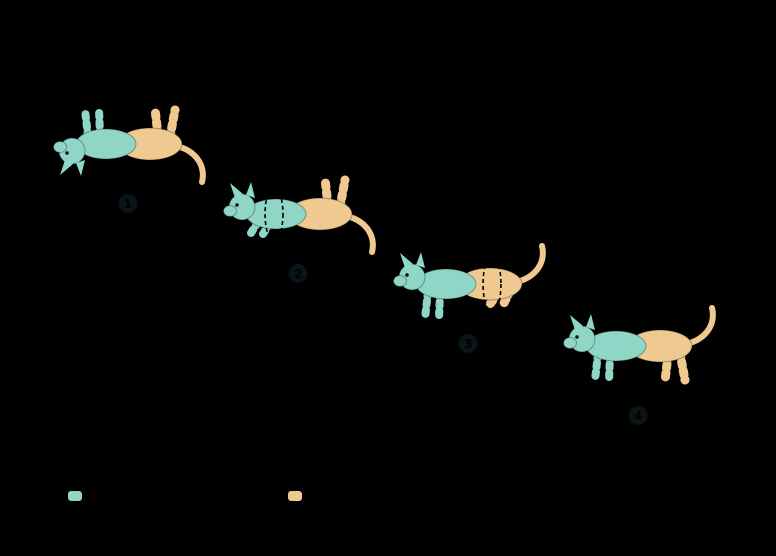
A simplified version of the cat’s manoeuvre, the “tuck and turn” (Fig. 1):
- Upside down. The cat falls with its back towards the ground. Its balance organ in the inner ear tells it which way is down 4.
- Front half turns. The cat pulls in its front legs and twists its front half round. With the legs close to the body, the front half turns easily; the rear half, with stretched hind legs, turns back only a little.
- Rear half follows. Now the cat stretches its front legs and pulls in its hind legs. The rear half turns round, and the front half turns back only a little.
- Feet down. Both halves face the ground, and the cat stretches its legs to land.
At every moment the rotations of the two halves cancel each other – the total angular momentum stays zero. Real cats also bend their body at the waist while they twist 1; Kane and Scher’s model of two cylinders includes this bend 2.
Biology lens: a reflex that grows up – and its limits
Kittens are not born with a working air-righting reflex. It develops in the first weeks of life and is mature by about 33 days. Cremieux and colleagues compared normal kittens with kittens that had been blind since birth: both developed the reflex at the same pace. The air-righting reflex is therefore mainly controlled by the vestibular system, the balance organ in the inner ear 4.
The tail plays a surprisingly small role. No difference in air-righting has been reported between cats with and without a tail – the turn comes from the spine 1. In geckos it is the other way round: a gecko that falls on its back swings its large tail and turns over in about 106 ms, at the time (2008) the shortest air-righting time reported for animals without wings 1.
The reflex does not make cats safe from falls. Veterinarians call the injuries of cats that fall from buildings high-rise syndrome. Of 132 cats seen over five months, 90 % had injuries to the chest; about 30 % needed no treatment, and 90 % of the treated cats survived 5. A study of 119 cats from Zagreb found an average fall height of four storeys; 96.5 % of the cats survived, but 46.2 % had broken limbs, and falls from the seventh floor or higher caused more severe injuries 6. Landing on its feet spreads the impact over the legs, but it does not cancel it.
Physics lens: angular momentum and a body that changes shape
Angular momentum measures how much a body rotates. For a body turning about a fixed axis, it is the product of its moment of inertia I and its angular velocity ω:
The moment of inertia describes how the mass is distributed around the axis: mass far from the axis counts much more than mass close to it. A cat that stretches its legs has a larger moment of inertia than a cat with its legs tucked in.
Angular momentum changes only if a torque acts on the body. Gravity pulls on every part of the cat, but in free fall it acts as if on the centre of mass and therefore exerts no torque about it. Air resistance is small during the short time the cat needs to turn. So the cat’s angular momentum stays constant – zero, if it is dropped without spin.
How can a body with zero angular momentum turn? For a rigid body it cannot: L = 0 means ω = 0. A cat, however, consists of parts that can rotate against each other. If the front half turns one way, the rear half must turn the other way so that the angular momenta cancel:
The half with the smaller moment of inertia turns more. By tucking in first the front legs and then the hind legs, the cat makes sure that each half turns a lot when it moves forward and only a little when it moves back. After both steps, the whole cat has turned – while L was zero at every moment. Divers and trampolinists use the same effect: they can start twists and somersaults during a jump although their angular momentum does not change 3.
Mathematics lens: how far one cycle turns the cat
Take the two halves of the “tuck and turn” model. A half with tucked legs has the moment of inertia It, with stretched legs the larger Ie. The cat twists its halves against each other by an angle φ. With zero total angular momentum, the angle φ is shared in inverse proportion to the moments of inertia:
Step 1 (front legs tucked, twist by +φ): the front half turns by φ · Ie / (It + Ie). Step 2 (hind legs tucked, twist back by −φ): the front half turns back by only φ · It / (It + Ie). What remains after one cycle – for the front and the rear half alike – is
Two results follow directly. If the cat does not change its shape (Ie = It), it does not turn at all. And the more the moment of inertia changes, the more each cycle achieves: with Ie = 3 It and φ = 180°, one cycle turns the cat by 180° · 2/4 = 90°.
How far does the cat fall meanwhile? In free fall, the height after the time t is
If a turn took 0.3 s – an assumed value for illustration – the cat would drop ½ · 9.81 m/s² · (0.3 s)2 ≈ 44 cm before its feet point down. Because h grows with the square of the time, a turn that takes twice as long needs four times the height.
Computer science lens: simulating a turn without spin
Can a body really turn by 180° while its angular momentum is zero at every step? The program below simulates the “tuck and turn” model from the mathematics lens in small time steps. It checks the total angular momentum at every step, counts how many cycles the cat needs to land on its feet and computes how far it falls meanwhile. The moments of inertia and the duration of a twist are assumed values chosen for illustration, not measurements.
import numpy as np
import matplotlib.pyplot as plt

# Two halves of the cat turn about the same axis (the spine), in the "tuck and turn" model.
I_TUCKED = 1.0      # moment of inertia of a half with its legs pulled in (relative units)
I_EXTENDED = 3.0    # the same half with its legs stretched out – assumed 3 times larger
TWIST = 180.0       # how far the front half twists against the rear half in each step (degrees)
STEP_TIME = 0.1     # duration of one twist (s), assumed
G = 9.81            # gravitational acceleration (m/s²)


def twist(i_front, i_rear, d_relative):
    """Twist the halves against each other by d_relative with zero total angular momentum.
    I_f·Δθ_f + I_r·Δθ_r = 0 and Δθ_f − Δθ_r = d_relative give each half's rotation."""
    d_front = d_relative * i_rear / (i_front + i_rear)
    d_rear = -d_relative * i_front / (i_front + i_rear)
    return d_front, d_rear


# One cycle: (1) front legs tucked, twist the front half; (2) rear legs tucked, untwist.
steps = [(I_TUCKED, I_EXTENDED, +TWIST), (I_EXTENDED, I_TUCKED, -TWIST)]
front, rear, time = [0.0], [0.0], [0.0]
largest_momentum = 0.0
for cycle in range(2):
    for i_front, i_rear, d_relative in steps:
        for _ in range(50):                     # each twist in 50 small steps
            d_front, d_rear = twist(i_front, i_rear, d_relative / 50)
            rate_front, rate_rear = d_front / (STEP_TIME / 50), d_rear / (STEP_TIME / 50)
            largest_momentum = max(largest_momentum, abs(i_front * rate_front + i_rear * rate_rear))
            front.append(front[-1] + d_front)
            rear.append(rear[-1] + d_rear)
            time.append(time[-1] + STEP_TIME / 50)

per_cycle = front[100]
print(f"largest total angular momentum during the turn: {largest_momentum:.3f}")
if abs(per_cycle) < 1e-6:
    print("turn per cycle: 0° – without changing shape the cat cannot turn")
else:
    cycles = 180.0 / per_cycle
    fall_time = cycles * 2 * STEP_TIME
    print(f"turn per cycle: {per_cycle:.1f}° (front and rear half alike)")
    print(f"cycles needed to land on its feet (180°): {cycles:.1f}")
    print(f"time needed: {fall_time:.2f} s  →  it falls {0.5 * G * fall_time**2 * 100:.0f} cm meanwhile")

time = np.array(time)
plt.rcParams["font.size"] = 13      # large type: the chart stays readable on a phone
fig, ax = plt.subplots(figsize=(6.4, 5.2), layout="constrained")
for k in range(4):                      # shade the steps in which the front legs are tucked
    if k % 2 == 0:
        ax.axvspan(k * STEP_TIME, (k + 1) * STEP_TIME, color="0.92")
ax.plot(time, front, lw=2.5, label="front half")
ax.plot(time, rear, "--", lw=2.5, label="rear half")
ax.axhline(180, color="gray", lw=1, ls=":")
ax.text(0.005, 186, "feet down (180°)", color="dimgray", fontsize=11)
ax.text(0.205, -52, "grey: front legs\ntucked", color="dimgray", fontsize=11)
ax.set_xlabel("time (s)")
ax.set_ylabel("rotation about the spine (degrees)")
ax.set_title("Changing shape turns the cat – with zero spin")
ax.set_ylim(-60, 230)
ax.legend(loc="lower right")
plt.show()
Output · what the code prints, re-run at every build
largest total angular momentum during the turn: 0.000
turn per cycle: 90.0° (front and rear half alike)
cycles needed to land on its feet (180°): 2.0
time needed: 0.40 s  →  it falls 78 cm meanwhile
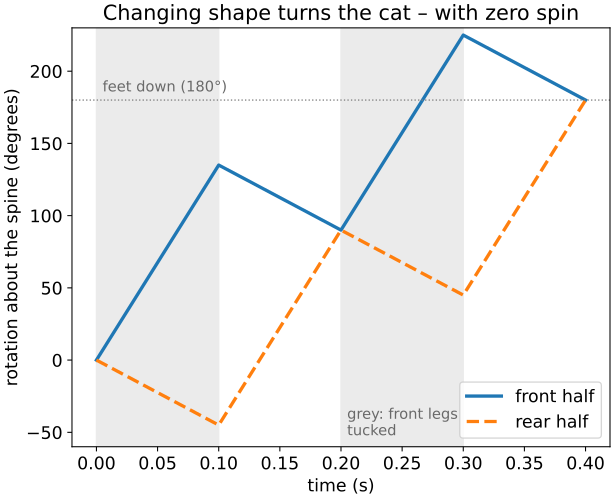
What the result teaches:
- Zero angular momentum, 180° turn. The largest total angular momentum during the whole manoeuvre is 0.000 – yet after two cycles both halves have turned by 180°. Each cycle turns the cat by 90.0°, exactly as the formula of the mathematics lens predicts.
- Forward far, back a little. In the chart, each half moves a long way while its own legs are tucked and a short way back while they are stretched. This asymmetry is the whole trick.
- The model is slower than a cat. With the assumed 0.1 s per twist, the model needs 0.40 s and falls about 78 cm. Real cats also bend their body while they twist 1, so they may need less time and height than this model – its numbers are an illustration, not a measurement.
Two programming ideas are worth noticing:
- A conservation law as a test. The program does not just assume that the angular momentum is zero – it computes Ifrontωfront + Irearωrear at every step and reports the largest value. Checking a physical law inside the simulation catches mistakes early.
- Guarding against division by zero. If the halves never change shape, the turn per cycle is zero and “cycles needed” would be infinite. The program detects this case and says so instead of printing nonsense.
Try it yourself – each change takes one line:
- Set
I_EXTENDED = 6.0: a larger change of shape turns the cat by 128.6° per cycle; it needs 1.4 cycles and 0.28 s, and falls only 38 cm. - Set
I_EXTENDED = 1.0: tucking the legs changes nothing – the program reports that without changing shape the cat cannot turn. - Set
TWIST = 90.0: a smaller twist turns the cat by only 45.0° per cycle; it needs 4.0 cycles, 0.80 s and falls 314 cm.
Tested output with I_EXTENDED = 6.0
largest total angular momentum during the turn: 0.000
turn per cycle: 128.6° (front and rear half alike)
cycles needed to land on its feet (180°): 1.4
time needed: 0.28 s  →  it falls 38 cm meanwhile
Tested output with I_EXTENDED = 1.0
largest total angular momentum during the turn: 0.000
turn per cycle: 0° – without changing shape the cat cannot turn
Tested output with TWIST = 90.0
largest total angular momentum during the turn: 0.000
turn per cycle: 45.0° (front and rear half alike)
cycles needed to land on its feet (180°): 4.0
time needed: 0.80 s  →  it falls 314 cm meanwhile
A real cat has far more joints than two halves. Ara Arabyan and Derliang Tsai built a model of a falling animal with many segments and joints and controlled it in two stages: first turn as fast as possible, then hold the body steady relative to gravity. Their control scheme works out the sequence of movements by itself and includes learning features 7.
Physical AI lens: robots that turn in mid-air
A robot that jumps, falls or floats in space faces the cat’s problem: it has nothing to push against, yet it must land the right way up. Two solutions from biology are being copied.
An active tail. Geckos turn over in the air by swinging their tail; this observation inspired an active tail for a climbing robot 1. Thomas Libby, Robert Full and colleagues showed that leaping lizards swing their tails to redirect angular momentum from the body to the tail. They built a lizard-sized robot with an active tail that used sensory feedback to keep its body level as it drove off a ramp 8.
Legs instead of a tail. Nikita Rudin, Marco Hutter and colleagues trained a neural network with deep reinforcement learning to control the jumping four-legged robot SpaceBok – using only its legs to turn the body in mid-air, as a cat does. The policies were trained in simulation for low-gravity celestial bodies and then transferred to the real robot on a test bed for two-dimensional microgravity experiments, where it jumped and landed again and again 9.
For Physical AI, the falling cat teaches that moving the body can itself be the control. No motor pushes against the ground, no thruster fires – shifting mass at the right moment is enough to change orientation. Learning systems like SpaceBok’s controller discover such movement sequences by trial and error in simulation. A comparison with kittens is only an analogy: their reflex matures within about 33 days 4, but how it develops is a different question from how a robot learns.
From cats to divers and robots
The falling cat shows that conservation laws limit what a body can do, but not how cleverly it can move within those limits. A body that changes its shape can reorient itself without any external help – a principle shared by cats, geckos 1, divers 3 and legged robots 9.
Open questions remain. How the nervous system coordinates the many joints of the spine and legs so quickly is still being modelled 7. And for cats themselves the best protection is simple: the reflex helps, but secured windows and balconies prevent the injuries of high-rise syndrome 5 6.
Frequently asked questions
How do cats always land on their feet?
A falling cat senses with its balance organ which way is up and turns its body in two steps. First it pulls in its front legs and twists the front half of its body round, while the rear half, with stretched hind legs, turns back only a little. Then it pulls in its hind legs and brings the rear half round. Because each half changes its moment of inertia at the right moment, the cat turns over although its total angular momentum stays zero.
Doesn't a falling cat violate the conservation of angular momentum?
No. A rigid body without angular momentum cannot start rotating. But a cat is not rigid: it can twist and bend its spine and move its legs. The rotations of its parts cancel at every moment, so the total angular momentum stays zero, yet the cat ends up in a different orientation. Divers and trampolinists use the same principle to twist in the air.
Do cats need their tail to land on their feet?
No. No difference has been reported between cats with and without a tail; the turn comes from twisting and bending the body. Geckos are different: they swing their large tail to turn over and do it in about a tenth of a second, the shortest air-righting time reported for animals without wings as of 2008.
At what age can kittens right themselves in the air?
Kittens develop the air-righting reflex in their first weeks of life; it is mature by about 33 days. Kittens that were blind from birth develop it at the same pace as kittens with normal vision, which shows that the reflex is controlled mainly by the balance organ in the inner ear.
Are cats safe when they fall from a window?
No. In a study of 132 cats after falls from high buildings, 90 percent had injuries to the chest, and many had facial injuries or broken limbs. In another study of 119 cats, most survived, but almost half had broken legs, and falls from the seventh floor or higher caused more severe injuries. Securing windows and balconies protects cats better than any reflex.
Sources
- Jusufi, A., Goldman, D. I., Revzen, S., Full, R. J. (2008). Active tails enhance arboreal acrobatics in geckos. Proceedings of the National Academy of Sciences 105, 4215–4219. doi:10.1073/pnas.0711944105 · Open Access
- Kane, T. R., Scher, M. P. (1969). A dynamical explanation of the falling cat phenomenon. International Journal of Solids and Structures 5, 663–670. doi:10.1016/0020-7683(69)90086-9
- Frohlich, C. (1979). Do springboard divers violate angular momentum conservation?. American Journal of Physics 47, 583–592. doi:10.1119/1.11759
- Cremieux, J., Veraart, C., Wanet, M. C. (1984). Development of the air righting reflex in cats visually deprived since birth. Experimental Brain Research 54, 564–566. doi:10.1007/BF00235481
- Whitney, W. O., Mehlhaff, C. J. (1987). High-rise syndrome in cats. Journal of the American Veterinary Medical Association 191, 1399–1403. doi:10.2460/javma.1987.191.11.1399
- Vnuk, D., Pirkić, B., Matičić, D., Radišić, B., Stejskal, M., Babić, T., Kreszinger, M., Lemo, N. (2004). Feline high-rise syndrome: 119 cases (1998–2001). Journal of Feline Medicine and Surgery 6, 305–312. doi:10.1016/j.jfms.2003.07.001 · Open Access
- Arabyan, A., Tsai, D. (1998). A distributed control model for the air-righting reflex of a cat. Biological Cybernetics 79, 393–401. doi:10.1007/s004220050488
- Libby, T., Moore, T. Y., Chang-Siu, E., Li, D., Cohen, D. J., Jusufi, A., Full, R. J. (2012). Tail-assisted pitch control in lizards, robots and dinosaurs. Nature 481, 181–184. doi:10.1038/nature10710
- Rudin, N., Kolvenbach, H., Tsounis, V., Hutter, M. (2022). Cat-like jumping and landing of legged robots in low gravity using deep reinforcement learning. IEEE Transactions on Robotics 38, 317–328. doi:10.1109/TRO.2021.3084374 · Open Access
Text and figures: CC BY-SA 4.0. Found a mistake? Open an issue or edit this article on GitHub.