A cat with sabres
Smilodon fatalis is a sabre-toothed cat – and few extinct predators are as well known as the sabre-toothed cats 1. Despite its popular name, the “sabre-toothed tiger” was not a tiger: ancient DNA – from the South American Smilodon populator and from Homotherium – shows that the sabre-toothed cats (Machairodontinae) form a group that is distinct from all living cats, and that the mitochondrial lineages of Smilodon and its sabre-toothed relative Homotherium diverged about 18 million years ago 2.
Much of what we know about how Smilodon fatalis lived comes from an unusual place: the asphalt seeps of Rancho La Brea in Los Angeles 3. Their fossils span the past ~50,000 years 4. Dying plant-eaters stuck in the asphalt lured predators, which could become trapped in turn – and so predators far outnumber plant-eaters among the fossils 5. Among 3,324 carnivores counted in one study (as minimum numbers of individuals), 51 % were dire wolves and 33 % Smilodon 5.
Its upper canines are among the most specialised teeth known 6. In Zhijie Jack Tseng’s digital models of the specimens he studied, fully erupted canines reach heights of up to about 140 mm 6. Yet the bite that drove them was relatively weak 7. This article follows the clues: bones and mechanics for how such an animal killed, chemistry for how it grew, what sabre-toothed cats ate and when they disappeared.
The kill in four steps
The following sequence is the reconstruction favoured by several studies; parts of it are debated, as the lenses show.
- Ambush. Smilodon is regarded as an ambush predator, and its injuries – more frequent than expected in the lower back and shoulders – point to a risky way of killing 8.
- Hold. Powerful forelimbs probably pinned the prey and limited its struggles, protecting the long canines from breaking 1.
- Bite. With the prey restrained, the cat bit – most likely into the neck – and, according to a detailed skull model, force from the neck muscles added to the relatively weak jaw muscles 7.
- Kill quickly. The relatively low bite force may reflect an ability to kill large prey quickly, without the long suffocating bite of a lion 7.
Biology lens: built to hold
Forelimbs like a wrestler. Julie Meachen-Samuels and Blaire Van Valkenburgh measured the bones of Smilodon, 28 living cat species and the even larger American lion Panthera atrox on radiographs. The upper arm bones of Smilodon were reinforced by thicker bone walls than in any living cat or in the American lion; the thigh bone was thickened too, but within the range of other cats. The authors interpret this as a greater ability to subdue prey with the forelimbs – to keep the canines from breaking and to position the bite for a quick kill 1.
What injuries reveal. Caitlin Brown and colleagues studied over 1,900 diseased or injured bones from Rancho La Brea. The frequency of traumatic injuries was higher in Smilodon (4.3 %) than in the dire wolf (2.8 %), which implies that its way of killing carried a greater risk of injury. Smilodon, which the authors classify as an ambush predator, was injured more often than expected in the lumbar vertebrae and the shoulders; the dire wolf, a pursuit predator, more often in the limbs and the neck vertebrae 8.
Alone or in groups? Chris Carbone and colleagues compared the fossil counts at La Brea with predators that come to recordings of distressed prey in Africa. In both, two species dominate – the social lions and spotted hyenas in Africa, the presumably social dire wolf and Smilodon at La Brea – and the authors conclude that Smilodon was social 5. Christian Kiffner questioned the comparison: in the asphalt seeps, heavier animals were more likely to get stuck, the lure lasted longer than a playback, and the Ice Age predators of North America need not have behaved like those of an African savannah 9.
A family in Ecuador. Coastal deposits in Ecuador preserved at least two young Smilodon fatalis and one adult that probably died together. Both young have a rare extra tooth, a third premolar in the lower jaw, which, as Reynolds and colleagues report from earlier studies, occurs in only 2.4–6 % of Smilodon at Rancho La Brea. This suggests inheritance – a rare sign of relatedness in the fossil record. The young were at least two years old and were found with an adult that was probably their mother, which indicates prolonged parental care. According to Ashley Reynolds and colleagues, Smilodon may have grown about as fast as a tiger, but for as long as a lion 3.
Physics lens: a weak bite, a strong neck
Bite force. Colin McHenry and colleagues built one of the most detailed computer models of a vertebrate skull and simulated how Smilodon bit. The bite force produced by its jaw muscles was relatively weak – about one third of that of a lion of comparable size – and the skull withstood forces from struggling prey poorly. It was better suited to bites on restrained prey, in which the neck muscles add to the force of the bite. The authors conclude that prey was brought to the ground and held before the killing bite, which was most likely directed at the neck 7. Comparing many living and fossil predators, Stephen Wroe and colleagues likewise estimated a relatively low bite force for its body mass 10.
A stiff skull for a stab. Borja Figueirido and colleagues compared the amount of compact and spongy bone in the skulls of Smilodon and the scimitar-toothed cat Homotherium. Smilodon had an extremely thick skull with relatively little spongy bone, consistent with a large investment in cranial strength for a stabbing “canine-shear” bite. Homotherium had more spongy bone and probably killed more like a lion, with a clamp-and-hold bite 11.
How wide, how hard? From skull measurements that stand in for the size and leverage of the jaw muscles, Ashley Deutsch and colleagues estimate a bite force of about 1,280 N at the canine and about 4,670 N at the carnassial, the shearing cheek tooth. That is similar in magnitude to estimates for the much smaller jaguar – slightly lower at the canine, higher at the carnassial – not to those for the largest living cats. The angle to which Smilodon could open its jaw was significantly larger than in living cats, but the opening measured at the canine tips (linear gape) was not. The authors note that their estimates fit the view that muscles of the neck and body helped to power a canine-shear bite 12.
An alternative model. Not everyone accepts the neck-powered bite. In a study with a digitised replica of the skull and neck, Jeffrey Brown found that rotating the skull with the neck muscles does not close the jaws. He proposes instead that the lower jaw was braced against the neck of the prey while the forelimbs rotated the skull forward, like a lever 13.
Many sabres, many solutions. Sabre-like canines evolved several times in different groups of vertebrates over the last 265 million years. Simulations of gape angle, bending strength and bite force by Stephan Lautenschlager and colleagues show a remarkably high functional diversity: the lineages differed in function, and different ways of killing evolved even within the same lineage 14.
Mathematics lens: the sabre as a beam
A tooth is a cantilever. A canine is fixed in the jaw at one end and free at the other – a cantilever beam. Blaire Van Valkenburgh and Christopher Ruff modelled canines in this way, with an elliptical cross-section, and found that the canines of sabre-toothed cats resemble those of the living dog family (canids) more than those of living cats in shape and strength 15. Tseng used beam theory as well, together with finite element simulations, to follow the sabre of Smilodon through its eruption 6.
A force F at the tip of a tooth of height h bends it with the moment M = F · h. In this simple model, the largest stress occurs at the base, on the surface farthest from the bending axis:
Here W is the section modulus, which describes how well the cross-section resists bending. For an ellipse with semi-axis a front to back and b side to side, standard beam theory gives (a calculation for this article):
Tseng writes the same quantities with the full length x and width y of the cross-section (I = π · x · y3 / 4); the constant differs, but the ratio of the two stresses does not 6.
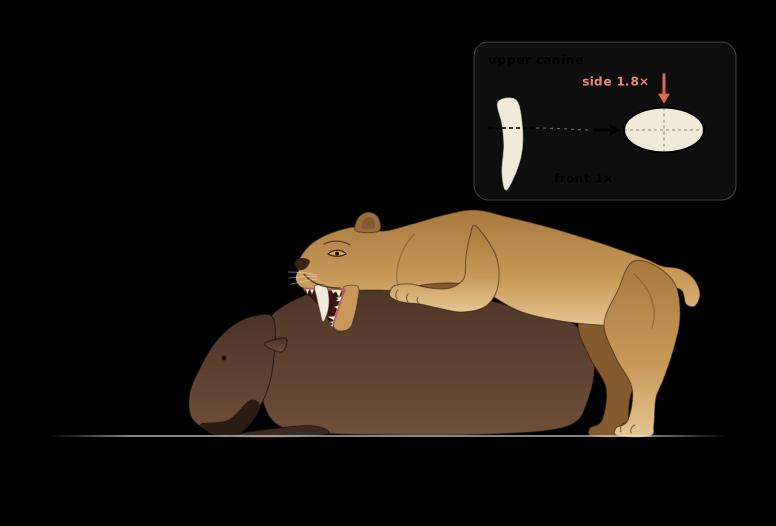
The weak direction. The ratio of the two stresses for the same force is simply a/b: a tooth twice as long as it is wide is stressed twice as much from the side as from the front. In Tseng’s digital eruption model of specimen AMNH FM55576, the cross-section of the fully erupted canine at the gum line is 32.17 mm by 18.00 mm (Table S1) 6 – so a sideways load stresses it about 1.8 times as much as a load from the front. This ratio alone does not show that the sabre was fragile: every flattened tooth is weaker from the side. The comparison with living cats comes from Van Valkenburgh and Ruff: cats have relatively stronger canines than dogs, particularly against bending about the front-to-back axis (in our reading of the abstract: by a load from the side), while the canines of sabre-toothed cats resemble those of dogs 15. Meachen-Samuels and Van Valkenburgh likewise describe the long sabres as more vulnerable to fracture than the canines of living cats 1.
Growing into strength. Tseng found that the cross-section of the sabre grows with its height in a way that increases its bending strength, although its sideways deflection under a load increases as it grows. According to Wysocki and colleagues, the milk canine and the erupting sabre were present together for about 11 of the roughly 22 months the sabre took to erupt – about half of the eruption period 16, which Tseng describes as more than half. Standing side by side, the two canines effectively widened the tooth, which brought Tseng’s estimates of strength and stiffness closer to theoretical optima 6.
Chemistry lens: what teeth remember
A clock in the enamel. Tooth enamel is formed layer by layer, and it locks in the ratio of the oxygen isotopes ¹⁸O and ¹⁶O, written δ¹⁸O, in the body when it forms. Measured along a growing canine, the changes in this ratio can be used as a clock for how fast the enamel grew. For the sabre-toothed cat Smilodon gracilis, Robert Feranec found a growth rate of about 5 mm per month over roughly 16 months 17. For Smilodon fatalis, Aleksander Wysocki and colleagues combined a previously published oxygen-isotope growth rate with CT scans of developing teeth: the upper canine erupted at about 6.0 mm per month. The rest of the permanent teeth were in place by 14–22 months of age, but the sabres finished erupting only at about 34–41 months – a delayed dental development compared with living cats of similar size 16.
A menu in the enamel. Carbon isotopes (δ¹³C) record the plants at the base of the food chain. In one canine of Smilodon gracilis from Florida, the carbon isotope values point to prey that fed only on so-called C3 plants; this probably rules out some prey animals such as horses and mammoths, and the values may indicate prey caught in a closed habitat – or prey species not yet analysed, according to Feranec 17.
Competition – a debate. At Rancho La Brea, Larisa DeSantis and colleagues combined several lines of evidence (a multi-proxy approach) from hundreds of carnivore and herbivore fossils. They conclude that dire wolves ate prey from more open habitats than the cats, and that sabre-toothed cats and dire wolves competed little for prey – overturning an earlier view 4. That would place the cats’ hunting grounds in more wooded, less open country – our inference from the prey, not a direct finding. Blaire Van Valkenburgh and colleagues challenged this conclusion, pointing to problems with inferring a lack of competition from the dental enamel data 18; DeSantis and colleagues replied to these concerns 19. The question remains open.
Radiocarbon and the end. Radiocarbon dating uses the decay of the radioactive isotope carbon-14 in once-living material. Robin O’Keefe and colleagues obtained 172 new radiocarbon dates from megafauna at Rancho La Brea. Seven extinct species of megafauna disappeared there by 12,900 years ago. The authors link this to a shift of the ecosystem after aridification and vegetation change, time-series models point to large fires as the primary cause, and growing human impact may have been the trigger – a hypothesis, not a settled result 20.
Computer science lens: stress in a growing sabre
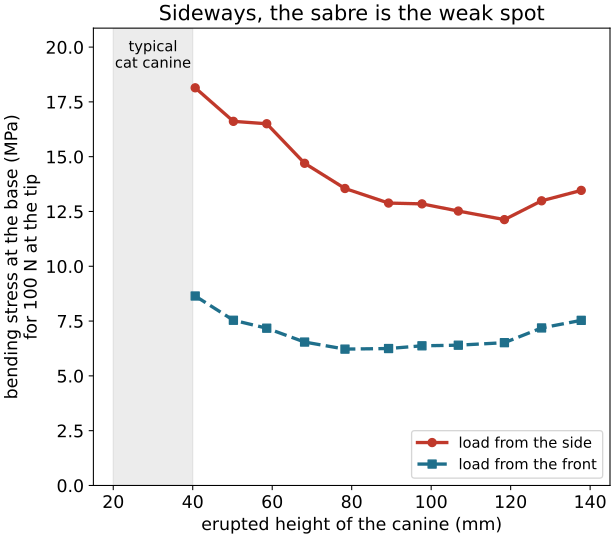
How much does the direction of a load matter, and does a longer sabre become weaker? The program below takes the cross-sections of a fully grown Smilodon fatalis canine that Tseng took from digital 3D models at successive heights of a simulated eruption 6, and calculates, with the beam formulas from the mathematics lens, the bending stress at the base for a load from the side and from the front. Assumptions: the cross-section is an ellipse; the load of 100 N at the tip is an assumed round value for comparison, not a measured force; only the ratio of the stresses and their trend are meaningful, not the absolute values.
import numpy as np
import matplotlib.pyplot as plt

# How strong is a sabre? The upper canine of Smilodon fatalis as a cantilever beam with an
# elliptical cross-section, measured at the gum line of each stage of a simulated eruption (the adult tooth shifted step by step into the jaw).
# Data: Tseng (2025), Table S1, "morpho" models (article licensed CC BY-NC-ND 4.0; measurement values quoted with citation): (erupted height, front-to-back
# length x, side-to-side width y) in mm.
CANINES = {
    "AMNH FM55576": [(40.62, 21.58, 10.28), (50.23, 24.64, 11.18), (58.62, 26.75, 11.63),
                     (68.15, 28.78, 12.81), (78.31, 30.34, 13.93), (89.28, 31.08, 15.07),
                     (97.68, 31.58, 15.66), (106.83, 32.16, 16.44), (118.43, 32.55, 17.48),
                     (127.78, 31.99, 17.70), (137.76, 32.17, 18.00)],
    "KU S2255": [(20.20, 14.89, 7.73), (31.31, 19.81, 9.67), (42.91, 22.99, 10.58),
                 (54.85, 26.80, 11.96), (65.21, 29.56, 13.25), (75.16, 31.41, 13.94),
                 (85.12, 33.21, 14.94), (95.03, 34.63, 15.65)],
}
SPECIMEN_INDEX = 0          # 0: AMNH FM55576, the longest “morpho” series in Table S1 (11 stages, 41–138 mm); 1: KU S2255
SPECIMEN = list(CANINES)[SPECIMEN_INDEX]
LOAD_N = 100.0              # force at the tip (N) – an assumed round value for comparison
ROUND = False               # True: same cross-sectional area, but a round tooth


def bending_stress(force, height, x, y):
    """Peak bending stress (MPa) at the base of an elliptical cantilever.
    Semi-axes a = x/2 (front-to-back) and b = y/2 (side-to-side), all in mm.
    Side load bends about the long axis: section modulus π·a·b²/4.
    Front load bends about the short axis: section modulus π·b·a²/4."""
    a, b = x / 2, y / 2
    moment = force * height                      # N·mm
    side = moment / (np.pi * a * b**2 / 4)       # N/mm² = MPa
    front = moment / (np.pi * b * a**2 / 4)
    return side, front


data = np.array(CANINES[SPECIMEN])
height, x, y = data.T
if ROUND:                                        # same area, circular: x = y = √(x·y)
    x = y = np.sqrt(x * y)
side, front = bending_stress(LOAD_N, height, x, y)

print(f"{SPECIMEN}, load {LOAD_N:.0f} N at the tip")
for h, s, f in ((height[0], side[0], front[0]), (height[-1], side[-1], front[-1])):
    print(f"  height {h:.0f} mm: {s:.1f} MPa from the side, {f:.1f} MPa from the front")
print(f"at the last stage, a side load stresses the tooth {side[-1] / front[-1]:.1f} times more than a front load")
print(f"from first to last stage, the side stress changes by a factor of {side[-1] / side[0]:.2f}, "
      f"while the height grows {height[-1] / height[0]:.1f} times")

plt.rcParams["font.size"] = 13      # large type: the chart stays readable on a phone
fig, ax = plt.subplots(figsize=(6.4, 5.6), layout="constrained")
ax.plot(height, side, "o-", lw=2.5, color="#c0392b", label="load from the side")
ax.plot(height, front, "s--", lw=2.5, color="#1f6f8b", label="load from the front")
ax.set_ylim(0, 1.15 * side.max())
ax.axvspan(20, 40, color="grey", alpha=0.15)
ax.text(30, 1.12 * side.max(), "typical\ncat canine", ha="center", va="top", fontsize=11)
ax.set_xlabel("erupted height of the canine (mm)")
ax.set_ylabel(f"bending stress at the base (MPa)\nfor {LOAD_N:.0f} N at the tip")
ax.set_xlim(15, 145)
ax.set_title("Sideways, the sabre is the weak spot")
ax.legend(loc="lower right", fontsize=11)
plt.show()
Output · what the code prints, re-run at every build
AMNH FM55576, load 100 N at the tip
  height 41 mm: 18.1 MPa from the side, 8.6 MPa from the front
  height 138 mm: 13.5 MPa from the side, 7.5 MPa from the front
at the last stage, a side load stresses the tooth 1.8 times more than a front load
from first to last stage, the side stress changes by a factor of 0.74, while the height grows 3.4 times
What the result teaches:
- Sideways is the weak direction. For the fully erupted canine, a load from the side causes 13.5 MPa, a load from the front 7.5 MPa – the side load causes about 1.8 times as much stress. The side is the weak direction at every stage, because the ratio of the two stresses is just the tooth’s length-to-width ratio – between 1.8 and 2.3 in this specimen.
- A longer sabre is not a weaker sabre. In Tseng’s simulated series the erupted part becomes 3.4 times taller, yet the side stress falls to 0.74 times its starting value: the section at the gum line widens fast enough to more than compensate for the longer lever. This matches Tseng’s finding that the cross-section is optimised for bending strength 6 – although, by his results, it also bends more easily sideways.
- Robust and limited. The direction effect follows from the measured shape alone. The absolute numbers depend on the assumed load and ignore the jaw bone and the milk canine that supported the growing tooth. And the series is one adult tooth shifted step by step against a hypothetical gum line, with the same load at every stage – not a record of a growing tooth.
Try it yourself:
- Another specimen: set
SPECIMEN_INDEX = 1(KU S2255). Its tooth is even flatter; at its last stage (95 mm), the side load causes 2.2 times the stress of the front load, and from the first to the last stage the side stress falls to 0.49 times its starting value. - A round sabre: set
ROUND = True– the same cross-sectional area, but circular. The direction no longer matters (ratio 1.0), and the side stress of the fully erupted tooth drops to 10.1 MPa.
Tested output with SPECIMEN_INDEX = 1
KU S2255, load 100 N at the tip
  height 20 mm: 23.1 MPa from the side, 12.0 MPa from the front
  height 95 mm: 11.4 MPa from the side, 5.2 MPa from the front
at the last stage, a side load stresses the tooth 2.2 times more than a front load
from first to last stage, the side stress changes by a factor of 0.49, while the height grows 4.7 times
Tested output with ROUND = True
AMNH FM55576, load 100 N at the tip
  height 41 mm: 12.5 MPa from the side, 12.5 MPa from the front
  height 138 mm: 10.1 MPa from the side, 10.1 MPa from the front
at the last stage, a side load stresses the tooth 1.0 times more than a front load
from first to last stage, the side stress changes by a factor of 0.80, while the height grows 3.4 times
What we still do not know
Bones and tooth mechanics agree on a picture of a cat that held its prey before it bit – but how exactly the bite worked is still debated, between a neck-powered canine-shear bite 7 11 and a forelimb-powered lever 13. Whether Smilodon lived in groups 5 9, and how much it competed with dire wolves 4 18, remain open questions.
New tools keep adding evidence: computer models that test how sabre-toothed skulls of different lineages worked 14, chemical clocks in the enamel 16, and ever more precise radiocarbon dates that link the disappearance of the Ice Age giants at La Brea to a changing, fire-prone landscape, as one study argues 20.
Frequently asked questions
Was the sabre-toothed tiger a tiger?
No. Smilodon belongs to the sabre-toothed cats (Machairodontinae), an extinct group that ancient DNA shows to be distinct from all living cats, including tigers and lions. That is why the name sabre-toothed cat is more accurate.
How strong was the bite of Smilodon?
Weaker than you might expect. A detailed computer model suggests that its jaw muscles produced about one third of the bite force of a lion of comparable size. A recent anatomical estimate, made with a different method, gives about 1,280 newtons at the canine – in the range of a jaguar (slightly lower at the canine, higher at the cheek teeth) rather than of the largest living cats. According to the computer model, the neck muscles helped to drive the canines in – an idea that not all researchers accept.
Why did Smilodon need strong forelimbs?
Its long, flattened canines could break under sideways loads from struggling prey. Its upper arm bones were reinforced more than in any living cat, which suggests that it held prey still with its forelimbs before it bit, protecting its canines and positioning the bite for a quick kill.
How do scientists know how fast its sabres grew?
The ratio of oxygen isotopes locked into tooth enamel changes along a growing canine, and researchers use these changes as a clock for how fast the enamel formed. Combined with CT scans of developing teeth, this gives an eruption rate of about 6 millimetres per month; the sabres were fully erupted only at an estimated age of 34 to 41 months.
Did Smilodon live in groups?
That is debated. At Rancho La Brea, Smilodon is the second most common carnivore, which one study compared with African predators attracted by playbacks of prey distress calls and read as a sign of social behaviour. A critic argued that the asphalt seeps and the playbacks are not directly comparable, for example because heavier animals were more likely to become trapped.
Sources
- Meachen-Samuels, J. A., Van Valkenburgh, B. (2010). Radiographs Reveal Exceptional Forelimb Strength in the Sabertooth Cat, Smilodon fatalis. PLoS ONE 5, e11412. doi:10.1371/journal.pone.0011412 · Open Access
- Paijmans, J. L. A., Barnett, R., Gilbert, M. T. P., Zepeda-Mendoza, M. L., Reumer, J. W. F., de Vos, J., Zazula, G., Nagel, D., Baryshnikov, G. F., Leonard, J. A., Rohland, N., Westbury, M. V., Barlow, A., Hofreiter, M. (2017). Evolutionary History of Saber-Toothed Cats Based on Ancient Mitogenomics. Current Biology 27, 3330–3336.e5. doi:10.1016/j.cub.2017.09.033
- Reynolds, A. R., Seymour, K. L., Evans, D. C. (2021). Smilodon fatalis siblings reveal life history in a saber-toothed cat. iScience 24, 101916. doi:10.1016/j.isci.2020.101916 · Open Access
- DeSantis, L. R. G., Crites, J. M., Feranec, R. S., Fox-Dobbs, K., Farrell, A. B., Harris, J. M., Takeuchi, G. T., Cerling, T. E. (2019). Causes and Consequences of Pleistocene Megafaunal Extinctions as Revealed from Rancho La Brea Mammals. Current Biology 29, 2488–2495.e2. doi:10.1016/j.cub.2019.06.059
- Carbone, C., Maddox, T., Funston, P. J., Mills, M. G. L., Grether, G. F., Van Valkenburgh, B. (2009). Parallels between playbacks and Pleistocene tar seeps suggest sociality in an extinct sabretooth cat, Smilodon. Biology Letters 5, 81–85. doi:10.1098/rsbl.2008.0526 · Open Access
- Tseng, Z. J. (2025). Bending performance changes during prolonged canine eruption in saber‐toothed carnivores: A case study of Smilodon fatalis. The Anatomical Record 308, 2994–3006. doi:10.1002/ar.25447 · Open Access
- McHenry, C. R., Wroe, S., Clausen, P. D., Moreno, K., Cunningham, E. (2007). Supermodeled sabercat, predatory behavior in Smilodon fatalis revealed by high-resolution 3D computer simulation. Proceedings of the National Academy of Sciences 104, 16010–16015. doi:10.1073/pnas.0706086104 · Open Access
- Brown, C., Balisi, M., Shaw, C. A., Van Valkenburgh, B. (2017). Skeletal trauma reflects hunting behaviour in extinct sabre-tooth cats and dire wolves. Nature Ecology & Evolution 1, 0131. doi:10.1038/s41559-017-0131
- Kiffner, C. (2009). Coincidence or evidence: was the sabretooth cat Smilodon social?. Biology Letters 5, 561–562. doi:10.1098/rsbl.2009.0008 · Open Access
- Wroe, S., McHenry, C., Thomason, J. (2005). Bite club: comparative bite force in big biting mammals and the prediction of predatory behaviour in fossil taxa. Proceedings of the Royal Society B: Biological Sciences 272, 619–625. doi:10.1098/rspb.2004.2986 · Open Access
- Figueirido, B., Lautenschlager, S., Pérez-Ramos, A., Van Valkenburgh, B. (2018). Distinct Predatory Behaviors in Scimitar- and Dirk-Toothed Sabertooth Cats. Current Biology 28, 3260–3266.e3. doi:10.1016/j.cub.2018.08.012
- Deutsch, A. R., Berger, A., Martens, L. L., Witt, B. R., Smith, R. L. J., Hartstone‐Rose, A. (2025). Myological and osteological approaches to gape and bite force reconstruction in Smilodon fatalis. The Anatomical Record 308, 2944–2961. doi:10.1002/ar.25529 · Open Access
- Brown, J. G. (2014). Jaw Function in Smilodon fatalis: A Reevaluation of the Canine Shear-Bite and a Proposal for a New Forelimb-Powered Class 1 Lever Model. PLoS ONE 9, e107456. doi:10.1371/journal.pone.0107456 · Open Access
- Lautenschlager, S., Figueirido, B., Cashmore, D. D., Bendel, E. M., Stubbs, T. L. (2020). Morphological convergence obscures functional diversity in sabre-toothed carnivores. Proceedings of the Royal Society B: Biological Sciences 287, 20201818. doi:10.1098/rspb.2020.1818 · Open Access
- Van Valkenburgh, B., Ruff, C. B. (1987). Canine tooth strength and killing behaviour in large carnivores. Journal of Zoology 212, 379–397. doi:10.1111/j.1469-7998.1987.tb02910.x
- Wysocki, M. A., Feranec, R. S., Tseng, Z. J., Bjornsson, C. S. (2015). Using a Novel Absolute Ontogenetic Age Determination Technique to Calculate the Timing of Tooth Eruption in the Saber-Toothed Cat, Smilodon fatalis. PLOS ONE 10, e0129847. doi:10.1371/journal.pone.0129847 · Open Access
- Feranec, R. S. (2005). Growth Rate and Duration of Growth in the Adult Canine of Smilodon gracilis and Inferences on Diet Through Stable Isotope Analysis. Bulletin of the Florida Museum of Natural History 45, 369–378. doi:10.58782/flmnh.psyo5090 · Open Access
- Van Valkenburgh, B., Clementz, M. T., Ben-David, M. (2020). Problems with inferring a lack of competition between Rancho La Brea dire wolves and sabertooth cats based on dental enamel. Current Biology 30, R149–R150. doi:10.1016/j.cub.2020.01.009
- DeSantis, L. R. G., Feranec, R. S., Fox-Dobbs, K., Harris, J. M., Cerling, T. E., Crites, J. M., Farrell, A. B., Takeuchi, G. T. (2020). Reply to Van Valkenburgh et al.. Current Biology 30, R151–R152. doi:10.1016/j.cub.2020.01.011
- O’Keefe, F. R., Dunn, R. E., Weitzel, E. M., Waters, M. R., Martinez, L. N., Binder, W. J., Southon, J. R., Cohen, J. E., Meachen, J. A., DeSantis, L. R. G., Kirby, M. E., Ghezzo, E., Coltrain, J. B., Fuller, B. T., Farrell, A. B., Takeuchi, G. T., MacDonald, G., Davis, E. B., Lindsey, E. L. (2023). Pre–Younger Dryas megafaunal extirpation at Rancho La Brea linked to fire-driven state shift. Science 381, eabo3594. doi:10.1126/science.abo3594
Text and figures: CC BY-SA 4.0. Found a mistake? Open an issue or edit this article on GitHub.