
A songbird with a compass
The European robin is a night-migratory songbird. Birds like it fly alone and often over great distances, and among the directional cues they use, a light-dependent magnetic compass plays a crucial role 1. Robins helped to discover how this compass works: in 1972, Wolfgang and Roswitha Wiltschko showed with robins that the bird’s compass works differently from a hiking compass 2.
A hiking compass needle points to magnetic north because it follows the polarity of the field. The robin ignores the polarity. It reads the inclination – the angle at which the field lines dip into the ground – and takes as “north” the direction along the north–south axis in which the field lines and the gravity vector form the smaller angle 2. In other words, the robin can tell “towards the pole” from “towards the equator”, but not north from south.
How does a bird sense a field as weak as Earth’s, about 50 microtesla 3? The answer is still being researched. The leading hypothesis is an unusual idea for biology: a quantum effect in the bird’s eyes 4.
The compass in three steps (leading hypothesis)
- Light. Light excites cryptochrome, a protein in the retina, and creates a radical pair: two molecular groups – in robin cryptochrome a flavin and a tryptophan – each with one unpaired electron 4 1.
- Spin. The two electron spins switch back and forth between a “singlet” and a “triplet” state. Earth’s magnetic field and the magnetic nuclei nearby drive this switching – and how it happens depends on the angle between the molecule and the field 5 6.
- Signal. Singlet and triplet pairs react differently, so the amount of reaction product depends on the field’s direction. If such molecules are aligned in the eye, the field could appear as a pattern laid over the bird’s view 5.
Biology lens: a compass that works through the eyes
For a long time, two mechanisms competed: tiny iron-mineral particles (magnetite) in the beak, or a magnetically sensitive chemical reaction in the eye 6 7. Experiments with robins pointed to the eye. Manuela Zapka and colleagues found that robins with bilateral lesions of Cluster N, a night-active, light-processing region of the forebrain, could no longer orient with their magnetic compass – but they could still use their sun and star compasses. Cutting the ophthalmic branch of the trigeminal nerve, which connects the beak to the brain, had no effect on the magnetic compass 7. According to the authors, the data strongly suggest that the robin’s magnetic compass is mediated by vision 7.
According to the leading hypothesis, the sensor molecule is cryptochrome. Jingjing Xu and colleagues produced cryptochrome 4 of the European robin and showed that its photochemistry is magnetically sensitive in the test tube – more so than cryptochrome 4 from two birds that do not migrate, the chicken and the pigeon. Mutations revealed that four successive radical pairs inside the protein (each made of a flavin and a tryptophan) take part 1.
The robin’s world is not only magnetic but also acoustic. In cities, robins sing at night where it is noisy during the day: daytime noise predicted night-time singing much better than artificial light at night 8.
Physics lens: spins that feel a weak field
An electron behaves like a tiny magnet; its magnetic property is called spin. In Earth’s field of about 50 µT 3, the splitting between the two magnetic energy levels of an electron spin – the Zeeman splitting – is extremely small: about 2 × 10⁻⁷ of the thermal energy of a molecule at body temperature, as the computer science lens calculates. A sensor that relied on aligning spins in thermal equilibrium would give an extremely weak signal.
The radical-pair model does not need thermal equilibrium. Light creates the pair, and what matters is how the field changes the spin dynamics during the short life of the pair – the simulation in the computer science lens contains no temperature at all, and still the field changes the outcome. Theoretical work showed that fields of Earth’s strength can change the reaction yield, and that the change depends on how the radical pair is aligned with the field, if the coupling of an electron to nearby nuclear spins – the hyperfine coupling – is anisotropic 5. In the laboratory, a synthetic molecule built of a carotenoid, a porphyrin and a fullerene showed exactly this: the lifetime of its radical pair changed in fields of 50 µT or less, and the response depended on the field’s direction 3.
A test with radio waves. If the compass relies on spins, oscillating magnetic fields at the right frequencies should disturb it. Thorsten Ritz and colleagues exposed robins to radio-frequency fields: a vertically aligned broadband field (0.1–10 MHz) or a 7-MHz field disoriented the birds. With the 7-MHz field the effect depended on the angle: parallel to Earth’s field the birds oriented normally, at 24° or 48° they were disoriented – consistent with a resonance on the transitions between singlet and triplet states 6. In Earth’s field an electron spin precesses at about 1.4 MHz – inside the broadband range that disturbed the birds, though below the single frequency of 7 MHz that was tested; that the two are connected is our inference, not a result of the study.
City noise. Svenja Engels and colleagues found that robins could not use their magnetic compass in unscreened wooden huts on the campus of the University of Oldenburg. In huts screened with grounded aluminium, which weakened the electromagnetic noise between 50 kHz and 5 MHz by about two orders of magnitude, the birds oriented again – and lost it as soon as the grounding was removed or noise was added. The tests were fully double-blinded 9.
Mathematics lens: reading the tilt
Split Earth’s field vector B into a horizontal part Bh and a vertical part Bv. The inclination I is the angle between the field and the horizontal plane:
The robin’s rule uses this geometry: along the horizontal axis of the field, it takes as “poleward” the direction in which the field line and the gravity vector form the smaller angle 2. Whether the field lines point into the ground or out of it, the rule picks the side towards the nearer pole – it needs the tilt, not the polarity.
Why polarity drops out. If you reverse the field, B → −B, the field lines still lie along the same axis with the same tilt. A sensor that only responds to the axis of the field – to the angle θ between the field and the molecule, with no difference between θ and 180° − θ – cannot tell the two polarities apart. That is exactly what the robin’s compass shows 2, and it is what a radical pair predicts, as the simulation in the next lens confirms.
One consequence follows directly from the formula: where the field is horizontal (I = 0, at the magnetic equator), the field line forms the same angle with gravity on both sides – the rule alone cannot distinguish poleward from equatorward there.
Computer science lens: simulating a quantum compass
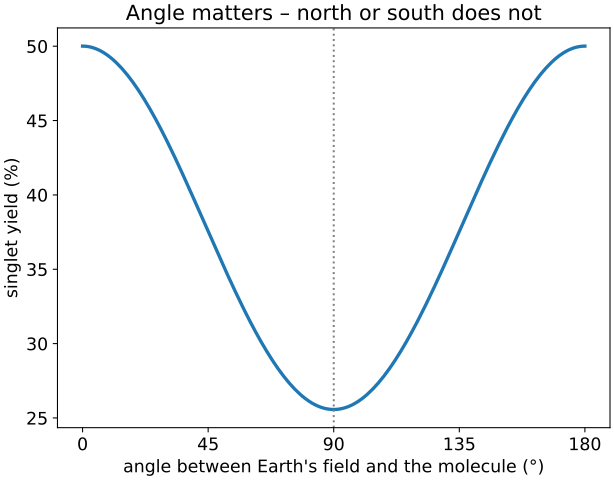
The program below simulates the simplest radical pair that can work as a compass, in the spirit of the model by Ritz, Adem and Schulten 5: two electron spins, one of them coupled to a single nucleus with an anisotropic (axial) hyperfine coupling. The pair starts as a singlet and reacts with a rate k; the program calculates the singlet yield – the fraction of pairs that react from the singlet state – for every angle θ between Earth’s field and the molecule. The field strength of 50 µT is Earth’s typical value 3; the hyperfine coupling of 1 mT, the axial shape and the lifetime of 1 µs are model assumptions. The model is deliberately minimal – one nucleus, no relaxation – and shows the principle, not the size of the effect in a real protein.
The method: the spin Hamiltonian is an 8 × 8 matrix (three spins ½). After diagonalising it, the singlet yield for an exponential lifetime is a sum over all pairs of eigenstates m, n with energy difference ωmn: each term is weighted by k2/(k2 + ωmn2), so only spin oscillations slower than about the reaction rate matter.
import numpy as np
import matplotlib.pyplot as plt

# Physical constants
GAMMA_E = 1.760859e11     # gyromagnetic ratio of the electron (rad s⁻¹ T⁻¹)
MU_B = 9.2740101e-24      # Bohr magneton (J/T)
K_B = 1.380649e-23        # Boltzmann constant (J/K)
H = 6.62607015e-34        # Planck constant (J s)

# Model – a minimal radical pair (assumptions, see the text)
B_EARTH = 50e-6           # Earth's field (T), about 50 µT
HYPERFINE = 1.0e-3        # axial hyperfine coupling of electron 1 to one nucleus (T)
ANISOTROPY = (0.0, 0.0, 1.0)   # hyperfine tensor diag(x, y, z) in units of HYPERFINE: purely axial
LIFETIME = 1e-6           # radical-pair lifetime (s); recombination rate k = 1/LIFETIME

# Why this is surprising: the Zeeman splitting of an electron spin in Earth's field vs. heat
zeeman = 2 * MU_B * B_EARTH
print(f"Zeeman splitting / thermal energy at 37 °C: {zeeman / (K_B * 310):.0e}")
print(f"electron spins precess at {GAMMA_E * B_EARTH / (2 * np.pi) / 1e6:.1f} MHz in Earth's field")

# Spin operators for spin 1/2, combined for electron 1, electron 2 and the nucleus (8 states)
sx, sy, sz = (np.array(m, dtype=complex) / 2 for m in ([[0, 1], [1, 0]], [[0, -1j], [1j, 0]], [[1, 0], [0, -1]]))
one = np.eye(2)
def op(a, b, c):
    return np.kron(np.kron(a, b), c)
spin = (sx, sy, sz)
S1 = [op(s, one, one) for s in spin]                     # electron 1
S2 = [op(one, s, one) for s in spin]                     # electron 2
S1_I = [op(s, one, s) for s in spin]                     # products S1x·Ix, S1y·Iy, S1z·Iz
singlet = 0.25 * np.eye(8) - sum(op(s, s, one) for s in spin)     # projector onto the singlet state


def singlet_yield(theta):
    """Fraction of radical pairs that react from the singlet state, field at angle theta to the molecule."""
    b = np.array([np.sin(theta), 0.0, np.cos(theta)])
    w = GAMMA_E * B_EARTH
    zeeman_h = w * sum(bi * (s1 + s2) for bi, s1, s2 in zip(b, S1, S2))
    hyperfine_h = GAMMA_E * HYPERFINE * sum(a * si for a, si in zip(ANISOTROPY, S1_I))
    energies, states = np.linalg.eigh(zeeman_h + hyperfine_h)
    p = np.einsum("im,ij,jn->mn", states.conj(), singlet, states)   # singlet projector in the eigenbasis
    k = 1 / LIFETIME
    omega = energies[:, None] - energies[None, :]
    return float(np.sum(np.abs(p) ** 2 * k**2 / (k**2 + omega**2)).real / 2)   # Tr(singlet) = 2


angles = np.radians(np.linspace(0, 180, 181))
yields = np.array([singlet_yield(a) for a in angles])
print(f"singlet yield: {yields[0]:.4f} along the field axis, {yields[90]:.4f} across it")
print(f"compass signal (max − min): {100 * (yields.max() - yields.min()):.2f} % of all pairs")
print(f"north and south look alike – yield at θ equals yield at 180° − θ to within 1e-12: "
      f"{np.allclose(yields, yields[::-1], rtol=0, atol=1e-12)}")

plt.rcParams["font.size"] = 13      # large type: the chart stays readable on a phone
fig, ax = plt.subplots(figsize=(6.4, 5.0), layout="constrained")
ax.plot(np.degrees(angles), 100 * yields, lw=2.5)
ax.axvline(90, color="grey", ls=":", lw=1.5)
ax.set_xlabel("angle between Earth's field and the molecule (°)")
ax.set_ylabel("singlet yield (%)")
ax.set_xticks([0, 45, 90, 135, 180])
ax.set_title("Angle matters – north or south does not")
plt.show()
Output · what the code prints, re-run at every build
Zeeman splitting / thermal energy at 37 °C: 2e-07
electron spins precess at 1.4 MHz in Earth's field
singlet yield: 0.5001 along the field axis, 0.2557 across it
compass signal (max − min): 24.44 % of all pairs
north and south look alike – yield at θ equals yield at 180° − θ to within 1e-12: True
What the result teaches:
- Tiny energy, clear signal. The Zeeman splitting is only 2 × 10⁻⁷ of the thermal energy, yet the singlet yield changes from 50 % (field along the molecule’s axis) to 25.6 % (across it): the compass signal is 24 % of all pairs in this idealised model. Spin dynamics, not equilibrium, makes this possible.
- North and south look alike. The yield at θ equals the yield at 180° − θ to within 10−12 – the simulated sensor reads the axis of the field, just like the robin’s inclination compass 2.
- The right timescale. The spins precess at 1.4 MHz; a pair that lives 1 µs has time for about one turn. In our reading, this is consistent with the finding that radio-frequency fields in the megahertz range disorient robins 6.
Try it yourself:
- Make the hyperfine coupling isotropic,
ANISOTROPY = (1.0, 1.0, 1.0): the compass signal disappears (0.00 %). Without a built-in direction in the molecule there is no compass. - Shorten the lifetime to 10 ns,
LIFETIME = 1e-8: the signal shrinks to 0.02 % – the pair reacts before the weak field can act.
Tested output with ANISOTROPY = (1.0, 1.0, 1.0)
Zeeman splitting / thermal energy at 37 °C: 2e-07
electron spins precess at 1.4 MHz in Earth's field
singlet yield: 0.3876 along the field axis, 0.3876 across it
compass signal (max − min): 0.00 % of all pairs
north and south look alike – yield at θ equals yield at 180° − θ to within 1e-12: True
Tested output with LIFETIME = 1e-8
Zeeman splitting / thermal energy at 37 °C: 2e-07
electron spins precess at 1.4 MHz in Earth's field
singlet yield: 0.7817 along the field axis, 0.7814 across it
compass signal (max − min): 0.02 % of all pairs
north and south look alike – yield at θ equals yield at 180° − θ to within 1e-12: True
Physical AI lens: quantum sensors and a compass made of molecules
Physical AI is about machines that sense and act in the real world. If the leading hypothesis is right, the robin’s compass would be a quantum sensor grown by evolution: a system whose quantum states respond to the quantity to be measured. In quantum sensing, a growing field of precision measurement, the working part of the sensor contains one or a few qubits, and resources such as entanglement are tailored to maximise sensitivity 10.
The chemical side is already in the laboratory. The carotenoid–porphyrin–fullerene molecule of Kiminori Maeda and colleagues showed that a synthetic radical pair can respond to fields as weak as Earth’s and to their direction – the feasibility of a chemical compass, and a guide to the design features such a sensor needs 3.
The robin also shows a lesson in design. Its compass is not a separate instrument: it may be built into vision, processed by a brain region that also handles light 7 5, and it works alongside the sun and star compasses 7. And it is fragile: radio-frequency noise from human electronics can switch it off 9. In our view, these two points – sensing built into the body, and robustness against noise – are exactly the questions a robot with a bio-inspired quantum compass would face. Such a robot does not exist yet; it is a research idea, not a product.
Open questions
The radical-pair compass is the leading hypothesis; as of the 2016 review by Hore and Mouritsen, the primary sensory mechanism was still unclear 4. In our view, two questions stand out: which radical pair in which cryptochrome would carry the signal in the living bird – Xu and colleagues describe potential signalling states inside the protein 1 – and how a chemical yield would become a direction the bird can use. The robin, a familiar garden bird, keeps an open puzzle of sensory biology – and a possible link between quantum physics and the behaviour of a whole animal.
Frequently asked questions
How do robins find their way when they migrate?
European robins migrate at night and use several compasses: the sun, the stars and Earth's magnetic field. Their magnetic compass does not tell north from south directly. It reads the tilt of the field lines and takes as 'poleward' the direction in which the field lines and gravity form the smaller angle.
Is the robin's compass really a quantum effect?
It is the leading hypothesis, not a proven fact. Light is thought to create pairs of radicals in cryptochrome proteins in the retina; the spins of their unpaired electrons respond to the direction of Earth's field and change the outcome of a chemical reaction. Experiments with radio-frequency fields and with isolated robin cryptochrome support the idea, but as far as the cited studies show, the full chain from molecule to behaviour has not been demonstrated.
Why does electromagnetic noise disturb robins?
In experiments, robins could not use their magnetic compass in wooden huts exposed to the background electromagnetic noise of a university campus. When the huts were screened with grounded aluminium, which weakened the noise between 50 kHz and 5 MHz about a hundredfold, the birds oriented again. This is consistent with a radical-pair compass: earlier experiments had shown that radio-frequency fields disorient robins.
Why do robins sing at night in cities?
A study of urban European robins found that they sing at night in places that are noisy during the day. Daytime noise predicted night singing much better than artificial light. According to the authors, the robins reduce acoustic interference this way.
Can engineers build a compass like the robin's?
Chemists have shown in the laboratory that a chemical compass is feasible: the radical pair of a synthetic molecule responds to fields of Earth's strength and to their direction. Quantum sensors are a growing field of technology. A robin-like quantum compass for robots or vehicles is still a research idea.
Sources
- Xu, J., Jarocha, L. E., Zollitsch, T., Konowalczyk, M., Henbest, K. B., Richert, S., Golesworthy, M. J., Schmidt, J., Déjean, V., Sowood, D. J. C., Bassetto, M., Luo, J., Walton, J. R., Fleming, J., Wei, Y., Pitcher, T. L., Moise, G., Herrmann, M., Yin, H., Wu, H., Bartölke, R., Käsehagen, S. J., Horst, S., Dautaj, G., Murton, P. D. F., Gehrckens, A. S., Chelliah, Y., Takahashi, J. S., Koch, K. W., Weber, S., Solov’yov, I. A., Xie, C., Mackenzie, S. R., Timmel, C. R., Mouritsen, H., Hore, P. J. (2021). Magnetic sensitivity of cryptochrome 4 from a migratory songbird. Nature 594, 535–540. doi:10.1038/s41586-021-03618-9
- Wiltschko, W., Wiltschko, R. (1972). Magnetic Compass of European Robins. Science 176, 62–64. doi:10.1126/science.176.4030.62
- Maeda, K., Henbest, K. B., Cintolesi, F., Kuprov, I., Rodgers, C. T., Liddell, P. A., Gust, D., Timmel, C. R., Hore, P. J. (2008). Chemical compass model of avian magnetoreception. Nature 453, 387–390. doi:10.1038/nature06834
- Hore, P. J., Mouritsen, H. (2016). The Radical-Pair Mechanism of Magnetoreception. Annual Review of Biophysics 45, 299–344. doi:10.1146/annurev-biophys-032116-094545 · Open Access
- Ritz, T., Adem, S., Schulten, K. (2000). A Model for Photoreceptor-Based Magnetoreception in Birds. Biophysical Journal 78, 707–718. doi:10.1016/s0006-3495(00)76629-x · Open Access
- Ritz, T., Thalau, P., Phillips, J. B., Wiltschko, R., Wiltschko, W. (2004). Resonance effects indicate a radical-pair mechanism for avian magnetic compass. Nature 429, 177–180. doi:10.1038/nature02534
- Zapka, M., Heyers, D., Hein, C. M., Engels, S., Schneider, N. L., Hans, J., Weiler, S., Dreyer, D., Kishkinev, D., Wild, J. M., Mouritsen, H. (2009). Visual but not trigeminal mediation of magnetic compass information in a migratory bird. Nature 461, 1274–1277. doi:10.1038/nature08528
- Fuller, R. A., Warren, P. H., Gaston, K. J. (2007). Daytime noise predicts nocturnal singing in urban robins. Biology Letters 3, 368–370. doi:10.1098/rsbl.2007.0134 · Open Access
- Engels, S., Schneider, N. L., Lefeldt, N., Hein, C. M., Zapka, M., Michalik, A., Elbers, D., Kittel, A., Hore, P. J., Mouritsen, H. (2014). Anthropogenic electromagnetic noise disrupts magnetic compass orientation in a migratory bird. Nature 509, 353–356. doi:10.1038/nature13290
- Degen, C. L., Reinhard, F., Cappellaro, P. (2017). Quantum sensing. Reviews of Modern Physics 89, 035002. doi:10.1103/revmodphys.89.035002 · Open Access
Text and figures: CC BY-SA 4.0. Found a mistake? Open an issue or edit this article on GitHub.