Clean leaves from muddy water
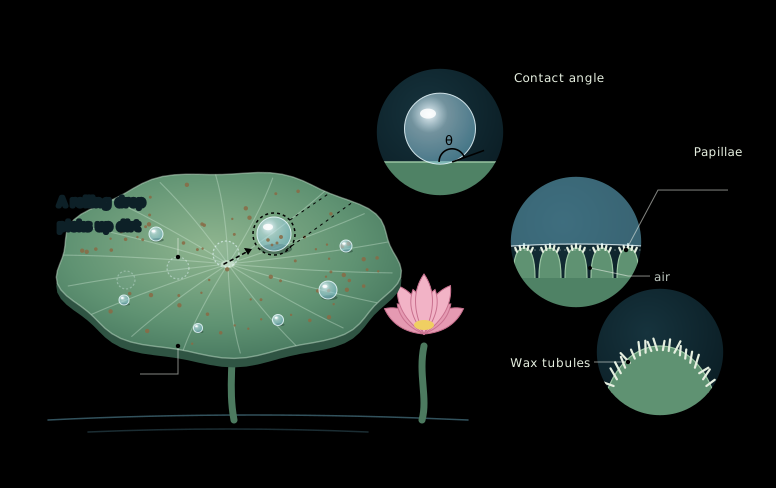
The sacred lotus (Nelumbo nucifera) is rooted in the mud of ponds and wetlands, yet its large, round leaves unfold spotless and stay clean 1. Pour water on one and it does not spread out: it beads up into silvery spheres that run across the leaf at the slightest tilt and roll off – taking dust and dirt with them 2.
In 1997, the botanists Wilhelm Barthlott and Christoph Neinhuis explained how this works. The water-repellent leaves they studied were anything but smooth: they carried textures in the micrometre and nanometre range, in which wax crystals play the key role 3. Their key finding was that roughness, water repellency and the weak adhesion of dirt particles depend on each other – “the keystone in the self-cleaning mechanism of many biological surfaces” 4 2. Barthlott had already coined the short term lotus effect in 1992 2.
The numbers are striking. On a lotus leaf, water forms a contact angle of more than 160° – measured values lie between 162° and 164° 5 6. A drop rolls off as soon as the leaf is tilted by less than 4° 7. Surfaces with contact angles above 150° and a tilt angle below 10° are called superhydrophobic 7.
Self-cleaning in four steps
- Rest on air. A drop comes to rest on the leaf. It touches only the tips of the highest bumps, the papillae, and the wax crystals on top of them. Underneath the drop, air stays trapped. When a raindrop hits the leaf, water is pressed deeper between the papillae – but the wax crystals stop it 5.
- Bead up. Because the drop touches so little solid material, it stays almost spherical, with a contact angle of more than 160° 5.
- Roll. The small contact area makes the water stick only weakly to the leaf, so the drop rolls instead of sliding 5 3. A tilt of less than 4° is enough 7.
- Take the dirt along. Dirt particles on the leaf stick to the surface of the rolling drop and leave the leaf with it 2 3.
Biology lens: a surface built on two levels
Seen through a scanning electron microscope, the upper side of a lotus leaf looks like a field of hills. These bumps are called papillae: about 3,400 of them sit on every square millimetre 5, on average about 15 µm high and 22.6 µm apart 8. The numbers come from different measurements and do not quite match: 3,400 papillae per square millimetre would be about 17 µm apart. Their tips are not round but pointed like a Gothic arch, and small drops that rest on the leaf or roll across it touch only the highest papillae 5.
Everything is covered with a second, much finer layer: tiny tubes of wax, the wax tubules. On the upper side of the leaf they are only 0.3–1 µm long and 80–120 nm thick, but very dense – about 200 of them on every 10 µm² 5. This epicuticular wax lies on top of the cuticle, the protective skin of the leaf. It consists of 65 % diols and 22 % nonacosan-10-ol, a long-chain alcohol. According to a layer model supported by X-ray measurements, the molecules are arranged so that their water-attracting OH groups are hidden inside, and only water-repellent CH3 groups face outwards 5. With a melting point of 90–95 °C, the wax is also unusually heat-resistant 5. The underside of the leaf carries longer and thicker tubules (1–2 µm long, about 150 nm thick) with a different chemistry 5.
What is the benefit for the plant? Barthlott’s retrospective describes the self-cleaning surfaces as a defence mechanism: hierarchically structured, superhydrophobic surfaces reduce the adhesion of particles and pathogens 2.
The two levels also share the work. When Ensikat and colleagues wiped lotus leaves with a finger, they destroyed only the wax on the tips of the papillae – the wax between the papillae was protected, and the leaves stayed superhydrophobic. On kohlrabi leaves (Brassica oleracea), which have wax but no papillae, the same treatment reduced the contact angle from 160° to about 130° 5.
The lotus is the most famous example, but not the only one. Neinhuis and Barthlott measured 162° on lotus leaves – among the highest values of all species they compared. Yet 43 % of the superhydrophobic plants they tested reached between 160° and 163°, too 9 5.
The system has limits. When water condenses from humid air directly on the leaf, the droplets grow inside the structure. Such drops can stick and do not roll off even when the leaf is tilted by 45° 1.
Physics lens: surface tension, roughness and an air cushion
Water molecules attract each other. Inside a drop, each molecule is pulled evenly from all sides; at the surface, the partners on the outside are missing. Water therefore tries to keep its surface as small as possible. This tendency is called surface tension – for water at room temperature about 72 mN/m. It is the reason why small amounts of water form round drops.
When a drop sits on a solid surface, three interfaces meet at its edge: solid–liquid, solid–air and liquid–air. Each pulls along the surface, and their balance sets the contact angle θ, the angle between the solid and the surface of the drop. Thomas Young described this balance in words in 1805 10; written as an equation, it reads:
Here γSV, γSL and γLV are the tensions of the solid–air, solid–liquid and liquid–air interfaces. On glass, which attracts water, θ is small and the drop spreads. On wax, which repels it, θ is larger than 90°.
But chemistry alone is not enough. A flat, smooth film of melted lotus wax gives a contact angle of only 119° 6. Even smooth surfaces made of fluoropolymers, which are strongly water-repellent, reach only up to about 120° 2. The step from 120° to 160° comes from roughness: both the contact angle and its hysteresis (see below) can be changed dramatically by the texture of a surface 11. There are two ways a drop can sit on a rough surface (Fig. 2):
- Wenzel state: the water fills the grooves 12. The larger wetted area amplifies whatever the chemistry does: a water-repellent material becomes even more water-repellent – but the drop is anchored in the grooves.
- Cassie–Baxter state: the drop rests on the tips, with air underneath 13. The water touches the solid only in small patches and air everywhere else. This is the state of the lotus leaf.

Why does a drop roll on the lotus but stick to smooth wax? The answer is the contact angle hysteresis. When a drop starts to move, its front edge advances over dry surface and its rear edge recedes. The angle at the front (advancing angle) is larger than at the back (receding angle), and the difference holds the drop in place. On flat lotus wax, the advancing angle is 148° and the receding angle 92° – a hysteresis of 56°, so the drop clings. On the lotus leaf, the hysteresis is only 3° 6. As Ensikat and colleagues put it, the minimised contact area is the basic cause of the very low adhesion of water and the small roll-off angles 5.
The same geometry cleans the leaf. A dirt particle lying on the papillae also touches only a few tips. When a drop rolls over it, the particle sticks to the surface of the drop and is carried off the leaf 2.
Mathematics lens: how much leaf does a drop touch?
Cassie and Baxter described a drop on a mixed surface by a weighted average 13. If φ is the fraction of the area under the drop where water touches solid, and the rest is air, the apparent contact angle θ* is
For φ = 1 (only solid) this gives back Young’s angle; for φ → 0 (only air) the angle approaches 180°, a perfectly round drop. The formula can be turned around to ask: how much solid does a drop on a lotus leaf actually touch?
With the angle of flat lotus wax, θY = 119° 6, and the angle measured on the leaf, θ* = 162° 5:
A drop on a lotus leaf touches solid material on only about 9.5 % of the area beneath it; the rest is air. For strongly structured leaves, Wagner and colleagues estimated that the roughness reduces the contact area by more than 95 % compared with the projected area of the drop 14 – the same order of magnitude. The simple formula treats the wax as flat at the smallest scale, so it can only give an estimate.
The formula also shows how steeply the angle depends on the air fraction:
- φ = 1, no air: 119° – flat wax
- φ = 0.5, half air: 138°
- φ = 0.26, 74 % air: 150° – the threshold for superhydrophobic
- φ = 0.1, 90 % air: 162° – the lotus leaf
- φ = 0.01, 99 % air: 174°
To reach 150°, a surface made of lotus wax needs at least about three quarters air under the drop.
Wenzel’s formula for a drop that fills the grooves looks different 12:
Here r ≥ 1 is the roughness ratio: the true surface area divided by the projected area. For a water-repellent material, cos θY is negative, and roughness makes it even more negative. With r = 2, lotus wax would give cos θ* = 2 · (−0.485) = −0.970, so θ* ≈ 166° – a high angle, too. But the drop would be anchored in the grooves. The contact angle alone does not tell whether a drop rolls; what matters is whether there is air underneath.
Computer science lens: why two levels of roughness?
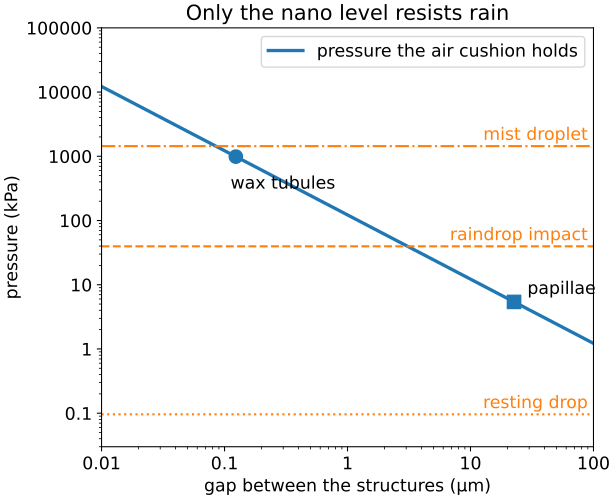
The mathematics lens showed that the air cushion makes the high contact angle. But the cushion must also survive. Water pressing on the surface tries to push into the gaps between the structures. What stops it is surface tension: to enter a gap, the water surface must bulge into it, and a curved water surface resists with a pressure, the Laplace pressure. For a gap of width w between water-repellent walls, the largest pressure it can hold is
where γ is the surface tension and θa the advancing angle – the angle the water front must reach before it creeps down the wall. The smaller the gap, the more pressure it holds.
The program below compares the two levels of the lotus leaf against three kinds of water that press on the cushion:
- a drop resting on the leaf, which presses with its own curvature, 2γ/R;
- a raindrop hitting the leaf, estimated with the stagnation pressure ρU2/2 – a similar estimate to the one Watson and colleagues used for raindrops hitting water striders. Raindrops 4 mm across fall at 8.89 m/s 15;
- a tiny droplet, for example from condensation, whose strong curvature presses with 2γ/r. Ensikat and colleagues estimated that droplets with a radius below about 100 nm could enter between the wax tubules 5.
The inputs come from the sources: the advancing angle on flat lotus wax (148° 6), the spacing of the papillae (22.6 µm 8), and the density and thickness of the wax tubules (200 per 10 µm², 80–120 nm 5). The program also computes the contact angle that the tips of the wax tubules alone would give (math lens). It makes simplifying assumptions: the tubules stand upright, so that water touches only their tips; every gap is treated as a long slit with straight walls (for an array of thin pillars, the holding pressure is roughly half as large); and the gap between two pointed papillae is about as wide as their spacing.
import numpy as np
import matplotlib.pyplot as plt

# Water and lotus wax
SURFACE_TENSION = 0.072   # surface tension of water (N/m), at about 25 °C
WATER_DENSITY = 1000      # density of water (kg/m³)
THETA_FLAT = 119          # contact angle on a flat film of lotus wax (degrees)
THETA_ADVANCING = 148     # angle a water front must reach before it creeps along the wax (degrees)

# The two levels of roughness on the upper side of a lotus leaf
PAPILLA_PITCH = 22.6e-6   # distance between neighbouring papilla tips (m)
TUBULE_DENSITY = 200 / 10e-12   # wax tubules per m² (200 per 10 µm²)
TUBULE_DIAMETER = 100e-9  # diameter of a wax tubule (m), measured 80–120 nm

# Three kinds of water that press on the air cushion
DROP_RADIUS = 1.5e-3      # a drop resting on the leaf (m)
RAIN_SPEED = 8.9          # impact speed of a large raindrop, 4 mm across (m/s)
MIST_RADIUS = 100e-9      # a tiny droplet, e.g. from condensation (m)


def cassie_angle(solid_fraction, theta_flat=THETA_FLAT):
    """Apparent contact angle when water touches only the tips (Cassie–Baxter)."""
    cos_theta = solid_fraction * (np.cos(np.radians(theta_flat)) + 1) - 1
    return np.degrees(np.arccos(cos_theta))


def holding_pressure(gap):
    """Largest pressure (Pa) a water surface spanning a gap can take before it slips in."""
    return 2 * SURFACE_TENSION * -np.cos(np.radians(THETA_ADVANCING)) / gap


# How much solid does a drop touch? Invert Cassie–Baxter for the measured 162°.
cos_flat = np.cos(np.radians(THETA_FLAT))
needed = (np.cos(np.radians(162)) + 1) / (cos_flat + 1)
tubule_tips = TUBULE_DENSITY * np.pi * (TUBULE_DIAMETER / 2) ** 2
print(f"flat wax: {THETA_FLAT}°  →  measured on the leaf: 162°")
print(f"solid fraction needed for 162°: {needed:.3f} (drop touches {needed:.1%} of the area)")
print(f"tips of the wax tubules alone:  {tubule_tips:.3f}  →  {cassie_angle(tubule_tips):.0f}°")
print()

# How much pressure can each level of roughness hold?
tubule_spacing = 1 / np.sqrt(TUBULE_DENSITY)
tubule_gap = tubule_spacing - TUBULE_DIAMETER
levels = {"papillae": PAPILLA_PITCH, "wax tubules": tubule_gap}
threats = {
    "resting drop": 2 * SURFACE_TENSION / DROP_RADIUS,
    "raindrop impact": WATER_DENSITY * RAIN_SPEED**2 / 2,
    "mist droplet": 2 * SURFACE_TENSION / MIST_RADIUS,
}
print("level          gap        holds up to")
for name, gap in levels.items():
    print(f"{name:12s} {gap * 1e6:7.2f} µm   {holding_pressure(gap) / 1e3:7.1f} kPa")
print()
print("pressure from       kPa     papillae   wax tubules")
for name, pressure in threats.items():
    verdict = ["air holds" if holding_pressure(g) > pressure else "water in" for g in levels.values()]
    print(f"{name:16s} {pressure / 1e3:7.1f}   {verdict[0]:10s} {verdict[1]}")
print()
largest_gap = 2 * SURFACE_TENSION * -np.cos(np.radians(THETA_ADVANCING)) / threats["raindrop impact"]
print(f"to resist the raindrop, gaps must be smaller than {largest_gap * 1e6:.1f} µm")
smallest_safe = tubule_gap / -np.cos(np.radians(THETA_ADVANCING))   # where 2γ/r equals the holding pressure
print(f"droplets with a radius below {smallest_safe * 1e6:.2f} µm can slip between the wax tubules")

gaps = np.logspace(-8, -4, 200)        # 10 nm to 100 µm
plt.rcParams["font.size"] = 13      # large type: the chart stays readable on a phone
fig, ax = plt.subplots(figsize=(6.4, 5.2), layout="constrained")
ax.loglog(gaps * 1e6, holding_pressure(gaps) / 1e3, lw=2.5, label="pressure the air cushion holds")
for (name, gap), marker, offset in zip(levels.items(), ["s", "o"], [(10, 6), (-4, -24)]):
    ax.plot(gap * 1e6, holding_pressure(gap) / 1e3, marker, ms=10, color="C0")
    ax.annotate(name, (gap * 1e6, holding_pressure(gap) / 1e3), xytext=offset, textcoords="offset points")
for (name, pressure), style in zip(threats.items(), [":", "--", "-."]):
    ax.axhline(pressure / 1e3, color="C1", ls=style, lw=1.6)
    ax.text(90, pressure / 1e3 * 1.25, name, color="C1", ha="right")
ax.set_xlabel("gap between the structures (µm)")
ax.set_ylabel("pressure (kPa)")
ax.set_title("Only the nano level resists rain")
ax.set_xlim(0.01, 100)
ax.set_ylim(0.03, 1e5)
ax.xaxis.set_major_formatter("{x:g}")   # plain numbers: 0.01, 0.1, 1, 10
ax.yaxis.set_major_formatter("{x:g}")
ax.legend(loc="upper right")
plt.show()
Output · what the code prints, re-run at every build
flat wax: 119°  →  measured on the leaf: 162°
solid fraction needed for 162°: 0.095 (drop touches 9.5% of the area)
tips of the wax tubules alone:  0.157  →  157°

level          gap        holds up to
papillae       22.60 µm       5.4 kPa
wax tubules     0.12 µm     988.0 kPa

pressure from       kPa     papillae   wax tubules
resting drop         0.1   air holds  air holds
raindrop impact     39.6   water in   air holds
mist droplet      1440.0   water in   water in

to resist the raindrop, gaps must be smaller than 3.1 µm
droplets with a radius below 0.15 µm can slip between the wax tubules
What the result teaches:
- The nano level is the rain guard. In this estimate, a heavy raindrop presses with about 40 kPa. The gaps between the papillae hold only 5.4 kPa – on their own they would be flooded. The narrow gaps between the wax tubules hold about 990 kPa, 25 times more than the raindrop. To resist it, the gaps must be smaller than 3.1 µm – far narrower than the 22.6 µm between the papillae, while the tubules, about 0.12 µm apart, clear it easily. This matches what Ensikat and colleagues describe: at the impact of raindrops, water intrudes deeper between the papillae and forms a meniscus at the water-repellent wax tubules 5.
- Each level does its own job. The tips of the wax tubules alone would already give 157°, with the drop touching 15.7 % of the area. The measured 162° requires only 9.5 %: in this simple picture, the papillae supply the difference, because resting drops touch only the highest papillae 5. They also protect the wax between them from wear (biology lens).
- Condensation is the weak point. A droplet of 100 nm radius presses with 1,440 kPa – more than even the wax tubules can hold. In the model, droplets with a radius below 0.15 µm slip between the tubules; Ensikat and colleagues estimated a radius of about 100 nm 5, the same order of magnitude. This fits the observation that condensed water can make drops stick to the leaf 1.
- The limits of the model. It treats the gaps as simple slits, uses one average tubule thickness and estimates the raindrop with the stagnation pressure. The first moment of an impact on a rigid surface creates much higher pressure peaks: Ensikat and colleagues cite about 0.9 MPa for a raindrop at only 3 m/s – but also note that impacts on flexible surfaces such as a leaf generate considerably lower pressures 5. The results are orders of magnitude, not precise values – but the gap of more than two orders of magnitude between the two levels is robust.
A few programming ideas are worth noticing, too:
- Inverting a formula. Instead of asking “which angle results from a given structure?”, the program asks the reverse: “which structure is needed for the measured angle?” This kind of inversion is a common trick to get at a quantity that is hard to measure.
- Data in dictionaries. The levels and the threats are stored in dictionaries, and two loops compare every threat with every level. A new threat or a third level needs one line, not new code.
- Straight lines on a log-log plot. A power law such as p ∝ 1/w becomes a straight line on logarithmic axes. This makes it easy to read a whole range from 10 nm to 100 µm in one chart.
Try it yourself – each change takes one line:
- Set
RAIN_SPEED = 3.0, a slow drop falling from a leaf just above: it presses with only 4.5 kPa, and in this stagnation-pressure estimate the papillae alone would hold it. Gaps up to 27.1 µm are then narrow enough. - Set
TUBULE_DIAMETER = 80e-9, the thin end of the measured range 5: the drop now touches only 10.1 % of the area at the tubule tips (tubule tips alone: 161°), while the wider gaps hold a little less, 850.4 kPa. - Set
PAPILLA_PITCH = 10e-6, the papilla spacing of about 10 µm that Ensikat and colleagues use 5: the papillae now hold 12.2 kPa – still far less than the raindrop’s 39.6 kPa. The conclusion does not depend on which measurement of the spacing is right.
Tested output with RAIN_SPEED = 3.0
flat wax: 119°  →  measured on the leaf: 162°
solid fraction needed for 162°: 0.095 (drop touches 9.5% of the area)
tips of the wax tubules alone:  0.157  →  157°

level          gap        holds up to
papillae       22.60 µm       5.4 kPa
wax tubules     0.12 µm     988.0 kPa

pressure from       kPa     papillae   wax tubules
resting drop         0.1   air holds  air holds
raindrop impact      4.5   air holds  air holds
mist droplet      1440.0   water in   water in

to resist the raindrop, gaps must be smaller than 27.1 µm
droplets with a radius below 0.15 µm can slip between the wax tubules
Tested output with TUBULE_DIAMETER = 80e-9
flat wax: 119°  →  measured on the leaf: 162°
solid fraction needed for 162°: 0.095 (drop touches 9.5% of the area)
tips of the wax tubules alone:  0.101  →  161°

level          gap        holds up to
papillae       22.60 µm       5.4 kPa
wax tubules     0.14 µm     850.4 kPa

pressure from       kPa     papillae   wax tubules
resting drop         0.1   air holds  air holds
raindrop impact     39.6   water in   air holds
mist droplet      1440.0   water in   water in

to resist the raindrop, gaps must be smaller than 3.1 µm
droplets with a radius below 0.17 µm can slip between the wax tubules
Tested output with PAPILLA_PITCH = 10e-6
flat wax: 119°  →  measured on the leaf: 162°
solid fraction needed for 162°: 0.095 (drop touches 9.5% of the area)
tips of the wax tubules alone:  0.157  →  157°

level          gap        holds up to
papillae       10.00 µm      12.2 kPa
wax tubules     0.12 µm     988.0 kPa

pressure from       kPa     papillae   wax tubules
resting drop         0.1   air holds  air holds
raindrop impact     39.6   water in   air holds
mist droplet      1440.0   water in   water in

to resist the raindrop, gaps must be smaller than 3.1 µm
droplets with a radius below 0.15 µm can slip between the wax tubules
Physical AI lens: robots that walk on water
The lotus effect has a counterpart in the animal world: the water strider. These insects are about 1 cm long and weigh about 10 mg. They stand on the surface of ponds, rivers and even the open ocean, carried by surface tension, and row with their middle pair of water-repellent legs 16. Xuefeng Gao and Lei Jiang showed that the legs owe their water repellency less to wax than to their structure: they are covered with countless tiny, oriented hairs (microsetae) with fine grooves in the nanometre range 17 – the same principle of two levels of roughness as on the lotus leaf.
Water striders have become models for robots – a topic for Physical AI, embodied AI that senses and acts in the physical world. David Hu, Brian Chan and John Bush filmed striders with high-speed cameras and found that they push the water backwards mainly through small vortices shed by their legs, not through surface waves. Based on this, they built a mechanical water strider that moves in the same way 16.
Jumping is even harder. Je-Sung Koh and colleagues found that water striders push down with a force just below the limit at which the water surface would break (144 mN per metre of leg length). They built a robotic insect of only 68 mg that jumps from the water surface in the same way 18.
Water repellency also protects the insects in the rain, where drops fall at up to 9 m/s. Watson and colleagues tested impacts at up to 6 m/s in the laboratory and found that water striders survive them. Besides superhydrophobicity, what helps them is that they stay passive and can swim back to the surface when a drop pushes them under 15.
For Physical AI, the water strider shows how much the body can do. The legs do not need a sensor to stay dry: their surface structure keeps the water out. In this sense, the body takes over part of the control – and the movement must respect a physical limit: push hard, but not so hard that the surface breaks.
From lotus leaves to technology
Barthlott’s group turned the lotus effect into successful industrial products 19. Self-cleaning façade paints such as Lotusan have been on the market since around 2000 20 2. A sustainability assessment rated Lotusan as cost-effective and resource-saving compared with a conventional façade paint 20. Today, the lotus effect is used mainly in paints, coatings, some textiles and sprays 2.
The biggest weakness of artificial superhydrophobic surfaces is their fragility. The fine roughness that keeps water out is easily worn away, and worn surfaces become sticky 21. Because only a small part of the surface carries the load, rough surfaces experience high local pressures and are easily abraded – for a long time, robustness and water repellency were considered mutually exclusive 22.
A team led by Dehui Wang and Xu Deng found a solution in 2020 that follows the same principle as the lotus leaf: a microstructured frame acts as “armour” with small pockets that house the fragile, water-repellent nanostructures. Surfaces made this way stayed water-repellent even after abrasion with sandpaper and a steel blade. The authors suggest such transparent, self-cleaning glass for solar cells, whose efficiency suffers from dust 22. On the lotus leaf, the papillae protect the wax between them in the same way 5.
Open questions remain. Condensation remains a weak point of superhydrophobic surfaces 1, oils and other organic contaminants are harder to repel than water 21, and it is still a challenge to make surfaces durable enough for everyday use.
Frequently asked questions
What is the lotus effect?
The lotus effect is the self-cleaning property of extremely water-repellent surfaces, named after the sacred lotus. Water drops on a lotus leaf stay almost spherical, with a contact angle of more than 160 degrees, and roll off at a tilt of less than 4 degrees. As they roll, they pick up dirt particles and carry them away. The term was coined by the botanist Wilhelm Barthlott.
Why do lotus leaves not get wet?
The upper side of a lotus leaf is covered with tiny bumps, the papillae, about 15 micrometres high, and these are covered with even smaller wax tubules less than a micrometre long. A drop rests on the tips of these structures, with air trapped underneath. It touches solid material on only a small fraction of its base, so it hardly sticks and rolls off easily.
What is a contact angle?
The contact angle is the angle between a solid surface and the surface of a liquid drop at the point where they meet. On water-attracting surfaces such as clean glass it is small and the drop spreads out. On water-repellent surfaces it is larger than 90 degrees. Surfaces with contact angles above 150 degrees and a small roll-off angle are called superhydrophobic.
Why is the wax on a lotus leaf not enough on its own?
A flat, smooth film of lotus wax gives a contact angle of only about 119 degrees, and drops cling to it. The high angle of more than 160 degrees comes from the roughness: papillae and wax tubules keep an air cushion under the drop. When a raindrop hits the leaf, water is pressed between the larger papillae, but the narrow gaps between the tiny wax tubules stop it.
Is the lotus the only self-cleaning plant?
No. The lotus is the best-known example, but many plants have water-repellent, self-cleaning leaves. In a comparison by Neinhuis and Barthlott, 43 percent of the superhydrophobic plants tested reached contact angles between 160 and 163 degrees, close to the 162 degrees of the lotus.
Are there products that use the lotus effect?
Yes. Self-cleaning façade paints such as Lotusan have been available since around 2000, and the principle is used in paints, coatings, textiles and sprays. The main weakness of artificial surfaces is that their fine roughness wears off easily. A design from 2020 protects the delicate nanostructures inside a sturdier microscopic frame, much as the papillae of the lotus protect the wax between them.
Sources
- Latthe, S. S., Terashima, C., Nakata, K., Fujishima, A. (2014). Superhydrophobic surfaces developed by mimicking hierarchical surface morphology of lotus leaf. Molecules 19, 4256–4283. doi:10.3390/molecules19044256 · Open Access
- Barthlott, W. (2026). The purity of sacred lotus: superhydrophobic self-cleaning plant surfaces and the consequences revisited. Planta 263, 80. doi:10.1007/s00425-026-04937-9 · Open Access
- Vonna, L. (2023). The Barthlott effect. Quantitative Plant Biology 4, e16. doi:10.1017/qpb.2023.15 · Open Access
- Barthlott, W., Neinhuis, C. (1997). Purity of the sacred lotus, or escape from contamination in biological surfaces. Planta 202, 1–8. doi:10.1007/s004250050096
- Ensikat, H. J., Ditsche-Kuru, P., Neinhuis, C., Barthlott, W. (2011). Superhydrophobicity in perfection: the outstanding properties of the lotus leaf. Beilstein Journal of Nanotechnology 2, 152–161. doi:10.3762/bjnano.2.19 · Open Access
- Bhushan, B. (2011). Biomimetics inspired surfaces for drag reduction and oleophobicity/philicity. Beilstein Journal of Nanotechnology 2, 66–84. doi:10.3762/bjnano.2.9 · Open Access
- Barthlott, W., Mail, M., Bhushan, B., Koch, K. (2017). Plant surfaces: structures and functions for biomimetic innovations. Nano-Micro Letters 9, 23. doi:10.1007/s40820-016-0125-1 · Open Access
- Schulte, A. J., Droste, D. M., Koch, K., Barthlott, W. (2011). Hierarchically structured superhydrophobic flowers with low hysteresis of the wild pansy (Viola tricolor) – new design principles for biomimetic materials. Beilstein Journal of Nanotechnology 2, 228–236. doi:10.3762/bjnano.2.27 · Open Access
- Neinhuis, C., Barthlott, W. (1997). Characterization and distribution of water-repellent, self-cleaning plant surfaces. Annals of Botany 79, 667–677. doi:10.1006/anbo.1997.0400
- Young, T. (1805). III. An essay on the cohesion of fluids. Philosophical Transactions of the Royal Society of London 95, 65–87. doi:10.1098/rstl.1805.0005 · Open Access
- Quéré, D. (2008). Wetting and roughness. Annual Review of Materials Research 38, 71–99. doi:10.1146/annurev.matsci.38.060407.132434
- Wenzel, R. N. (1936). Resistance of solid surfaces to wetting by water. Industrial & Engineering Chemistry 28, 988–994. doi:10.1021/ie50320a024
- Cassie, A. B. D., Baxter, S. (1944). Wettability of porous surfaces. Transactions of the Faraday Society 40, 546–551. doi:10.1039/tf9444000546
- Wagner, P., Fürstner, R., Barthlott, W., Neinhuis, C. (2003). Quantitative assessment to the structural basis of water repellency in natural and technical surfaces. Journal of Experimental Botany 54, 1295–1303. doi:10.1093/jxb/erg127
- Watson, D. A., Thornton, M. R., Khan, H. A., Diamco, R. C., Yilmaz-Aydin, D., Dickerson, A. K. (2024). Water striders are impervious to raindrop collision forces and submerged by collapsing craters. Proceedings of the National Academy of Sciences 121, e2315667121. doi:10.1073/pnas.2315667121 · Open Access
- Hu, D. L., Chan, B., Bush, J. W. M. (2003). The hydrodynamics of water strider locomotion. Nature 424, 663–666. doi:10.1038/nature01793
- Gao, X., Jiang, L. (2004). Water-repellent legs of water striders. Nature 432, 36. doi:10.1038/432036a
- Koh, J.-S., Yang, E., Jung, G.-P., Jung, S.-P., Son, J. H., Lee, S.-I., Jablonski, P. G., Wood, R. J., Kim, H.-Y., Cho, K.-J. (2015). Jumping on water: Surface tension–dominated jumping of water striders and robotic insects. Science 349, 517–521. doi:10.1126/science.aab1637
- Solga, A., Cerman, Z., Striffler, B. F., Spaeth, M., Barthlott, W. (2007). The dream of staying clean: Lotus and biomimetic surfaces. Bioinspiration & Biomimetics 2, S126–S134. doi:10.1088/1748-3182/2/4/S02
- Antony, F., Grießhammer, R., Speck, T., Speck, O. (2016). The cleaner, the greener? Product sustainability assessment of the biomimetic façade paint Lotusan® in comparison to the conventional façade paint Jumbosil®. Beilstein Journal of Nanotechnology 7, 2100–2115. doi:10.3762/bjnano.7.200 · Open Access
- Verho, T., Bower, C., Andrew, P., Franssila, S., Ikkala, O., Ras, R. H. A. (2011). Mechanically durable superhydrophobic surfaces. Advanced Materials 23, 673–678. doi:10.1002/adma.201003129
- Wang, D., Sun, Q., Hokkanen, M. J., Zhang, C., Lin, F.-Y., Liu, Q., Zhu, S.-P., Zhou, T., Chang, Q., He, B., Zhou, Q., Chen, L., Wang, Z., Ras, R. H. A., Deng, X. (2020). Design of robust superhydrophobic surfaces. Nature 582, 55–59. doi:10.1038/s41586-020-2331-8
Text and figures: CC BY-SA 4.0. Found a mistake? Open an issue or edit this article on GitHub.