A drink without a scoop
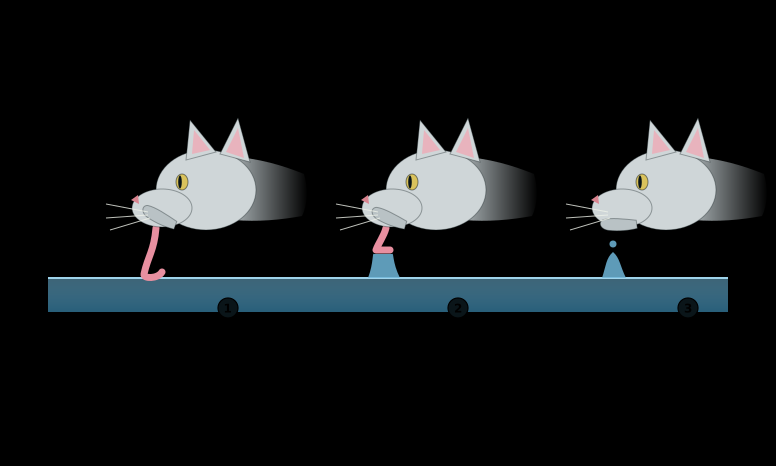
Watch a cat drink and its tongue seems to scoop water like a spoon. High-speed cameras show something quite different. In 2010, Pedro Reis, Sunghwan Jung, Jeffrey Aristoff and Roman Stocker filmed domestic cats lapping and found a subtle mechanism: the cat does not scoop at all. Instead, water sticks to the upper side of the tongue, and the cat uses the water’s inertia to defeat gravity and pull it into its mouth 1.
Why lap at all? Most animals drink by suction 2. Sucking needs closed cheeks, so that the pressure inside the mouth can be lowered. Cats and dogs have incomplete cheeks that leave the sides of the mouth open – they cannot suck, and so they lap 1 3. Lapping is one of several drinking strategies that evolved in animals whose body shape rules out suction 2.
The cat’s method turns out to be a precise piece of physics. How fast the tongue moves, how high the water rises and when the jaws snap shut are set by a competition between two forces: inertia, which keeps the water moving up, and gravity, which pulls it back down 1.
A lap in three steps
- Touch. The cat curls the tip of its tongue backwards and lowers it until the upper side rests on the water surface – it does not dip in 1 4.
- Pull. The tongue moves up fast, accelerating at about one to two times the acceleration of gravity, and then slows down as it enters the mouth 3. Water sticks to the tongue and is dragged up in a thin column 1.
- Bite. The column keeps rising for a moment, then gravity wins and it starts to fall back. The cat closes its jaws just in time and catches the top of the column 1.
Biology lens: a tongue for drinking and grooming
Cats and dogs share the problem of incomplete cheeks, and both lap 3. For a while it was thought that dogs, unlike cats, scoop water with a spoon-shaped tongue. High-speed light and X-ray videos showed that dogs, too, rely on water sticking to the tongue. Inside the mouth, the liquid is moved backwards towards the throat on the surface of the tongue; ridges on the palate hold it in place while the tongue moves forward again. A dog needs at least three lapping cycles to move a portion of water through its mouth 4.
The details still differ. Dogs accelerate the tongue more strongly than cats and curl it backwards, which pulls a larger column of water from the bowl. Sean Gart and colleagues filmed 19 dogs: their tongues left the water with accelerations of 1–4 times gravity and speeds of 0.7–1.8 m/s. Dogs time their bite to the moment when the column breaks up – and the large, splashing column explains why dogs are such messy drinkers 3.
Within the cat family the mechanism appears to be the same. Reis and colleagues measured lapping frequencies across the cat family, Felidae, and found them consistent with one physical model – which suggests that the mechanism is conserved among cats 1.
The cat’s tongue has a second specialty. It is covered with sharp, backward-pointing spines, the papillae. Alexis Noel and David Hu studied the tongues of six cat species, from the domestic cat to the lion – a 30-fold range in body weight. Each papilla has a hollow cavity at its tip that soaks up saliva on its own and releases it onto the hairs during grooming 5.
Physics lens: inertia against gravity
When the tongue pulls away from the surface, the water stuck to it is set in motion. A moving body of water tends to keep moving – that is its inertia. At the same time, gravity pulls the water back towards the bowl. As long as inertia dominates, the column rises; when gravity takes over, it slows down, stops and falls back. Reis and colleagues showed that the cat exploits exactly this competition: it closes its mouth before gravity can win 1.
Physicists compare the two effects with a dimensionless number, the Froude number:
Here U is the speed of the tongue, g the acceleration of gravity and R the size of the tongue tip. If Fr is much larger than 1, inertia dominates; if it is much smaller, gravity does. The balance between the two, Fr of about 1, sets the rhythm of lapping 1.
Two other forces play only a minor role at the scale of a cat or a dog. In experiments that mimicked a dog’s tongue, Gart and colleagues estimated Reynolds numbers of about 103 to 104 and Weber numbers of 10 to 1,000: viscosity and surface tension are small compared with inertia and gravity 3. For very small animals this changes – they drink using subtle effects at the water surface, such as capillary forces 2.
Cats and dogs differ in one more respect. For cats, the water’s motion is governed by steady inertia: what counts is mainly how fast the tongue moves. Dogs accelerate their tongue so strongly that the acceleration itself matters – an unsteady inertial regime, a kind of open pump driven by acceleration 3.
Mathematics lens: why big cats lap only a little slower
A scaling argument predicts how the lapping rate depends on body size. Start with the balance of inertia and gravity, Fr ≈ 1:
One lap takes roughly as long as the tongue needs to travel a distance of the order of its own size R at speed U. The lapping frequency f is the inverse of that time:
Animals of similar shape grow in all directions alike: their volume and mass M grow as R3, so R grows as M1/3. Inserting this gives
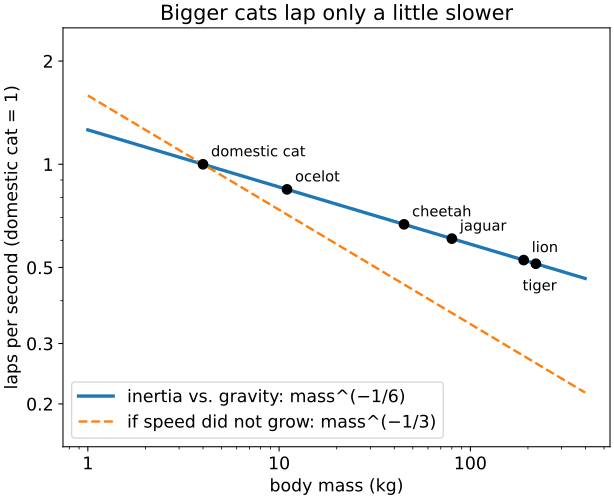
Measurements across the cat family support this prediction 1, and dogs follow the same trend 3. The exponent −1/6 is small: a lion that is about 47.5 times heavier than a 4 kg house cat should lap only 47.51/6 ≈ 1.9 times more slowly.
Without gravity in the argument the result would be very different. If all cats moved their tongues at the same speed, the frequency would fall as 1/R, that is as M−1/3 – a lion would lap 47.51/3 ≈ 3.6 times more slowly. Bigger tongues move faster, because a bigger column needs more speed to keep gravity at bay.
Computer science lens: a scaling law in code
How fast do different members of the cat family lap compared with a house cat? The program below applies the scaling law of the mathematics lens, f ∝ M−1/6, to six cats and compares it with the law that would hold if tongue speed did not grow with size. The body masses are typical values for illustration, not measurements from the cited studies, and the program gives frequencies relative to a house cat rather than in laps per second.
import numpy as np
import matplotlib.pyplot as plt

# Typical body masses (kg) – rough values for illustration, not measurements
CATS = {"domestic cat": 4, "ocelot": 11, "cheetah": 45, "jaguar": 80, "lion": 190, "tiger": 220}
EXPONENT = -1 / 6     # frequency ∝ mass^EXPONENT: inertia balancing gravity (see the maths lens)


def relative_frequency(mass, reference=CATS["domestic cat"]):
    """Lapping frequency relative to a domestic cat.

    Inertia balances gravity when the tongue speed U is about √(g·R) (Froude number ≈ 1),
    so one lap takes a time of order R/U = √(R/g). The tongue radius R grows like mass^(1/3)
    for animals of similar shape, hence frequency ∝ √(g/R) ∝ mass^(−1/6).
    """
    return (mass / reference) ** EXPONENT


print("animal          mass    laps relative to a domestic cat")
for name, mass in CATS.items():
    print(f"{name:13s} {mass:5d} kg   {relative_frequency(mass):5.2f}")
lion = relative_frequency(CATS["lion"])
print(f"a lion is {CATS['lion'] / CATS['domestic cat']:.1f} times heavier "
      f"but laps only {1 / lion:.1f} times slower")

masses = np.logspace(0, 2.6, 100)
plt.rcParams["font.size"] = 13      # large type: the chart stays readable on a phone
fig, ax = plt.subplots(figsize=(6.4, 5.2), layout="constrained")
ax.loglog(masses, relative_frequency(masses), lw=2.5, label="inertia vs. gravity: mass^(−1/6)")
ax.loglog(masses, (masses / CATS["domestic cat"]) ** (-1 / 3), "--", lw=1.8,
          label="if speed did not grow: mass^(−1/3)")
for name, mass in CATS.items():
    below = name == "tiger"             # lion and tiger are close: one label above, one below
    ax.plot(mass, relative_frequency(mass), "o", ms=7, color="black")
    ax.annotate(name, (mass, relative_frequency(mass)), textcoords="offset points",
                xytext=(-10, -20) if below else (6, 6), fontsize=11)
ax.set_xlabel("body mass (kg)")
ax.set_ylabel("laps per second (domestic cat = 1)")
ax.set_title("Bigger cats lap only a little slower")
ax.set_ylim(0.15, 2.5)
ax.set_yticks([0.2, 0.3, 0.5, 1, 2])
ax.xaxis.set_major_formatter("{x:g}")   # plain numbers: 1, 10, 100
ax.yaxis.set_major_formatter("{x:g}")
ax.legend(loc="lower left")
plt.show()
Output · what the code prints, re-run at every build
animal          mass    laps relative to a domestic cat
domestic cat      4 kg    1.00
ocelot           11 kg    0.84
cheetah          45 kg    0.67
jaguar           80 kg    0.61
lion            190 kg    0.53
tiger           220 kg    0.51
a lion is 47.5 times heavier but laps only 1.9 times slower
What the result teaches:
- Size matters, but weakly. A lion is 47.5 times heavier than a house cat but laps only 1.9 times slower (relative frequency 0.53). Across the whole range from house cat to tiger, the frequency changes by less than a factor of two.
- The exponent carries the physics. The dashed line shows what would happen if every cat moved its tongue at the same speed: the lion would lap at only about a quarter of the house cat’s rate. Because gravity sets the tongue speed, U ≈ √(gR), bigger cats move their tongues faster and the frequency falls much more gently.
- A model, not a measurement. The program uses a proportionality, not measured laps per second; the body masses are rough typical values. It shows the shape of the law that Reis and colleagues tested against measurements 1.
Two programming ideas are worth noticing:
- Relative values remove unknown constants. The scaling law only says that frequency is proportional to M−1/6. Dividing by the value for a house cat cancels the unknown constant of proportionality – a common trick when only a scaling law is known.
- Log–log plots turn power laws into straight lines. On logarithmic axes, f ∝ M−1/6 becomes a straight line with slope −1/6, so different exponents can be compared at a glance.
Try it yourself – each change takes one line:
- Set
EXPONENT = -1 / 3: the law for a constant tongue speed. The lion now laps at 0.28 of the house cat’s rate, 3.6 times slower. - Set
EXPONENT = 0: if size did not matter at all, every cat would lap at the same rate, 1.00 – and the lion only 1.0 times slower.
Tested output with EXPONENT = -1 / 3
animal          mass    laps relative to a domestic cat
domestic cat      4 kg    1.00
ocelot           11 kg    0.71
cheetah          45 kg    0.45
jaguar           80 kg    0.37
lion            190 kg    0.28
tiger           220 kg    0.26
a lion is 47.5 times heavier but laps only 3.6 times slower
Tested output with EXPONENT = 0
animal          mass    laps relative to a domestic cat
domestic cat      4 kg    1.00
ocelot           11 kg    1.00
cheetah          45 kg    1.00
jaguar           80 kg    1.00
lion            190 kg    1.00
tiger           220 kg    1.00
a lion is 47.5 times heavier but laps only 1.0 times slower
From cats to engineering
The cat’s way of drinking shows how much physics can hide in an everyday movement. Instead of fighting gravity with force, the cat uses the water’s own inertia and simply times its bite. Similar questions – how to move small amounts of liquid quickly and cleanly – matter in engineering, and Kim and Bush discuss biomimetic applications of natural drinking strategies 2.
The cat’s tongue has already inspired one invention: a grooming brush with 3D-printed copies of the hollow papillae, which needs less force than a normal hairbrush and is easier to clean 5. How exactly dogs and cats coordinate their tongue, jaw and swallowing, and how the mechanism varies between species, remains a subject of research 4 3.
Frequently asked questions
How do cats drink water?
A cat curls the tip of its tongue backwards and rests it on the water surface without dipping it in. Then it pulls the tongue up very fast. Water sticks to the tongue and is dragged upwards in a thin column. Before gravity can pull the column back down, the cat closes its mouth and catches the top of it. Then it starts the next lap.
Why don't cats suck up water like we do?
To suck, an animal needs closed cheeks so that it can lower the pressure in its mouth. Cats and dogs have incomplete cheeks that leave the sides of the mouth open, so they cannot create suction. Instead they lap, using their tongue to lift water into the mouth.
Do dogs drink the same way as cats?
Partly. High-speed videos show that dogs, like cats, rely on water sticking to the tongue rather than on scooping. But dogs accelerate their tongue more strongly and curl it backwards, which pulls up a larger water column. Physically, dogs lap in an unsteady regime governed by acceleration, cats in a steady one – and dogs splash much more.
Do lions and tigers drink like house cats?
Yes. Measurements of lapping across the cat family support the same mechanism. Larger cats lap more slowly, but only slightly: the lapping frequency falls roughly with the sixth root of body mass. By this rule a lion, almost 50 times heavier than a house cat, laps only about twice as slowly.
What is the cat's rough tongue for?
The cat's tongue is covered with backward-pointing spines called papillae. Each has a hollow tip that soaks up saliva like a straw and releases it onto the fur during grooming. Researchers copied the papillae with a 3D printer to build a grooming brush that needs less force and is easier to clean than a normal hairbrush.
Sources
- Reis, P. M., Jung, S., Aristoff, J. M., Stocker, R. (2010). How cats lap: water uptake by Felis catus. Science 330, 1231–1234. doi:10.1126/science.1195421
- Kim, W., Bush, J. W. M. (2012). Natural drinking strategies. Journal of Fluid Mechanics 705, 7–25. doi:10.1017/jfm.2012.122
- Gart, S., Socha, J. J., Vlachos, P. P., Jung, S. (2015). Dogs lap using acceleration-driven open pumping. Proceedings of the National Academy of Sciences 112, 15798–15802. doi:10.1073/pnas.1514842112 · Open Access
- Crompton, A. W., Musinsky, C. (2011). How dogs lap: ingestion and intraoral transport in Canis familiaris. Biology Letters 7, 882–884. doi:10.1098/rsbl.2011.0336 · Open Access
- Noel, A. C., Hu, D. L. (2018). Cats use hollow papillae to wick saliva into fur. Proceedings of the National Academy of Sciences 115, 12377–12382. doi:10.1073/pnas.1809544115 · Open Access
Text and figures: CC BY-SA 4.0. Found a mistake? Open an issue or edit this article on GitHub.